
Books
A happy home
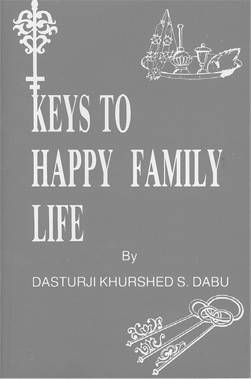
"The essays which comprise the book are full of earthy wisdom, written in a direct simple style. In a fast changing world where values are being eroded, there is much that can be gained by reading this book,” wrote the late Nani Palkhivala in appreciation of the first edition of Marzban Giara’s translation of the late Dastur Khurshed Dabu’s Keys to Happy Family Life. The book, originally published in Gujarati in 1959, comprised of 53 articles written by Dabu in the Nari Jagat column of the Jam-e-Jamshed. Inspired by Dabu’s "ideas of universal value,” Giara translated the book in 1991, "for the benefit of English speaking people the world over.” The second edition of the book has been printed in 2003.
Giara mentions that the 53 essays are keys to the "treasure house of worldly wisdom,” based on Dabu’s experience of a happy family life. A vegetarian since the age of 13, Dabu in an essay entitled "The Strength of Self Control” states that he who does not exercise restraint over his passions becomes weak of character. Since Dabu wanted to pursue higher education after his marriage, he did not converse with his wife for four years, he remarks. They corresponded and met as distant friends. "Today even before the engagement, liberties are taken. Such vanity is dangerous. Passions need to be curbed suitably,” he enforces.
Shakespeare’s Shrew was made to utter by her husband that, "the sun rises at midnight.” She did as she was told, but Dabu believes that to site this as an example of compatibility would be absurd. He is of the view that if both partners have an identical nature there is more likelihood of a clash. Each individual has his unique flavor and qualities. He writes that despite becoming a graduate, professor, principal and dastur he hasn’t acquired the common sense or natural wisdom of his wife.
Noting the different ways to deal with rebellious children, Dabu suggests that a rule should be made — "free food at the dinner table should be offered to those who by good conduct obey their parents’ orders. Those who do not do so will not get food.” Similarly all wants should be dealt with firmly. "Within a few days the storm will subside,” he assures.
Principal of the Surat Parsi Orphanage in 1919, despite his commitments Dabu would stitch or patch clothes and bedsheets for poor orphan students along with his wife on Sundays, mentions the book. In 1948 he was appointed principal of the M. F. Cama Athornan Institute and in 1946 became High Priest of the A. H. Wadia Atas Bahram.
Dabu’s articles make easy reading but as best put by Palkhivala, "readers may not always agree with the views expressed, but that in no way detracts from the value of the book.”
Priced at Rs 30 Keys To Happy Family Life can be purchased from Marzban Giara, Dhunmai Buliding, 667, Lady Jehangir Road, Parsi Colony, Dadar, Bombay 400014. Tel: 24166204.
S. J. P.
◆ ◆ ◆
From the archive