
Books
Lording over life
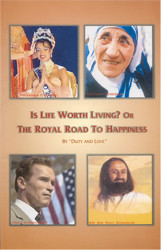
"Is life worth living?” asks Sohrab J. Bulsara before proceeding to answer in the book by the same name, "Certainly it is for it is planned by the wise, benevolent and beneficent creator in whose divine realm nothing futile subsists.” The noble thoughts expressed by him and five other eminent Zoroastrians of the 20th century add to the readability of the 122-page book, Is Life Worth Living? Or The Royal Road to Happiness. This book which carries thoughts on solutions to life’s difficulties is a reprint of the 1935 work where the author chose to identify himself as "Duty and Love.” Rangoonwalla has republished this book.
"Some of the features peculiar to the youth of the present generation are a defective outlook on life, a deplorable absence of sufficient thinking power, a very poor resistance against inevitable difficulties and a sad lack of strength to overcome the same. Should the ideas and suggestions offered in this work prove helpful even to a few readers in improving their outlook on life so as to make their existence cheerful, beautiful and meaningful, the publisher will feel gratified,” states the publisher of Is Life Worth Living. But the reader is confused: Is this statement by the publisher of the 1935 edition or the 2006 version which was printed with the support of The WZO Trust Funds?
"A world which is accustoming itself to the worship of force and to the expectation of salvation by military might and to self indulgence as the fruit and blossom of civilization will certainly do well to remember the message of Zarathushtra regarding the enlargement and expansion of the Divine Dominion through the practice of ‘humble, right-thinking piety,’” notes Sir Jehanghir Coyajee, former principal of Calcutta’s Presidency College.
"At every moment of one’s life, one is either a sovereign or a slave,” writes R. P. Masani, author and former vice chancellor of the Bombay University. "If one surrenders one’s self to human weaknesses and falls prey to temptation, one is a slave to one’s self. As one learns to govern one’s self and rises superior to one’s lower instincts and appetites, one is a king.”
"Seek humbly and most positively you will find the answer to all the heart’s and mind’s questionings, deep as well as superficial. Knock and assuredly, it shall be opened to you. Be sure, however, that you knock at the door and not on the blank wall,” advises solicitor Faredun Dadachanji. Justice Bomanji Wadia beseeches "the youth of my community to concentrate on the great things of life rather than on external show.”
"True life subsists in living truth which begins in the child with saying truth and flowers in man on doing good,” observes Khan Bahadur Dr J. K. Daji.
The rest of the book has sections devoted to virtues like duty, love, service, faith, hope and charity, monsters blighting human happiness — fear, worry and trouble. These are peppered with the quotes of seers and savants, poets and philosophers. In the chapter on "The Secrets of Efficiency” the prematurely old are forewarned, "Nobody grows old by merely living a number of years; people grow old only by deserting their ideals… You are as young as your faith, as old as your doubt; as young as your self-confidence, as old as your fear; as young as your hope, as old as your despair.”
The price of Rangoonwalla’s books is not quoted but for further queries the author can be contacted at: M-4, Dalal Estate, Lamington Road, Bombay 400008.
◆ ◆ ◆
From the archive