
Books
Zoroastrian heritage
The Legacy of Zarathushtra: An introduction to the Religion, History and Culture of Zarathushtis (Zoroastrians) edited by Roshan Rivetna. Published in 2002 by the Federation of Zoroastrian Associations of North America, 5750, South Jackson Street, Hinsdale, Illinois 60521, USA. Pp: 96. Price: Rs 500.
During recent years there has been a spate of beautiful, illustrated books on Parsi history and culture. And now comes a neat, portable, lavishly illustrated paperback, The Legacy of Zarathushtra edited by Roshan Rivetna. The targeted readership falls into three categories: Parsi Zoroastrians settled in India and elsewhere, Iranian Zoroastrians in their homeland and abroad, and the reading public of the Middle East, United Kingdom, Europe, America, Canada and Australia. We should not forget the small group of Zoroastrians who have formed themselves into an association in South Russia, nor the Zoroastrians of Tajikistan mentioned in the Nirang of our Sarosh Yasht Vadi. Both groups are keen to interact with their fellow Zoroastrians worldwide.
In an age when travel is almost instantaneous, it is important not only to study the economic and social background of various nations but also their religious beliefs. In the book under review, six of the world’s major religions, viz. Hinduism, Buddhism, Judaism, Christianity, Islam and the Bahai faith are compared and contrasted with Zoroastrianism. Comparative studies between Tibetan Buddhism and Zoroastrianism await research scholars.
It is not widely known that Tibet was the only country which refused to pay a vassal’s tribute to the reigning Sasanian monarch. Instead, it was suggested that Persia and Tibet exchange diplomatic visits at ambassadorial level as a token of friendship between the two countries. When the Zurvanite heresy was at its height and Sasanian priests were persecuting the sect mercilessly, a small group trekked all the way from Persia to the tiny kingdom of Khams in northeast Tibet where the Ringden kings gave the refugees shelter. They were permitted to settle in the country, marry Tibetan women and practise their faith in peace. There is thus striking evidence of the influence of Zoroastrian religious ideas on Tibetan Buddhism.
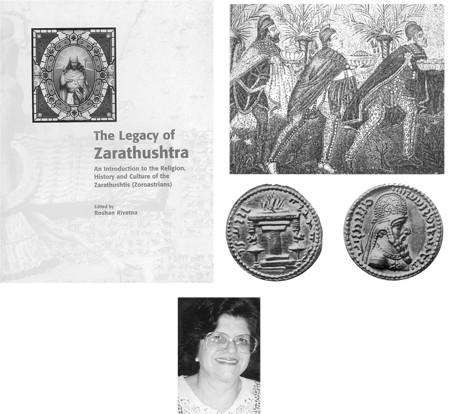
Top: The earliest existing depiction of the magi as three Persian kings in the basilica in Ravenna, Italy. Above: Silver drachma with Ardeshir I and the fire alter on the reverse. Alongside: Rivetna
At the International Academy of Indian Culture in Delhi there is a faded silk tanaka dating from the fourth century. The four Dhyani Buddhas of Meditation, each with his special symbols, are depicted at the four corners of the tanaka. In the center is a small circle inscribed Ahura Mazda, in Tibetan lettering. From this circle radiate lines which join the outer circle. Each line is inscribed with the name of our Amesha Spentas: Asha, Vohu Mana, Kshathra, Armaiti, Haurvatat and Amérétat, again in Tibetan lettering.
Turning to The Legacy of Zarathushtra, I would like to comment on the Three Magi depicted in the sixth century mosaic at the Basilica in Ravenna, Italy. There is an Aramaic Fragment in the Vatican Library at Rome which throws new light on the Three Magi. From the Fragment we learn that when St Matthew was composing his first Gospel there was a colony of Zoroastrians nearby. Five times in the course of a day a deep toned bell was rung and loud prayers chanted. The fragrance of frankincense and myrrh wafted into his little hut. He longed to draw these pious folk into the Christian fold. From this longing rose the legend of the Three Magi, later given Zoroastrian names to make the story more credible. Some of the most beautiful paintings in the world have been inspired by this pious fabrication.
It is good to see an attempt made to compare Iranian and Indian Zoroastrian traditions pictorially in the book under consideration. Beautiful photographs of the Atash Behram at Yazd, Iran, and the Iranshah at Udvada, India, are shown on the same page. On the occasion of the Fravardigan/muktad in India gleaming silver, bronze and glass vases filled with fresh flowers are placed on marble topped tables in every fire-temple and in some homes as well. In Iran, the beautiful Haft-Seen table is prepared in every Zoroastrian home when flowers, fruits, herbs, green shoots, and various symbolic items are placed side by side. Every morning, the family gather round the table, recite a short prayer and then have breakfast. On New Year’s Eve (March 20), after supper, the family hauls up a mattress on the low, flat roof of the house. Wrapping themselves in blankets, old and young keep vigil throughout the night till dawn. Facing the East, prayers are recited in a low voice urging the soul of dear ones to return to earth for a while to bless their former homes and their inmates. This unique custom still continues in rural areas but with the modernization of Iranian villages, this tradition may die out. A photograph of a family vigil would be of interest in preserving the tradition.
The most exciting part of the book lies between pages 64-70 where Zoroastrian history is placed in a world perspective. It is very important for all Zoroastrians, especially young students studying abroad, to know their historic roots. With inter-community marriages on the increase, how does a Zoroastrian keep his/her identity intact? Chiefly, by studying the prayers recited and understanding the significance of the navjote, marriage and death rituals.
In the section on "Parsi luminaries” the following could have been included: Ardeshir Cursetjee Wadia (1808-1877), Nanabhai Ardesher Moos (1869-1936) and Darashaw Nowsherwan Wadia (1883-1969).
Ardeshir Wadia who belonged to the Wadia shipbuilders’ family was the first to introduce steam engines in the battleships he built for the Royal British Navy. He also introduced gas lighting in the streets of Bombay. Moos was the first to introduce seismology and geomagnetism in India, founding the Alibag Observatory 32 km south-east of Bombay’s Colaba Observatory in 1904. Pioneering geologist Darashaw Wadia founded the National Institute of Himalayan Geology which was subsequently renamed the Wadia Institute of Himalayan Geology.
Again, The Legacy mentions Soli Sorabjee but not Fali S. Nariman and Jimmy B. Dadachanji. Nariman who is the first Asian to be elected twice as Chief Justice of the International Court of Justice at the Hague, Holland is senior to Sorabjee. Dadachanji, who is a household word throughout north India, has won several national and international honors including the Magsaysay Award of the Filipino Government.
In The Legacy the word monajat is mentioned but in passing. Actually monajats could play a useful role in linking Parsi and Iranian Zoroastrians, especially abroad. The word, monajat, is of Arabic origin and means "a whispered conversation between the soul and her creator.” Beautiful monajats were composed in Gujarati and Persian in the 19th and first half of the 20th century, and sung every night by parents and children before retiring to bed. Monajats would have died out among the Parsis but for the dedicated work of the late Rustom Saklat of Calcutta. Gradually, the singing of monajats spread among the anjumans of India and later among Parsi and Iranian Zoroastrians abroad. Audiocasettes were made and sold and they are even printed in my booklet, Fravarané.
The little sketch marking the Zoro-aster Temple, awoke memories. Many years ago, the American Government offered to sell land in the Grand Canyon of Arizona to various religious sects to build temples of their faith with a few rooms for residence and a small hall for interfaith discussion. The tiny community of Zoroastrians erected a prayer hall with a few rooms for residence. Jashans were performed and groups of young and middle-aged Parsi and Iranian Zoroastrians met in the summer and participated in interfaith dialog. What happened to those beautiful buildings and those loving souls? Would Rivetna please enlighten us?
There are some serious omissions in the Bibliography. The section, "Gathas, Avesta and prayer books” makes no mention of Dr Helmut Humbach’s The Gathas of Zarathushtra and Other Avestan Texts wherein our Haptan Yasht is translated and placed between the first and second Gatha where it belongs. Even more surprising is the omission of Dina McIntyre’s initiative in starting a lively discussion on the Gathas in 12 parts from October 1989 onwards, attracting 700 participants, worldwide, via the Internet. At this point Prof K. D. Irani felt it was important to hold a seminar on the Gathas only which was sponsored by the World Zoroastrian Organisation (WZO) based in London and the proceedings published six years later in 1999.
Finally, I heartily recommend The Legacy of Zarathushtra to both Zoroastrians and non-Zoroastrians for its historical interest and attractive presentation.
Piloo N. Jungalwalla
◆ ◆ ◆
From the archive