
Cover Story
The managerial credo
Incoming chairman Minoo Shroff aims to streamline the Punchayet into corporate efficiency
"The perception is that the Punchayet is not responsive, that it lacks consideration and care for the community,” accepts Bombay Parsi Punchayet (BPP) chairman and ex officio president of the Federation of Parsi Zoroastrian Anjumans of India (FPZAI) Minoo R. Shroff. He also believes that change "must start at the top (because) bottlenecks occur at the top of the bottle! No company or NGO (non governmental organization) can be better than the man at the top.”
Though his hair may have both thinned and blanched since his first arrival as BPP trustee in 1986 (trouncing two lady wannabes who have since become his supporters), the lithe vice chairman of Raymond Limited continues to portray disciplined upper crust meritocracy. As selective in his habits as in his dress code, Shroff rises early ("if you are not an early riser you can’t do much NGO work. You have to catch people early in the morning... You have to be a day ahead of everyone else to be successful”), walks daily, speaks softly, eats sparingly and maintains that "good grooming shows a tidy mind. Not all of us can be Albert Einstein!”
Having reached the helm of a somewhat sluggish Punchayet during the last six months of his second term of trusteeship, Shroff finds "this is not a laid-back job. People want to see you, meet you.” Accordingly, he says he has been joining Maneck Engineer and Burjor Antia, the most recent inductees on the BPP board of trustees, in their weekly trips to various colonies, meeting residents and association representatives with minutes of the discussions drawn up immediately and confirmed by both sides. To that is added almost daily telephonic contact with the Wadia Committee which manages the baugs.
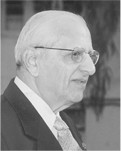
Shroff: ‘Not a laid back job’
Also, the board meetings at the Punchayet which started at 6 p.m. or later and droned on for hours with a meandering agenda which was often hijacked, are now said to start at 5 p.m. and end at 7 p.m. with all the points on the "more focused agenda” receiving due consideration. There is also greater emphasis on the working of the board of trustees as a team. What is percolating down the line is that no individual trustee can give instructions on substantive issues like housing. The community is also being made aware that such substantive issues may only be raised with the chairman or the BPP’s chief executive officer in their official capacities — not as individuals. Because as he has noted in his essay, "Good governance in India” [published by the Forum of Free Enterprises (FFE)] "no public body or trust of some size can operate and accomplish its objectives unless the... lines of command and communication are clearly spelled out.”
A policy of rotating jobs as in a corporation has been instituted in the Punchayet to counter the community’s apprehension of executives acquiring vested interest in their portfolios. Shroff agrees that "mindsets need to change.” In his good governance essay Shroff had quoted the Chinese proverb, "A man without a smile must not open a shop.” Conscious though he is that the staff, "often harangued and pressured by the way people come and talk, is also very adamant,” Shroff is trying to impress on them that "we are the interface with the community...”
Another problem the Punchayet faces is that of the cooperative society of flat owners at Parel’s A. H. Wadia Baug seeking to adopt model bylaws which would enable them to sell their community entrusted property in the open market. "We’ll take legal action if they force the pace; protect our rights as landlords,” notes Shroff with asperity.
An election in mid-June (Shroff’s term of office ends mid July unless reelected) will be the fifth trusteeship election performed by the present Anjuman Committee (AC) whose term of office expired in 1999. The lame duck AC is being made to render this function because of a revised scheme for election of trustees filed with the Bombay High Court. The Punchayet says that the issue being sub judice it cannot hold an AC election. No hearings have been held to date and there is no report of any attempt by the Punchayet to expedite the matter. "It will need to be pursued,” admits Shroff.
The revised scheme seeks to alter the ratio of elected members to donors from the current 1:1 to 2:1 i.e. twice as many elected members to each donor. There is also a strong lobby seeking adult franchise. Shroff had been in favor of amending the scheme to bring in an upper age limit for trustees as well as limit the number of terms a trustee can stand for reelection. He was, however, outvoted on the issue, he says.
As for the attempt of the six High Priests to put the clock back by 95 years on the issue of intermarried Parsi men and their progeny, Shroff says, "The Punchayet has decided to leave the religion to (the High Priests).”
"We like to claim that we are the apex body of the community. Now we are trying to do what we can to assume the role,” he notes with a trace of amusement.
Shroff is optimistic on the outcome of negotiations on the formation of a world body of Zoroastrians. "It is a breakthrough that we can work with the World Zoroastrian Organisation. There is a possibility of reaching agreement in the current year,” he asserts.
Though his years as senior BPP trustee and therefore (ex officio) joint honorary secretary of the FPZAI did not witness much overt contribution from Shroff, as ex officio president of the all-India body he says he is in constant touch with its affairs, attending the fortnightly meetings of its defunct anjumans subcommittee.
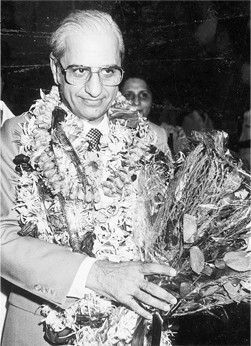
At the 1986 election: ‘You have to be a day ahead’
The only Zoroastrian on the steering committee of the Alliance of Religions and Conservation (ARC), Shroff was privy to a session with the Duke of Edinburgh. The various religions and their organizations invest between four to seven trillion US dollars, he estimates. The ARC is trying to mandate that this huge amount be invested in environmentally responsible areas of industry worldwide, he explains.
The Zoroastrian faith is said to be one of 11 recognized by ARC. As Shroff noted in his speech at the Avan Ardevisur Parab jashan where he was chief guest, the other faiths number votaries anywhere between 15 million to over 1,000 million as compared to our minute community of 150,000-200,000 Zoroastrians worldwide (if unsubstantiated figures from Iran are accepted)! But at the London meet Queen Elizabeth II surprised him with "her curiosity and deep interest in our religion and well-being.” He said that the Queen enquired about "the significance of fire and I had to clarify that besides light and energy it symbolized purity, incorruptibility, divinity and fecundity. She then went on to enquire about how Zoroastrians, a microscopic community, were able to hold their own and command such respect not only in India but even in the United Kingdom. She commented that Zoroastrians should be very proud of their magnificent contribution as, in whichever society they have lived, they have not asked for any special concessions like other minority groups. This set me thinking. Do we truly realize the awe and dignity we command in the world?
"However, times have changed and we cannot merely cash in on past glory. We must run ahead of others to retain our pre-eminence... which we are quite capable of doing provided we do not falter.”
Though not directly piloting the World Zarathushti Chamber of Commerce’s Bombay chapter, Shroff says he and the Punchayet are a source of "moral support.” The current president of the FFE which was founded by his uncle A. D. Shroff in the teeth of Nehru’s socialist dogma, Minoo Shroff is apt to quote the late financial wizard’s words, "Free enterprise was born with man and shall survive as long as man survives.” Minoo Shroff is actively pursuing the establishment of a management college under BPP aegis likely to be located on a Zoroastrian trust property in the western suburbs if current negotiations fructify.
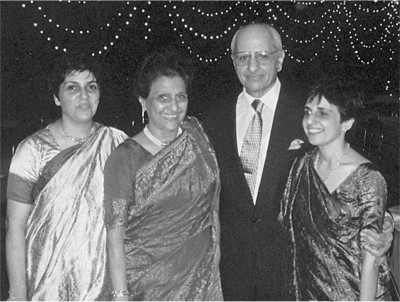
With wife Villoo and daughters Soona (right) and Niloufer Mistry
An alumnus of the Bharda New High School and St Xavier’s College, the son of Rustomji and Jerbai Shroff qualified as management accountant and business economist. Fellow of the London-based institutions, the Chartered Institute of Management Accountants and the Institute of Directors, Shroff has a background of 45 years in the running of public institutions. He remembers Narayan Dandekar and Kalyan Basu, founders of the Bombay Management Association (BMA), appointing him secretary of the BMA while he was still in his twenties. He later became its president. As president of the All India Manufacturers’ Organisation he had had numerous occasions to interact with then finance minister Morarji Desai. Invited by US AID (Agency for International Development) 40 years ago along with Indian stalwarts like G. L. Mehta (of the India Investment Centre) and A. D. Shroff, Shroff says he "met people from (New York governor Nelson) Rocke-feller down,” including people like Paul Mcreggor who later became economic advisor to US President Richard Nixon. On this occasion he participated in the first Advanced Management Program for developing countries at the University of Michigan.
In industry at home Shroff was general manager of J. N. Marshall for five years before setting up as a management consultant. He initially joined J. K. Industries as an economic advisor. Somewhere on the way he had been nudged along by the likes of Col Leslie Sawhny and Sir Dinshaw Petit, he recalls with respect and gratitude. He who has inherited Nani Palkhivala’s mantle as president of the FFE and the Lesile Sawhny Programme notes, "When you are interacting with a lot of people, thoru ghanu bi tau rub off thaiy ni (some of their sheen rubs off on you).” His work as president of the Indo-Japanese Association and as a business leader invited by the Government of Japan was rewarded in 2000 with the award of The Order of the Rising Sun, Gold Rays with Neck Ribbon conferred on him in the name of the Emperor of Japan. Former chairman of the Indian Advisory Board of Standard Chartered Bank, Shroff’s expertise on economic and financial matters has been tapped by leading industrial groups for over 25 years, notes his bio data.
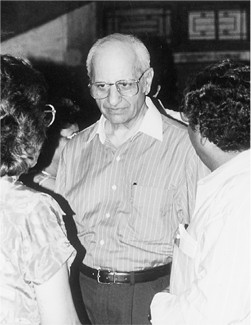
Chatting with the voters at his 1996 trusteeship election
"Everything is not hunky-dory,” Shroff readily admits to the BPP’s "grey areas,” adding hopefully, "Once you are in the driver’s seat you are in a better position to convince your colleagues... (Also), anyone with genuine injustice is welcome to come to me. There is no concrete evidence on lack of probity, of money changing hands (but) people can come to me in camera with evidence.”
To make himself more accessible to the community, Shroff has set up his personal office a stone’s throw away from the Punchayet in premises belonging to the A. D. Shroff Memorial Trust of which he is managing trustee. The elegant though simple refurbishing of a large room in an old building has been at his personal expense. He has also been traveling — to Delhi to attend the felicitation of Field Marshal Sam Manekshaw who entered his 90th year, to Dubai where he was invited to meet some of the 1,500-1,600 Zoroastrians who work in the Gulf, to see for himself what opportunities and challenges the area provides for Zoroastrians, to London for world body consultations and ARC conventions... He also continues with Raymond because "you need an income to carry on working with various bodies.”
Shroff is bent on bringing professionalism into the BPP. He feels he has been able "to build confidence with contending groups.” Dealing as he is with "elected people with different approaches,” his managerial credo is to "get the best out of a man without slighting him.” Aware that "it takes time and effort to bring chaps together,” Shroff says, "now that I have a better feel, I think I can make an impact on the aspirations of the community with the support of my colleagues, staff and community.”
Married to his cousin Villoo, the Shroffs have two daughters Soona and Niloufer Mistry and a grandson, Arman. It makes him sad to see that many young Zoroastrians today opt to remain single or opt to have only one child or none. He feels they are denying themselves the joy of caring, of sharing, of rearing children to carry on the legacy and of their companionship.
He hopes to leave behind some visible impact on the 350 years plus institution because "what happens, happens in the first six months.” Shroff believes in reflecting his Zoroastrian faith in his behavior: "People may doubt what you say; they believe what you do.” He says he is "doing small things in an effective way. Because it’s much nicer to see smoke brighten into flame than flame degenerate into smoke...”
Housing: "New, clearer guidelines”
Badgered by the Alert Zoroastrians Association (AZA), the Punchayet had to rethink its allotment policy vis-a-vis two new buildings at Panthaky Baug, originally conceived as ownership flats for Parsis. It is now committed to providing leave and licence accommodation under the MRS (merit rating system) to those on the waiting list in one building, while it will honor its commitments to those who had booked ownership flats earlier, in the other. About 70 flats will be ready for occupation by May or June at the Nirlon complex in Goregaon. An additional 250 flats at a cost of 12 crore rupees would be available there if funds are forthcoming, says Shroff. Allotment in the Nirlon complex will be entirely according to the MRS, he adds.
"The MRS is human. There are complaints largely because peoples’ status changes while they are on the waiting list. We now have an appeal agency — the Housing Advisory Committee — comprising of the Punchayet’s critics to look into grievances,” notes Shroff. However some complaints are absolutely bogus, he argues. Investigations reveal that the party already has a flat or that the family’s true income is not disclosed. "There are around 2,000 on the waiting list. But after scrutinizing I doubt if even 700 or 800 may be eligible,” he adds. Averring that it is the disqualified ones who are disgruntled, Shroff asks, "Do you hear from the people who have received flats?” He concedes however that "perception is important. How you seem to be doing a thing is important.”
As for deposits against leave and licence flats which according to the AZA range from five lakh to 30 lakh rupees, Shroff notes, "Originally the trust got nothing” when the occupancy of a flat changed. Now the Punchayet values its flat at about 30 percent below the open market rate in the area for out-of-turn allotments and claims its share of the sale price as landlord. An illegitimate inductee is charged a higher rate than others, he adds.
According to Shroff flats in Nowroz Baug, Jer Baug and Captain Colony do not come within the ambit of leave and licence deposits. "When such flats become vacant we even buy them over and pass them on for MRS allotment. But how can you give away Cursow Baug flats costing Rs 80 lakhs to a crore?” Shroff justifies the Punchayet’s decision to acquiesce in Montreal’s successful entrepreneur Ness Lakdavala buying the property from its original incumbent and paying the Punchayet its legitimate 40 percent share as landlord. Lakdavala is starting a business and wants to relocate here, says Shroff. A somewhat similar case exists at Ness Baug, he admits. In both instances the new inductees have acquired tenant status in exchange for paying a higher share (Rs 5 lakhs) to the Punchayet.
Shroff says that he has worked on streamlining the allotment policy. "New clearer guidelines” will be published after the board concurs on them.
◆ ◆ ◆
From the archive