
Cinema
Birju booms
Filmmaker Heeraz Marfatia’s award-winning Birju was nominated for the best alternative film in the students’ category at the Oscars
A jalebi in hand, little Birju flees from the scene with all the power at the command of his four-year-old physique. One stride too long and he lies sprawled on the road, his favorite jalebi beyond his reach. He does not move an inch. With just a turn of his eyeballs he sees an ant scampering for the same sweet but before the creature can reach its destination an old pilgrim has stamped on it. In this short film of 14 minutes and 30 seconds, written, produced and directed by Heeraz Marfatia, the viewer gets to see the world, or rather the small town of Pushkar in Rajasthan, through the eyes of the little boy Birju. "The story is told visually through images and sounds. There is hardly any dialog,” says 26-year-old Marfatia of his directorial debut.
A student at the San Francisco State University (SFSU), this was Marfatia’s first film when pursuing a Master of Fine Arts (MFA) in cinema. The shooting was done during his Christmas holidays in 2000-01, the editing when he was back in San Francisco for his next semester, and the post-production in India during the summer holidays of 2001. In 2002 he was fortunate to have Birju premiered at the Sundance Film Festival in Park City, Utah, to have been selected among the five finalists for the Oscar Academy Awards in the student category, to win the Jury Award at the New York Film Expo for Short Film and Video, and the Audience Award at the Big Bear Film Festival. Screened at nearly 30 international film festivals Birju won the second prize at the Berlin International Film Festival 2003 and was selected for competition at the Cler-mont Ferrand International Short Film Festival in February 2003, Marfatia happily announces.
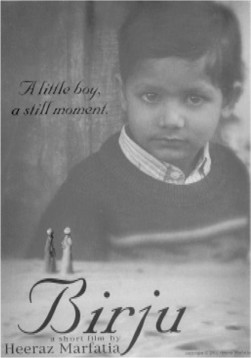
The prestigious Sundance Festival is considered "one of the country’s most prominent cinema catwalks,” according to The Independent of January 15, 2002. "It’s very competitive. It’s an honor for the school. I think it’s inspirational to the other students,” the chair of the cinema department at SFSU, Stephen Ujlaki, was quoted by a US newspaper. Ujlaki considered Marfatia "a very gifted filmmaker with a great eye.”
The SFSU nominated Marfatia’s film for the Oscars in the same year as Aamir Khan’s Lagaan got a nomination in the best foreign film category. Following this recommendation, Birju had to qualify at the zonal and regional level competitions to earn a nomination in the students’ category for best alternative film. "Of the 10 Indians nominated for the Oscars in the history of this festival, none of the nominees to my knowledge have been Parsis,” claims Marfatia.
Such enviable recognition has been consistently earning him acclaim though no monetary compensation, smiles the "financially challenged” Marfatia, valuing the generosity of his family, peers and seniors in the industry. "Seventeen of us (involved in the shooting) stayed in my house in Ajmer (half an hour’s drive from Pushkar) as I could not afford hotel accommodation for them. The crew comprising mainly college friends rendered honorary services. Helping out with cans of 35 mm film rolls were well-known directors like Shyam Benegal, Tinnu Anand, Subhash Ghai and Kodak India,” states Marfatia, adding that the lights and photography equipment were also courtesy friends. All his benefactors find a mention in his credits, including his parents Gulnar and Maj Noshir Marfatia for whom Heeraz has especially inscribed, "Thank you mum and dad for being my strength and inspiration.”
Only non actors would be used in the film, Marfatia had decided. To play the lead role of Birju, assistant director Vidura Jung Bahadur and casting director Sanjay Singh Badnor had scouted around and video tested about 100 children for the part, all of whom were found unsuitable. Marfatia hoped, and succeeded, in finding "Birju” (played by Vijju Parasher) in Pushkar when the lad was hiding in a marketplace! After obtaining his family’s consent Marfatia started readying him for the film. "Working with the star actor was a challenge,” acknowledges Marfatia, as "everyday of the (seven-day) shoot a new strategy had to be developed to sustain his interest in acting.” A lot of the accompanying sounds, although recorded, could not be used in the film as Marfatia had to constantly instruct Vijju even while the shooting was in progress. The entire film thus has only two dialogs — in Marwari.
The short narrative does though have its own rhythm, whether it is the call of the tea vendor, the spinning of a top, the grinding of condiments or the foot-tapping music of the folk dancers which even little Birju finds infectious, unable to resist gyrating his body. With his expressive eyes and impish smile, Birju endears himself to his audience even when he is up to his pranks. One of the scenes which remains with the viewer, long after the film is over, shows him sharing nuts with a monkey. When Birju gets up to finish the remnants on the plate, the monkey pulls his arm to ensure that the little boy remains seated next to him until the last crumbs are equally shared.
The narrow, winding alleys and life-style of Pushkar "with its interesting mix of attitudes, people, worlds” had captivated the Ajmer born Marfatia as a young boy. "Pushkar is not only vibrant visually but also has the tangles of a touristy place around it...where traditional Hindus live with marijuana worshiping foreigners,” he explains. Writing the script for Birju with the support of his executive producer Shubhra Swarup hence took him only a few days.
The story ends with a scene of Birju reuniting with his mother. The same shot of Birju clasping his mother’s hand is finally shown as one of the many exhibits on view at a gallery. "To me the core of my film was the last shot... I was committed to what I thought would complicate the experience of my film,” asserts Marfatia. "Behind every photograph there are untold stories that slip through the confines of the frame,” believes Marfatia who has grown up in the environs of a cinema house. Atash Arts is the banner he created for the launch of his own film.
With his maternal grandfather Eruch Sukhia owning the New Majestic Talkies in Ajmer, and his grand uncle Dara Sukhia owning the Apollo and Victory theaters in Poona, young Heeraz’s life was akin to the hero of the Italian film Cinema Paradiso who grows up on a regular diet of films and ultimately becomes a director, he admits. Despite being a dyslexic, Marfatia completed his schooling from Ajmer’s Mayo College, his BA from Bombay’s St Xavier’s College and diploma courses in advertising and marketing as also film and television production from the Xavier Institute of Communications. Before proceeding to the USA he worked for 14 months with Whitelight Moving Picture Company.
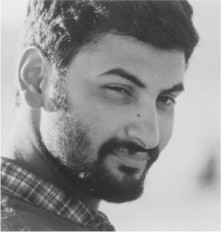
Marfatia: inspiration to other students
Whilst he was awaiting responses from the overseas institutes for his postgraduate studies came the news that an inferno at the New Majestic Talkies in Ajmer, caused by a short circuit, had levelled the family’s business and finances to the ground. "The family had to mortgage property and personal belongings to obtain loans to rebuild the cinema house. My studies abroad no longer seemed financially feasible. That is when I approached about 100 educational trusts, 80 percent of which must be Parsi controlled. Of these 100 trusts, around 30 were defunct. From the remaining 70 trusts, nearly 50 sanctioned sums in varying amounts enabling him to raise the requisite $ 45,000 for his MFA studies which he considers his "biggest achievement” surpassing his elation at being shortlisted for the Sundance and the Oscars. It was almost "like a miracle,” says Marfatia.
Once the J. N. Tata Endowment sanctioned Rs 1,25,000, within two weeks the other trusts too had opened up their purses, the major donors being Godrej, Bai Maneckbai P. B. Jeejeebhoy Charity Foundation, R. D. Sethna Trust, the Bombay Parsi Punchayet, recalls Marfatia. "It takes a hell of a lot of courage. You learn to appreciate, to be patient. I wrote a script incorporating all the anecdotes. Although some incidents were funny it was very emotional at the same time...” he adds. The success of Birju Marfatia would therefore like to share with all these people to whom he feels "very indebted for helping me with the money when I needed it. I want to give back as much as I can to the community.”
Considering himself "fairly religious,” the bachelor believes in wearing his sudreh and kusti and visiting the agiary regularly. He is not though in favor of the community’s "double standards,” accepting the children of men married out of the community whilst denying the same rights to women who have married out which he believes is "dissemination of patriarchy. The point is the community is shrinking and if we don’t do anything about it we may be in a museum.” He fails to understand how a community "known for its pragmatism and rationality, ceases to have that approach when it comes to marriage.”
Marfatia’s is one of the five Parsi families remaining in Ajmer. The youngest of three children, his elder sister Kainaz Dev is settled in Poona while his brother Riyaz heads the Centurion Bank’s capital market branch. "We have a different upbringing. We speak Hindi very well,” he informs us. When he had to carry a body inside the Ajmer dakhma there were no other corpses lying there so he does not know how to react to the dakhmenashini controversy which is brewing in Bombay following the absence of vultures.
A man’s struggle with life and death is the subject of Marfatia’s next project, his thesis film which he has to submit for his master’s degree. The script being a finalist in the Sundance Institute’s Feature Film Development Program, the funding for this venture will come from Hollywood, says Marfatia who has already won two scholarships from the SFSU. Working as graduate assistant and instructor at the University’s Cinema Department his tuition fees for the next semester have been waived although he has to provide for his board and lodging.
Neither willing to forego India where he learnt film appreciation nor the USA which brought him international recognition, Marfatia says, "I want to have one foot in both places.”
◆ ◆ ◆
From the archive