
Cover Story
Caught in the crossfire
The film Parzania is based on the tragic experiences encountered by a Parsi family in Ahmedabad during the Godhra riots
Religion, meant to be a revelation, becomes ruthless. A family, bound by fraternity, becomes fragmented. Childhood, once a celebration, becomes a curse. A cocooned life that we take for granted can so easily lose its safety net reminds the film Parzania: heaven and hell on earth, based on the true life story of a Parsi family in Ahmedabad which loses its son in the communal crossfire during the Gujarat riots five years ago.
On February 28, 2002, the Hindus in Ahmedabad were targeting the Muslims to avenge the death of 58 of their community members who lost their lives the previous day when the Sabarmati Express was set ablaze at Godhra railway station, three hours away. (The bogie was alleged to be set afire by Muslims though two probes determined the cause of the fire was accidental and started from within the bogie.) Among the Muslim pockets earmarked for destruction was Gulbarg Society where resided the Parsi family. The film shows that the government and the local police connived at the violence and came to the succor of the surviving Muslims much later, leaving the victims sore with resentment and suspicion.
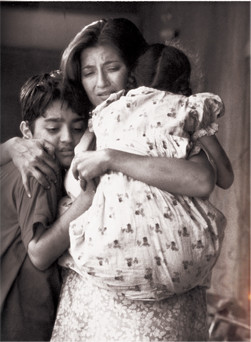
Above (from left): Parzaan Dastur, Sarika and Pearl Barsivala seeking escape
"I see the Parsi community as one of the most neutral, harmless communities in India. If something like that can happen to them, it could happen to anyone, anywhere,” says the US-based director-producer Rahul Dholakia. "I am from Gujarat. As a Hindu, I feel responsible, morally and socially,” the director cites his reasons for taking on this project on which he has toiled for "five years from conception to its release” in India on January 26, 2007.
Getting a clearance from the censor board was not difficult, but finding distributors was an uphill task although the film in English had been favorably received by audiences at the International Film Festival in India two years ago in Goa. Exhibiting Parzania in Gujarat is proving to be difficult with The Times of India of January 26 announcing, the film "will not be screened in Gujarat… anticipating communal trouble in select Gujarat cities where the release was planned.” The paper quoted Bajrang Dal leader Babu Bajrangi, "If the film portrayed a negative image of Gujarat, the multiplexes should think twice before releasing the film…If they have decided not to release the film we welcome the decision.” Jesuit activist and anti-riot campaigner Father Cedric Prakash alleged, "Apparently distributors and theater owners were threatened with dire consequences if the film was screened… the government of Gujarat is duty bound to ensure that the film is released. Citizens should be able to watch this film without fear or hindrance. If not, Gujarat must hang its head in shame.”
Depicting a police officer who is more interested in his pickle than the problem of the citizen facing him could be humiliating for the force. In the following sequence when the policeman asks to see a photograph of the missing boy, the father opens his wallet to show him the picture. Unruffled, the policeman calmly helps himself to the 100-rupee notes and returns the wallet. While the politicians and bureaucrats are projected as being more interested in promoting their personal agenda, it is the common man who shows genuine concern: When the father goes to a xerox shop to print extra copies of his "Missing boy” handbills, the man at the counter refuses to accept payment for this service realizing the father’s desperation.
The voice of sanity is expressed by different characters in the movie: "If you are going to break the law of the land, it should not be for selfish reasons;” "We must have the strength to stand up to any evil, whatever sacrifice we must make;” "Terrorism, isolation, self-destruction (cannot solve any problem);” "Religion could be the cause of a problem and a solution.”
Referring to the effort that went into "this intense film, a non-commercial, low budget film (made at a cost of around three crore rupees),” Dholakia told Parsiana how "flattered” he was that a cinestar of Naseeruddin Shah’s caliber agreed to portray the pivotal role of the Parsi father (Dara Mody in real life) named Cyrus Pithawala in the film. "You have to truly believe in a film like this to put in such a powerful performance,” commends Dholakia whilst simul-taneously appreciating the efforts of his entire team who "worked with tremendous passion and commit-ment…almost as if it was their own baby.”
"There was a sincerity to this film that made me want to be a part of it,” Naseeruddin Shah was quoted by rediff.com. "Once you enter a project, you entrust yourself to the director.” Undeterred by the controversy the veteran actor believed, "The film should be released, and people should have the choice to go and see it. That’s what is important…This is a powerful film…I will stand by it.” Endorsed co-star Sarika who stepped into the shoes of the Parsi mother Shernaz (Tanaz Mody in real life, better known by her pet name Roopa), "What impressed me was the maturity…It is a very difficult subject and the film has been handled with great sensitivity… The first time I read the script I believed that a film like this should be made, and I wanted to be a part of it…”
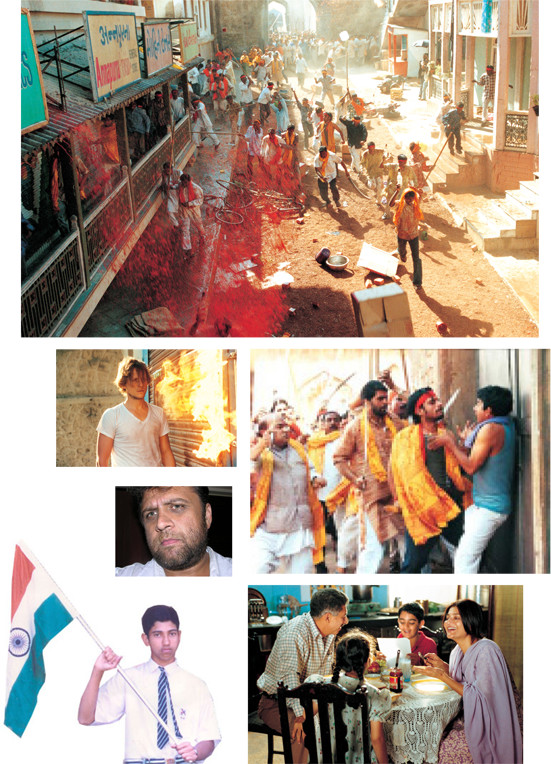
Clockwise from top: scenes of communal frenzy and family bonhomie; Azar Mody (holding flag), Rahul Dholakia and Corin Nemec
Corin Nemec as Allan, a young American student preparing for his thesis, is in quest of answers to the turmoil within him and without, in the land of Gandhi and non-violence. By bringing in an American, instead of an Indian, as an impartial commentator the director sought to keep bias and prejudice at bay.
Parzaan Tehmton Dastur enacts the role of the imaginative son Parzan (Azar Mody) who goes missing and little Pearl Ruzbeh Barsivala is the endearing daughter Dilshad (Binaifer Mody). The film’s name Parzania is meant to represent "the imaginary, make-believe, innocent, perfect world of a child” as conceived by little Parzan, says Dholakia. "In fact, such should be the world for every child but the reality is quite different,” he regrets.
Parzaan says he was offered a role in Parzania on the strength of his earlier acting in Dholakia’s first feature film Kehta hai dil baar baar. He found the story "quite new; nothing like I’d done in any other movies… Shooting for scenes showing riots, violence, fire was quite an experience (he was then 11 years old). The scenes were scary.” Although for the major part he was required to play the role of a 10-year-old happy boy, addicted to cricket and conjuring images of his make-believe world, Parzaan, now in his last year of school at St Mary’s ICSE, conveys, "The film has touched me. I now see that life may not always be as good. There will be ups and downs. We should be prepared for the downs and try and prevent them, if possible.”
Pearl, who was then eight years old, was selected for this role for her first feature film (earlier she had dubbed for the small octopus and turtle in the film Finding Nemo) after an audition when "the director asked me to make some sad faces,” recalls the 11-year-old VI grade student of J. B. Vachha School. "After the director made me understand each scene,” the acting came spontaneously, she says, appreciating how the senior actors "were very sweet with us and very helpful.” Initially the scenes showing the residential quarters engulfed in fire got her "very scared. But after some time I got used to it.” She particularly recalls one shot when blocked by a Hindu fundamentalist, Sarika tells him, "Don’t kill us, we are Parsis” which provokes him to retaliate with "You are Parsis? Take your fire temple” as he flings a blazing fire torch at a nearby wall.
The Parsi characters in the film are well etched with their strengths and foibles. The morality and value system of the community gets projected too. At first, Sarika does not want the disturbing Godhra news to fall on her young daughter’s ears believing her safe haven could not be threatened by some disaster at a distance of "three hours.” She does not then know how soon the tragedy will land at her doorstep. A little perplexing though was the three-fold religious message proffered by the Zoroastrian priest (enacted by Ervad Cyrus Dastoor) to a grieving Naseeruddin seeking whereabouts of his son: have faith in the power of the sudreh-kusti; cleanse your self of evil in the form of dushmakta, duzukta, duzvarashta; observe penance and seclusion for nine days and nights after which Ahura Mazda will guide you. In reality would this be the advice meted out by a Zoroastrian priest?
The stars in the movie portraying Parsi characters had an occasion to interact with the traumatized family of 43-year-old Dara Mody, his 40-year-old wife Tanaz, 16-year-old daughter Binaifer, only after the screening of the film which had reportedly reduced the Modys to tears. According to Dara, 90 percent of the movie accurately depicts the real-life scenario. When he asked Dholakia why the more horrendous details had been omitted, the director reportedly explained that the film has to be seen by men, not satans. After the tragedy, Dara says his employer Bharat Gyani and the family of Lilavati Pandya (distant relations) gave them shelter temporarily. The World Zoroastrian Organisation sent them a cheque for one lakh rupees and some small donations came in from Bombay. While Dara says he approached a former trustee of the Ahmedabad Parsi Panchayat for an alternate accommodation, present trustee Porus Karanjawalla maintains that no housing appeal was received from him. Fortunately with the monetary assistance of his maternal uncle Aspi Patel of USA Dara’s family was able to start life afresh in the predominantly Gujarati Thaltej locality in Ahmedabad. The movie ends with a still of Azar and the mobile number (9825336313) where the family can be contacted if any viewer has news of their missing son. Sharing the family’s optimism that Azar may be located through this movie, Dholakia conveys, "That would be my biggest reward.”
But it is not only the Modys who were disturbed, the film struck an emotional chord with other viewers too who were visibly moved to see Sarika’s final plea, while deposing before the enquiry commission, to bring her son back to her for his disappearance had taken a toll on the family — commu-nication between husband and wife was proving difficult; there was mounting frustration each time her husband received misleading calls to be told that Parzan had been found (alive or dead); the young daughter was unable to clear her mind of the scenes of terror that had lodged there; besides sleepless nights and endless despair lay the mother’s pining to see, feel and hear her son, never mind how long her patience is tried. Refusing to give up hope she declares, "I will wait...”
◆ ◆ ◆
From the archive