
Professions
From roll to role
A spontaneous actor and self-taught photographer Boman Irani’s talents have come into the limelight in the last decade
"Why did you shoot a photo of the tree and not of us?” the elders in the family wanted to know. "I don’t know. I’m sorry. I won’t do that again,” replied the young lad. "But I grew up and did that over and over again,” confesses Boman Irani, the non-conformist photographer cum model cum stage actor cum film star for whom life’s many doors started opening when he was in his thirties. Until then he was busy with the family business, Golden Wafers although even then "I was subconsciously observing people, their quirks, their nuances” which helped to convincingly emote the many characters he played in later life.
"I got my first audience at the age of 35,” announces Irani who is now 43. Cast in the lead role of a septuagenarian Dhunjishaw Batliwalla in the stage production I am not Bajirao in 1995, Irani won rave reviews. "I was nervous about Bajirao; whether my portrayal would come across as a caricature.” But once he knew that a character like Batliwalla really exists, the rest flowed easily, he relates. Today the play enjoys the distinction of being "India’s longest running English play.” "To me, acting is like telling a lie,” notes Irani who can play an old man on Thursday, Mahatma Gandhi on Friday (Irani played the father of the nation in Mahatma vs Gandhi) and sing in a musical the next day (he was King Herod in Jesus Christ Superstar).
Acting also gives one an opportunity to "give vent to the feelings,” points out Irani. It could be through shrieking, shouting, shaking up another person, banging the table... Irani got a chance to do all this and much more in the English film Let’s talk where he plays the role of a husband, Nikhil, confronted with his wife’s infidelity. The film is woven in such a way that while the wife summons the courage to confront her husband with the truth, she fantasizes about his varied responses: escapist, sympathetic, dismissive, aggressive.
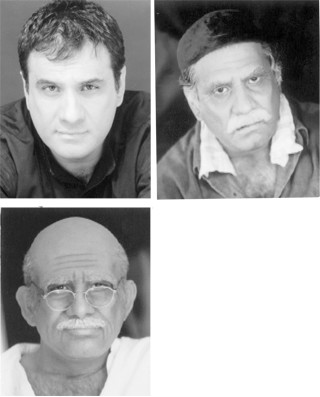
Irani (top) playing the character of Batliwalla (bottom) and Mahatma Gandhi
Though he refuses to share all the positive feedback he earned for this role, insisting it would be too pompous on his part to do so, he takes pride in reporting that the film won the Screen Jury Award recently, that it was premiered at the Locarno International Film Festival and was the official selection for the Mill Valley International Film Festival. More than his own accomplishment he sees this "as victory or recognition for English films made in India.” A trifle disappointed that Let’s talk did not open in India he is happy with the subsequent attention. That so many have seen it, that the media makes reference to films like Let’s talk he considers a major development. "Ten years ago Let’s talk would never have been screened, talked about or written about,” he is sanguine adding, "It did much better than anyone expected.”
"At last an Indian film that makes you laugh and think at the same time,” was the reaction of veteran film actress Shabana Azmi. Director Shyam Benegal acclaimed it as "a wildly funny black comedy...a real triumph.” Aamir Khan of Lagaan fame commented, "Boman’s performance is one of the most inspired I have seen in a long time. It was a huge learning experience.”
For co-star Maia Katrak who played the role of an anxious wife Radhika faced with the dilemma of baring her innermost thoughts to her husband, writing the script for the film was "quite joyful,” but acting in it was "not comfortable although very challenging.” Facing "a phenomenal actor like Boman who is so talented, I felt very insecure,” she confesses. "Both of us having the same bawa (Parsi) background we were able to laugh at the same corny jokes, but Boman could have forged a bond with any actress,” she maintains, insisting that the film needed a stronger heroine. "Boman dominates almost every scene. That was not how it was originally meant to be.” They had tested nearly 40 females but finally director Ram Madhvani convinced her that being instrumental in scripting the film along with Sanjay Sippy, she would have the best insights into projecting Radhika. And although a copywriter by profession (she and her father Kersy Katrak run their advertising agency, The Republic) Maia felt that with her limited background as a model for advertising films and participating in theatrical performances in Bombay and in London she could accept the challenge "as a lark.” Post release, "it was lovely to see the positive response. It was a great experience,” she admits.
Let’s talk is not a production heavy film. There are no great sets. It was shot on a digital video and then converted to 35 mm film, Irani provides the insights. "In fact the film was shot twice over,” says Irani who was part of the creative team too. After studying the first rough version they retained the scenes that were effective and restructured pieces that needed to be improved upon. After eight to nine months they reshot the film. "Most things I do are unusual,” he smiles.
"Almost every day I consider making a film. I have a lot of script ideas but I would require a little more free time before it clicks. It is a different medium altogether,” says the prospective director whose current time is evenly distributed between his acting and shooting assignments. "In films, Parsis are a very misrepresented community,” admits Irani although he is not offended by the Parsi stereotype, realizing that other communities like the Sardarjis or the South Indians have one too. "I enjoy the Parsi character... their uniqueness, generosity, perkiness. We are a very interesting people,” he continues, keen to "explore the reason for certain behaviors, the logic behind certain thought processes...”
A self-taught actor and photographer who towers over others at 6’2”, Irani proclaims, "I have figured out methods that suit me. I’ve got my own little style. I’d get bogged down if taught how to be spontaneous. If something comes spontaneously, it means you should pursue it.” His understanding of spontaneity though is interlinked with preparation, contradictory as it may sound. "You can’t go on the set and say ‘I’m a spontaneous actor.’” Before he assumes any new role, he likes to take time off, "learning all the dialogs, reflecting on all the possibilities.” During those five days of "character preparation” he is able to "discover the character.” As much as he enjoys the actual shooting he relishes the prospect of "putting meat on the character!”
In everybody says I’m fine he played a cameo role of a wealthy lecherous Punjabi businessman. Let’s talk gave him ample opportunity to display his histrionics. After his two successful films in English, waiting in the wings are Munnabhai MBBS where he depicts the dean of a medical institute and Darna mana hai where he plays a psychotic. These two films in Hindi required greater inputs from his side but as he says, "In every character you play you perform with a different diction and dialect, depending on the character.”
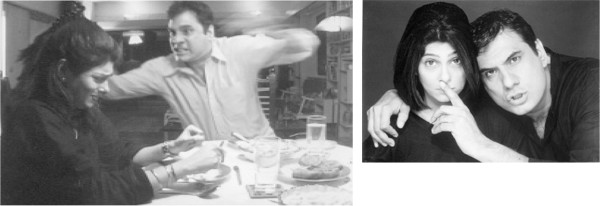
Irani and Katrak showing the different sides of Nikhil and Radhika in Let’s talk
"When I’m a photographer, I never play actor, and when I am an actor, I never talk direction,” Irani has his dividing lines clearly marked out. "The cap that I wear has to be nice and firm; fitting well,” he elaborates, understanding that each individual should have the freedom to express his own vision. Having taken up photography at the age of 32, Irani explains his fascination: "It is like magic...I enjoy talking to people. When you shoot a person it is not just to make him good looking but to capture the essence by making an effort to know and understand him... What makes him/her tick? What is his/her mantra (keynote)? Once you know which buttons to press and the person’s eyes light up, that’s when you come in as a photographer.”
Just as he models for advertising agencies so too does Irani shoot for advertising agencies as also for his own Highlight Films banner which creates advertisements on request. Designers, models, celebrities...the range of his subjects is ceaseless. This was the seventh year in succession when he shot photographs of all the contestants for the Femina Miss India beauty pageant. He works with the contestants before the elimination and competition rounds start.
The credit for his acting talent and wizardry with the camera go entirely to Irani although for his voice training he appreciates the efforts of Aloo Heerjeebehdin in correcting his lisp and Hetty Fernandes who taught the budding boy soprano the techniques of breathing which have remained with him over the years.
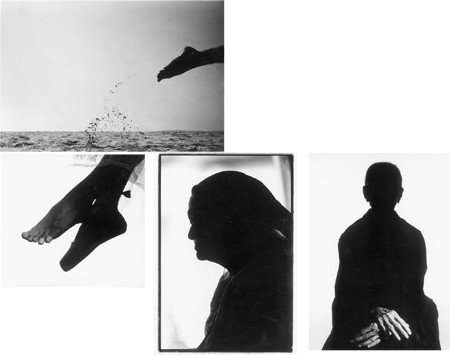
Images captured on the lens by Irani
"The people you are working with should be interesting and good enough to work with,” believes the all-rounder who may occasionally turn down offers when it does not go with his line of thinking, or he is not happy doing it, or due to constraints of time and resources. "I keep myself as occupied as I can be...Time is meant to be consumed.” Such effective one-liners punctuated the interview at his studio on Bhulabhai Desai Road on February 25, 2003. Equally noticeable was his insistence to find the most befitting words to describe an action or emotion.
During summer holidays he invariably takes two workshops — in drama and photography — for the students attending the Bombay Parsi Punchayet’s popular Holiday Programme for Youth. Last year he went a step further and guided the students to put up Black Comedy which was well received by the audience and which Irani thought was "a fantastic performance for a group of amateurs.” He was keen that they put up more shows for Navroz too.
His involvement with the community institutions comes to light at other times too: When the World Zoroastrian Organisation (India) was keen to promote Udvada as a heritage site they commissioned Irani to shoot every nook and corner of Udvada. "Call it a bird’s eye view or a worm’s eye view,” he notes.
"I’m all for change,” says the dramatist, adding after a significant pause, "while at the same time I’m all for tradition, but tradition which is feasible. My views are: ‘Times change, man changes.’ It’s all about growing, moving ahead. Otherwise we might as well go back and live in the mountains and retain those practices. I don’t like any argument which ends up rabid. Make progress and argue with a cool head,” he advises. According to him, "Religion is meant to keep me in touch with my roots, to keep me healthy and at peace with myself and others. Religion is not meant to be preached.” He visits the fire-temple regularly and wears the sudreh-kusti too saying, "I may not know its significance but it is supposed to be a humble vest and I treat it so. It gives us an identity of who we are.”
Irani’s grandfather Bomanji hailed from Nasarabad in Iran and when his wife was expecting, they had to travel across the land on a donkey until they set sail for India, he has been told. The family’s wafer business was started by Bomanji and after him, Boman’s father Khodadad took charge of the reins. When Khodadad passed away, his wife Jeroo was the mainstay until an accident forced Boman to get involved in the business. After his schooling from St Mary’s and two years of science studies at Wadia College in Poona, Irani did a course in catering and worked for a while at the Taj, he reports. The time that Boman used to give to the business is now given by his wife Zenobia who being stage shy prefers to remain "my guide and critic,” reveals the husband. Of their two sons, Danesh is studying HSC science at Ruia College, and younger son Kayoze is in Std IX at the Activity High School. "I urge parents not to push their children,” he counsels. "Some kids do so well in academics, some don’t, some can’t. Our system is very unforgiving for the youngsters. The kids know what is out for them. It is a matter of time before they realize their zone of spontaneity. I hate to be imposing.”
Willing to "accept criticism from anyone who is concerned about me,” Irani professes an undying love for: "entertaining people...the sound of applause...the spotlight.”
◆ ◆ ◆
From the archive