
Cover Story
Directional guidance
Sooni Taraporevala’s Little Zizou affectionately portrays the divisions, strengths and oddities of the community
"Overwhelming warmth and affection,” is how Sooni Taraporevala describes the response she has received to her directorial debut, Little Zizou. "People enjoyed it. They went out of their way to phone, SMS (text message) and e-mail. There was a (positive) reaction from people of all ages… Everybody may not have liked everything in the movie but everybody liked something…
"There has been no negative response yet,” notes the 52-year-old screen writer and mother of two. "The orthodox have not reacted” but she adds she has not come across any of them who may have seen the film. The story revolves around a young boy Xerxes (Little Zizou) who idolizes the French soccer star Zinedine Zidane or Zizou. Xerxes’ father Cyrus II Khodaiji is a fraudulent healer/preacher who is at odds with Boman Pressvala, the editor of a liberal community newspaper.
At the box office the movie has "held up very well” in its third week of showing, said Taraporevala on March 28, 2009. Aside from Bombay, the film is exhibiting in Poona, Delhi, Ahmedabad, Surat, Calcutta, Bangalore and elsewhere.
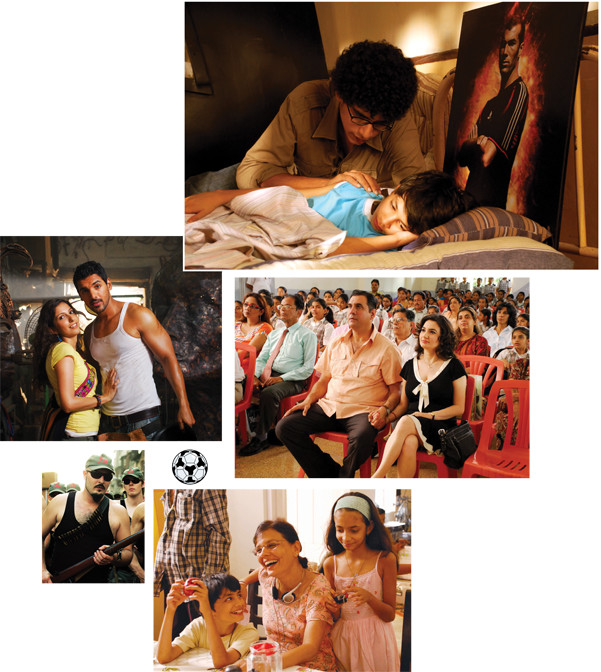
Top right: Imaad Shah (left) and Jahan Bativala with picture of soccer star Zinedine Zidane ; Below left: Dilshad Patel and John Abraham; Right: Boman Irani and Zenobia Shroff ; Below left :Tino Francorsi. Alongside: Jahan, Sooni and Iyanah
"Everywhere it is doing better than any other (new) release,” says Taraporevala. This despite the economic slowdown and the general drop in attendance at cinema houses. "In the occupancy rate per print we are number one” among all films including Hindi films, she states. The overseas release dates are still to be worked out between the producers and overseas distributors to be followed by DVD sales, television rights, etc (for updates on the releases and shows visit www.littlezizouthemovie.com).
The film received favorable reviews at international film festivals where it was screened. The first print of the movie was ready in March 2008 and was exhibited at film festivals in New York, Washington DC, Rome, Goa, Kerala and Singapore. The film won the Time Warner Best Screenplay and Best Director awards in New York and the Best Producer award in Singapore. "The reaction was superb,” she enthuses.
Do people abroad know about the Parsis? "Nobody knows about us… We are so marginalized really — even in India as well,” she notes. But this anonymity did not impede the viewers’ appreciation of the story.
"Even in Rome (people) totally understood” the film says the director noting the "story is a universal one.” The Wall Street Journal wrote about the movie and the Parsis.
Taraporevala sees the movie creating not only awareness of the community but also serving as a "showcase of Parsi/Irani talent… we cast the best persons for the roles. I was happy we were able to cast so many Parsis including the legendary Boman Irani, John Abraham (in a special appearance) and Shiamak Davar (cameo) who were Little Zizou’s angels.”
Among the cast are Sohrab Ardeshir, Shernaz Patel, Mahabanoo Mody-Kotwal, Zenobia Shroff, Kurush Deboo, Cyrus Broacha, Tino Francorsi, Dilshad Patel and even sculptor Arzan Khambatta in a cameo role. Taraporevala’s son Jahan and daughter Iyanah are among the main characters with Jahan playing Xerxes or Little Zizou. Dinaz Stafford and Tara-porevala are the team behind Jigri Dost Productions who produced the movie in association with Studio 18 whose distribution arm, Indian Film’s chairman Shyam Benegal found the movie "delightful,” according to Taraporevala.
Boman Irani especially "brought so much to the role” of Boman Pressvala, a crusading journalist who takes on a self-styled, self-righteous demagog Khodaiji (played by Ardeshir), said Taraporevala. Some of the dialogs in the movie was improvised by Irani to lend both authenticity and humor. The joke about the rotund Khodaiji’s elder slim son Artaxerxes (Imaad Shah) being introduced "as the son of Yasir Arafat, Yasir Arathin, was Irani’s contribution as was the scene between Boman and his wife Roxanne (Zenobia Shroff) where he swallows viagra pills and asks his wife to be patient as the pills take half an hour to take effect.” (Frantic phone calls and text messages were sent back and forth to ascertain the color and shape of a viagra pill to lend authenticity, notes Taraporevala.)
The scene was finally shot at 5.30 a.m. with the crew giving their all. Producer Stafford asked Irani what was the point of going through all the effort when the scene "was not going to make it in the film.” (Only around 10 percent of the film shot makes it to the final print.) The scene was included "and without fail gets laughs,” says Tara-porevala.
The roles for her children were tailor-made for them. "They lived with the script so long they knew it inside out.” The shooting took place in May when the children had their vacation. In New York Jahan was invited on stage and asked what it was like to be directed by his mother. "He joked that it was great because she is much kinder on the sets than at home… I was a lot more patient. On the sets I didn’t tell them what to do. At home I do,” she noted.
Even their dog, Toots, starred in the film, being taken for a walk by her husband, dentist Dr Firdaus Bativala. Toots promptly gave birth to eight puppies the same night. Even the puppies featured in a scene!
One of the most convincing sequences in the movie is when singer Gary Lawyer is filmed with a group of inebriated friends consisting of Taraporevala’s father Rumi and his drinking buddies. Five bottles of alcohol were ordered to ensure their spirits were high but at 10 p.m. at night they had to send for more. The carousing would have gone on and on till finally we had "to push them all out,” says Taraporevala.
The number of dance sequences involving Pressvala was to contrast him with the loveless, friendless Khodaiji. Hence Khodaiji’s home (shot at Dara Billimoria’s residence) has monochromatic colored walls while Pressvala’s home (Niloufer Unwalla’s residence in Dadar) has walls of purple and orange. While music and song accompanied Pressvala’s personage in the movie, no music is played when Khodaiji appears, barring one scene.
The idea of naming Khodaiji’s personal army the PLO (Parsi Liberation Organization) instead of the Parsi Sena was suggested by television presenter Cyrus Oshidar. The PLO consisted of Russians and Brazilians, a subtle reference to the Russians and Brazilians converting to Zoroastrianism; the music of the song Brazil blared out in the background.
Actually one of the titles first thought of for the movie was "The Russians are coming, The Russians are coming.” Another title was a Perry Como song, Catch a falling star. When a friend and art director Aurobind Patel saw a photo of Jahan with a football he captioned it ‘Little Zizou.’ It was shortlisted for the title. Taraporevala’s friend and colleague, Mira Nair, selected Little Zizou from three shortlisted. Taraporevala has written several scripts for Nair’s award winning films including Salaam Bombay. They were students together at Harvard University and subsequently collaborated professionally.
Cyrus Broacha’s line about Kunal Vijaykar being like the Dutch artist Vin-cent Van Gogh and therefore not listening to anything he said, was Broacha’s improvisation, says Taraporevala. Van Gogh had cut off a portion of his ear when rejected by a woman he loved.
"I had a wonderful time with the actors and crew. They brought so much to the roles and film. I’m getting credit for things I should not be getting credit for,” says the director.
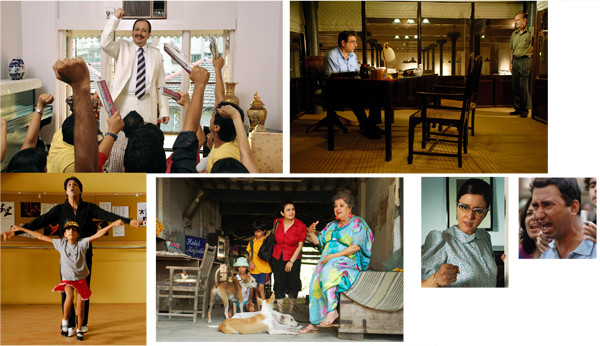
Clockwise from left: Sohrab Ardeshir; Boman Irani; Kurush Deboo; Shernaz Patel; Mahabanoo Mody-Kotwal, Zenobia Shroff, Jahan and Iyanah Bativala ;Shaimak Davar with Iyanah Bativala;
Setting the pace
How did directing a movie compare with script writing? "Directing is like photographing. You always have to look forward. A writer looks back… Direction is a great adrenal rush… a great deal of stress. The pace is set for you. In writing, you write at your own pace.” While filming, a budget is allocated for shooting over a fixed number of days. Missing a day or two’s work because of illness as once happened to Taraporevala, means a substantial financial loss.
"Everything is tightly scheduled, very organized. Boman was the busiest of the lot. Scheduling is a fine art. There are so many variables, circumstances, weather.” At Udvada, for example, they took cognizance of the tides. "I wanted a full moon. The variables are mind boggling.”
The film was shot over 42 days in May 2007 "entirely on location… you can’t replicate real life” in a studio, says Taraporevala though a studio provides you "a great deal of leeway… you can move walls, etc.”
One scene that created an unecessary community stir depicted an agiary. It was shot in a hall where marriages and navjotes take place and non-Parsis can attend. "The set had tables with hundreds of divas. It was a copy of the photo I had taken of Aslaji’s (agiary) on Meher roz, Meher mahino,” says the former photographer.
While a film "always has a base in reality” the lines between reality and fiction are blurred. "We mix it up…that is how fiction writers write film scripts. In Little Zizou the characters are fictional and everything is based on circumstances.”
One of her objectives in directing the movie was nostalgia for the type of humor the late dramatist Adi Marzban used to bring to his nataks (plays). "I missed that sense of humor. Little Zizou is my attempt to resurrect that, (take) something serious and disguise it in humor.” The film’s message is "if we don’t love each other, we’ll self distruct and die. This applies not only to Parsis but also to the world at large.”
The community’s weakness is that it is "jumping onto the fundamentalist bandwagon. (But) to be fair, we are the most benign (fundamentalists) going. I’ve no quarrel with the ‘orthodox,’” she states. "I’m against people who use religion for their own ends: power, personal glory and (possible) gain.”
On the community’s strengths Taraporevala lists "a sense of humor, morals, ethical (behavior), the affection with which we are held (by others) in India.”
She believes "the ethical, moral precepts have to override the rituals. I’m not against rituals — they’re beautiful but they are not the raison d’être of our religion and community.”
She has "no idea” what the future holds for the community but believes, "change is inevitable. It’s going to happen, it’s already happening. Zoroastrianism is a universal religion. We would be belittling (its) importance to the world if we say it is only for us and nobody else. I hope and desire that Zoroastrianism… would once again flourish and become one of the major (international) religions and lead us to a more peaceful world.”
◆ ◆ ◆
From the archive