
Cover Story
Headstart for Engineer
In his maiden film everybody says I'm fine Rehaan Engineer impresses audiences with his portrayal of an uncanny hairdresser
"I think I am reasonable although others may remark that I’m insanely bent on getting everything perfect. Within the given circumstances you have to do the best. If you are not going to bother to do it perfectly, why do it at all?” Rehaan Engineer explains his rationale for ensuring that he gets every frame correctly, whether he is in front of the camera or behind it. Playing the lead role of Xen, the owner of a beauty salon, in the English feature film everybody says I’m fine, Engineer’s portrayal has been acclaimed by audiences and critics.
For this 26-year-old graduate from the Royal Academy of Dramatic Art, shooting for his maiden film, the experience was "a steep learning curve,” acknowledges Engineer. "The scale, the complexity was an eye-opener. I had no idea how much coordination and planning is required.” The indefinite wait between shots was what he found particularly trying. "There we were, waiting for maybe two hours while the next scene was being readied, and the shoot would have lasted for barely 30 seconds,” reports Engineer, his expressive face and eyes, the pierced eyebrow notwithstanding, conveying much of the impatience he had experienced. The waits though did give the cast an opportunity to interact with each other.

There were an unprecedented number of Parsis, "almost like a Parsi mafia,” as observed Engineer, cast in the film directed by Rahul Bose. In addition to Engineer there was Boman Irani playing the role of the industrialist Mr Mittal who had messed up his daughter’s life; Anahita Uberoi who was cast as the bitchy socialite Misha Patel; Sharokh Bharucha who plays the role of the infatuated Bobby; and Delna Patel who acts as the well endowed receptionist Monica. Behind the screens there was choreography by Shiamak Davar and costume design by Anaita Shroff.
Engineer and Bose have known each other since their college days at St Xavier’s and that is probably why Bose thought of casting Engineer, the star undermines his importance. "I was not excited by the script he sent me,” admits Engineer but "Rahul’s enthusiasm is infectious. His love for the project was quite convincing.” Since Bose did not even have funds at that time Engineer was not sure when "it would take off but within six months everything moved so fast.”
Although not planned as a high budget movie with most of the scenes restricted to the confines within and outside the salon, the cost of the film ultimately worked out to Rs 3.5 crores, 15 percent over budget, mentions Bose. Launched under the banner of Insight Productions on July 26, 2002, the film produced by Viveck Vaswani had "notched an impressive 72 percent collection in Bombay, Delhi and Poona with Rs 50 lakh in the first week,” according to a report in The Economic Times of August 8. "In Delhi’s PVR Saket and PVR Naraiana where the English movie ran alongside the extravaganza Devdas in the third week, everybody says recorded 89 percent and 76 percent respectively, better than Devdas,” added The Economic Times. Bombay’s Sterling Theatre reportedly preferred everybody to Men In Black II and Minority Report for the late night show. "These figures show that the English movies made on contemporary Indian story lines cannot be dismissed and have a large appreciative audience. Of course, provided they are well made!” commented The Economic Times referring to patronage for the film from well known danseuse Malika Sarabhai who was raising funds for the Gujarat riot victims and activist Maneka Gandhi who was seeking support for animal rights.

The skin-deep beauty of the affluent customers stands exposed at the beauty parlor for the owner Xen (who had been christened Sikander, which translated into English became Alexander, and further abbreviated became Xen) is "a hairdresser who examines your head on the outside and in the inside.” As he stands behind each client snipping hair he is able to hear their innermost thoughts. Ever since he was trapped as a child in a room in a freak fire which engulfed his parents, he had vowed to himself that he would never wait to be verbally told anything by anybody. Niki, the heroine of the movie played by Koel Purie, is the only person whose thoughts are not laid bare. And as we learn the reason for this silence in the second half of the movie, we also realize why it was given an ‘Adult’ rating.
"A film about...trust and tenderness...damage and salvation... bravo,” commented columnist Shobhaa De. "One of the best films you have seen in recent times,” stated Asian Age while Canada’s Vancouver Westender declared that it reflected "the future of India and Indian cinema.” The film "belongs to Engineer and Purie...perfect chemistry,” declared Mid-Day.
"Extremely impressed” with Engineer’s acting as Xen, in a telephonic interview Bose commented how the star "brings to the role a certain ease,” effectively able to portray "both compassion and turmoil...I think he is most talented. An absolute delight to cast.” On the sets Bose also got to see Engineer as a "lovely, gracious person, tolerant, patient, never complained, never fussed.” Bose had good things to say about his other Parsi caste too. Irani "is clearly one of the finest actors in the world. Working with him was a privilege.” Remarking on Uberoi’s "grace and talent,” Bose perceived her as "beautifully cultured and versatile.” Bharucha "is a natural; full of beans with a great sense of humor.” Patel who was the executive producer of his plays is "extraordinary in the film. A very dear friend she has been most helpful.” Although presently he is concentrating on his acting assignments for three forthcoming film releases, following the success of his maiden directorial venture, Bose hopes to direct another film by the end of next year. "I would not hesitate to cast them again,” he declares.
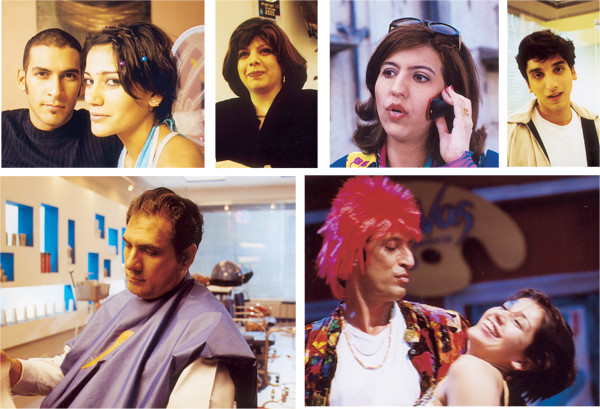
Top: Engineer with Bose Center row (from left) Engineer, Purie, Patel, Uberoi and Bharucha Bottom row (from left): Irani, Dodo Bhujwala and Purie
Never mind Bose’s willingness. For Engineer, the single experience of acting in a film has been sufficient, he says. The reviews he gets are of no consequence to him. He learnt that when starring in a production in his third year at drama school. Two of his voice teachers who were in attendance at the same show on the same day came backstage to give him two diametrically opposite views. This taught him a lesson for life: the impact an actor has on the audience "is so subjective that it does not matter. I have to be happy with my performance and my director has to be happy.”
Being behind the camera is more fulfilling for Engineer than facing it. When Parsiana met him in end August he was enthusiastic about producing his 45-minute short film which he had scripted himself. What is the subject of his film? "About mourning and dreams and philosophy. I’m sorry it sounds so pretentious.” Since avenues for screening such films would be limited he would have to be content with participating in film festivals, he realizes undeterred. Under the banner of the Industrial Theatre Company which Engineer co-founded with radio jockey Nadir Khan, cameraman Pushan Kripalani and third year BA student Karan Makhija they have worked on some path-breaking productions in the last two years. Agamemnon, a Greek tragedy, was staged one weekend at the Sakshi Art Gallery (due to limited funding they could only afford to have select shows). While the actors were performing, live footage was being projected on the walls behind. Their production of Girnish Karnad’s play Hayavadana at Bombay’s Horniman Circle was also well received by the "niche audience.” For the British Broadcasting Corporation (BBC) they did a radio play A suitable boy directed by John Dryden. "There is so little happening in the Bombay theater. Just an endless line of silly comedies. The corporate world doesn’t participate in the cultural life of the city,” notes Engineer. But his prospects here are better than the unchallenging roles that would have come his way had he stayed on in England. Due to the work permit regulations, Asians have been reduced to playing stereotype roles matching their physiological features, he states.
Born in Bombay to Jernaz and Khushroo, Rehaan had studied at a boarding school in Nainital and later at the Mayo School in Ajmer. After graduating in literature from Bombay’s St Xavier’s College, for a while he served as a Fellow of the English department, taking creative writing lessons. He then applied to the Royal Academy of Dramatic Art in UK where after auditioning he was among the 32 (of the nearly 3,000 applicants) fortunate to be admitted. On his return he chose to settle in Bombay, residing with his paternal grandmother Rutty Engineer and aunt Katie. His parents have made Nainital their home looking after his maternal grandfather’s oil business. Every year he spends nearly one and a half months in Nainital which he finds "blissful and wonderful (needing) to recover from Bombay.”
He may not speak Gujarati but his paternal grandmother keeps him informed of community developments every week as she reads the Jamé and regrets the bigotry increasing in the community. Though he can’t seem to feel passionately on issues like dakhmenashini and intercommunity marriages vexing the community, he believes that "more the freedom and less the restrictive practices, greater will be the sum of human happiness.” His sister Sanaya Raj Singh is settled in Bangalore. "I think plurality and variety make for a richer source of cultural fabric.” With numbers dwindling in the community and the pressures on identity preservation increasing, he realizes that some Parsis become more rigid. Delhi’s liberal approach he finds "quite cavalier” while Bombay’s is "quite trenchant...The stronger the barriers become, the more difficult it is to understand each other,” he adds.
About 10 years after his navjote, Engineer stopped wearing the sudreh-kusti. "I’m not a practising Parsi,” states the star who is interested in comparative religions. He finds that "Vedic and Upanishadic Hinduism has a more mature approach to integrating the physical and spiritual aspects of one’s life.” What he enjoys observing though are the "Parsi eccentricities and characters.” It is also difficult to overlook the community’s "strong cultural presence,” he adds.
Ever the thespian, the varying lifestyles fascinate Engineer. Studying them facilitates his projection of the different moods and nuances as required of a given role. For, as reinforced to Engineer at the drama school, "It takes 20 years to train an actor. This is just the beginning.”
◆ ◆ ◆
From the archive