
Professions
“Architect by choice”
Percy Nazir’s designs and execution for the Border Security Force and Coal India have won him many accolades
While still a student Percy Phiroze Nazir was invited to design the Director’s Bungalow at the Rakhikol collieries, near Parasia in Madhya Pradesh. Now 40 years old, the bungalow, as old as Nazir’s career in architecture, still sits atop the hill near the mines. "Little did I know then that my work would start and end with collieries,” mused Nazir.
Nazir who specialized in town planning and industrial architecture began his career as an associate with Mavlankar and Mavlankar. When the Indo-Pak War broke out in 1971, the BSF (Border Security Force) advertised for the post of assistant commandants in the technical wing. The glamor and glory of a uniform beckoned. Nazir applied and was selected. However, he hadn’t reckoned on the rigorous 10 weeks’ training for soldiers! "Parades, firing, tactics and maneuvers. Those 10 weeks really toughened me up. I emerged stronger in spirit and strength,” said Nazir. After his basic training Nazir was posted at the BSF headquarters, New Delhi, in the civil engineering wing.
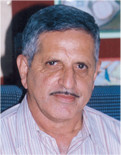
He set up BSF establishments and townships in the eastern sector at Assam, Meghalaya, Manipur, Mizoram and Nagaland. He was also associated with planning and designing of the four premier BSF Training Institutes at Gwalior, Indore, Hazaribag and Bangalore. "My mentor and role model in those days was K. F. Rustamji, then director general of the Border Security Force. He was a soldier, a scholar and a gentleman,” said Nazir.
After 12 years with the BSF, Nazir was expected, as per BSF norms, to undergo another round of intensive field training before he could qualify for higher promotions. "That was when I decided to quit,” laughed Nazir. "I was afraid they would make me forget my profession as an architect and turn me into a soldier.”
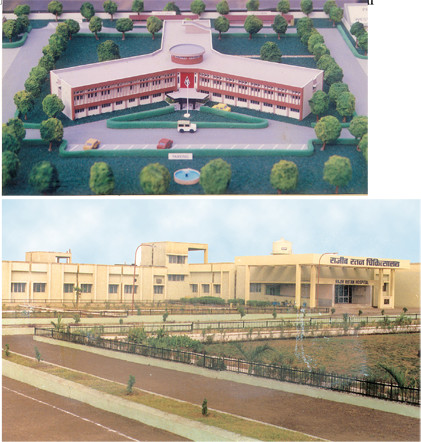
A model of the general manager’s office at Wani (above) and the hospital in Ghugus designed and built by Nazir (top)
In 1983, Nazir went on deputation to Coal India Limited (CIL), the country’s largest public sector undertaking. In 1986 he was absorbed in the company. In his 19 years with CIL, Nazir traveled widely, serving in the different subsidiaries of CIL, such as Central Coalfields Limited, Northern Coalfields Limited, and Western Coalfields Limited. "It was rough going, with most postings being in remote and near primitive areas,” remembered Nazir, "But seeing a forest or barren land being transformed into a model township, was very rewarding.” It took its toll on family life though as his wife was unable to reconcile to the situation. Their elder daughter Dilber is now a management consultant with Siemens and younger daughter Tushna is associate guest service manager of the Oberoi International.
Of the numerous townships and colonies he built, Kumbarkhani near Chandrapur in Maharashtra was a project Nazir is specially proud of. "The land was undulating and inhospitable. But we created a beautiful township of 350 houses for colliery workers of different categories, along with the supporting infrastructure of roads, school, dispensary, etc using the natural topography to good effect.”
Nazir is aware of the importance of human resources to any industry, specially one that is as labor intensive as coal mining. Both quality and quantity of production depends upon labor. He feels that motivation of any individual is attained only through providing him with the basic requirements of good shelter, clean environment and such amenities as will improve the quality of their lives.
Another landmark project handled by Nazir was the Latur Earthquake Rehabilitation Scheme. Yelwat village comprising over 150 homes was rehabilitated with quake-proof houses and supporting infrastructure in a record six months’ time and handed over to the villagers before the monsoons. Nazir received special appreciation from the then minister of coal, Ajit Panja, for the speed of construction and quality of work.
"If the job is to be completed within a strict timeframe, entrust it to Nazir. His commitment to his work and to his word can be fully relied upon,” his superiors at CIL had a very good opinion of one of the very few Parsis working in the government behemoth.
The Rashtriya Nirman Ratan Award, 2000, National Gold Star Award, 2000, Rashtriya Udyog Excellence Award, 2001 and the Rashtriya Shiromani Award, 2001, presented at the hands of Krishan Kant, then Vice President of India are just a few major awards, among the many he has received. In recognition of his worth, the Federation of Parsi Zoroastrian Anjumans of India conferred the Award for Excellence in the sphere of professional competence for the year 2001 to Nazir on November 23, 2002.
Born and raised in Nagpur, Nazir was a shy, handsome, hardworking boy. When he retired from CIL last year at age 60, he was a shy, handsome, hardworking man. "I became an architect by choice and not by chance,” said Nazir. "I always enjoyed sketching and was fascinated by space, proportion and perspective. My eldest brother Cawas was studying civil engineering. I would love to watch his plans and drawings. Architecture, I decided was an artistic extension of the same discipline.” In 1960 the Visvesera Regional College of Engineering, Nagpur, upgraded its diploma course to a full-fledged BArch. Nazir was admitted to the first batch of degree in architecture from Nagpur University.
Nazir acknowledges his late father Phiroze as the most formative influence of his early life. "Dad’s principles of honesty and integrity in every dealing and his tremendous courage in the face of prolonged physical pain, are deeply etched in my psyche,” said Nazir softly. "In hindsight, I can even appreciate my mum’s (Mehroo) goading,” laughed Nazir! His other siblings are Minoo who is a banker and sister Shereen Hirji.
Nazir’s looks belie his years. Being a sports and fitness freak all his life is paying rich dividends. Hockey, football, basketball, table tennis, he has played them all but cricket was and is a passion. While in college, he played university level cricket, in Delhi he played for the Indian Police Service cricket team, in Calcutta he played ‘A’ Division professional cricket for the Calcutta Parsi Gymkhana. Now Nazir takes pleasure in watching and organizing cricket matches. A walk of 10 to 12 km is a daily must even today.
Nazir, the award winning architect is always available to friends and fine causes where he gives happily and freely of his expertise, without any expectation of returns. A condolence hall and dharamshala at Indore, mandirs in Singrauli and Parasia, a gurudwara in Nanakpur and a Lutheran church in Nagpur are some of the places he has designed and supervised, in this way. The managing committee of the Nagpur Anjuman draws heavily on his experience and advice. Recently, they requested him to supervise the landscaping and beautification of the long neglected aramgah. Not only did Nazir do an excellent job of it, he went further and made a painstaking plan of the entire cemetery of over 1,200 graves. It is proposed to display this at the entrance, to make it easy for people to locate the grave of a loved one, if they know the grave number or seek it from the register of names kept there. This then, is his blueprint for success — service beyond the call of duty, or giving a little more than what is expected or asked for.
◆ ◆ ◆
From the archive