
Sports
Preparing the pitch
Playing with handkerchiefs tied on their heads, and bats and stumps crafted by a local carpenter, Parsis were the pioneers of cricket in India
As in the fields of politics and social reform so in those of games and sports the Parsis have well played their part and come off with flying colors. The sporting instinct is inborn in the members of the Zoroastrian community, and one of the noblest prospects which a Parsi ever sees after a hard day’s work is the high road that leads him to the maidans (playgrounds), gymkhanas and clubs for oiling the wheels of his mundane existence. That inordinate partiality for sports endures him through life and it only abates when age or ailment incapacitates him from fully enjoying the amenities of the sporting life.
Take, for instance, the game of cricket. Amongst all the Indian communities the Parsis were the first to take to it so far back as 1848 and they made themselves masters of it within 50 years, so much so that they defeated two English teams that had arrived from England, in 1890 under the captainship of G. F. Vernon and in 1892 under that of Lord Hawke, these being the only reverses the teams had experienced during their tour in this country. J. M. Patel writes in his Stray Thoughts on Indian Cricket that he was once told by Prince Ranjitsinhji, the Prince of Cricketers, that it was a Parsi who had first taught him cricket in India, and also Maharaja Sir Sayaji Rao, Gaikwad of Baroda, in a letter to Patel, said that he had the game taught to all his sons by professional Parsi cricketers. With years rolling on, the Parsis made themselves more efficient in this manly pastime, but latterly with the game of bridge coming into vogue they exchanged the willow for the cards with the result that their play has now in large measure deteriorated. It is, however, gratifying to take note, under these depressed circumstances, of the highly creditable performance of D. R. Havewalla who, playing for the B. B. and C. I. Railway in December 1933, made 515 runs against St Xavier’s College, a record and an achievement hitherto unsurpassed in the annals of Indian cricket...
J. R. B. Jeejeebhoy
•••
The Graphic describes them as follows: "It is not everywhere, however, that John Bull finds any of the natives inclined to join in the sport; they are generally content to ‘assist,’ in the French sense of the word, by simply looking on. There are, nevertheless, exceptions to the rule, and in the Bombay Presidency the Parsis, who have for long shown themselves superior to the prejudices with which other Indian races are more or less fettered, have come out quite strong as cricketers. Before long, it is rumored a Parsi eleven will visit our shores for the purpose of contending with us on our native turf. We have already received several severe drubbings in the cricket field from our Australian cousins, perhaps next we are destined to be knocked (cricketically) into a cocked hat by the descendants of the fire worshippers of Persia.”
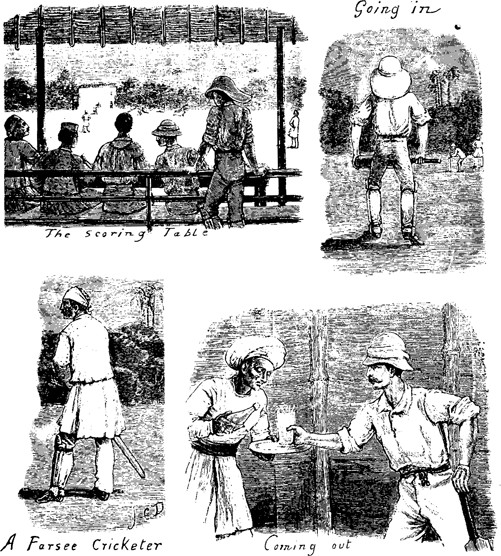
These old pictures, supplied by J. R. B. Jeejeebhoy, are taken from the London Graphic of August 10, 1878. The handkerchiefs seen on the heads of Parsi cricketers are tied to keep off the burning heat of the sun, sun-hats having been forbidden by strict orthodoxy. The Parsi players of those days did not mind taking the field with bandis (half shirt/badian) and pyjamas which stand in strong contrast to their present-day fashionable cricket accoutrements
Text and photos courtesy: Parsis and Sports by H. D. Darukhanawala
Early Parsi cricket was graphically described by Sir Pherozeshah Mehta who presided, on April 17, 1886, at the dinner given in honor of the Parsi team that was proceeding to England to measure its strength with English cricketers on their own soil. Said Mehta: "I, gentlemen, remember the time, about a quarter of a century ago, when our co-religionists first took to cricketing. Those days are quite fresh in my mind from the fact of my being one of the very first who was engaged in this game. This fact was unknown to fame, and I am particularly glad to make a public announcement this evening that it was in the maidan outside the ramparts that the pioneers of cricket, proud of their bats and stumps, which were made by a native carpenter, had begun to play. Since then the game has flourished among us and here I may mention, it has received a very great impetus from one who was anxious to introduce physical training among the natives of the soil, the late Sir Alexander Grant. The days of my exploits on the cricket field have long since passed away, but to this day there is no more agreeable sight to me in Bombay, while passing down Esplanade Road, than that of the whole maidan overspread by a lot of enthusiastic Parsi and Hindu cricketers, keenly and eagerly engaged in this manly game.”
Speaking about their tour, the president remarked: "I may say that the object of the team in going to England is a very modest one. Cricket, as you know, is the national game of England. It has taken root among the Parsi community, and as artists go to Italy to do homage to the great Masters, as pilgrims go to Jerusalem to worship at a shrine, or as students in the Middle Ages went to the chief seats of learning in places where science and philosophy had made their home, so now the Parsis are going to England to do homage to the English cricketers, to learn something of that noble and manly pastime in the very country which is its chosen home.”
In the words of Mehta, the Parsi cricketers "have gone over many parts of India and have played a number of matches with representatives of other nationalities, but whether they are balling or batting, gaining or losing, they have always distinguished themselves by their pluck, courage and perseverance”... •••
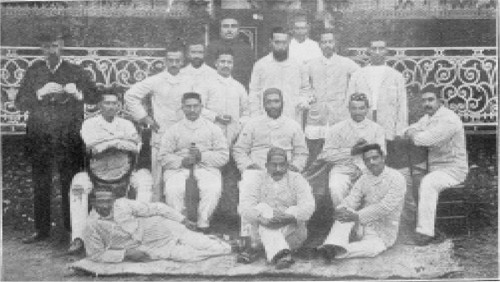
The first Parsi cricket team that went to England in 1886
This (first Parsi cricket) team (that went to England in 1886) was in no way a picked one, being composed of a number of Parsi gentlemen who could afford to pay their own expenses, and it speaks well of the enthusiasm and the sporting spirit of these pioneer Parsi cricketers. The brunt of the work of getting up the team fell upon the willing shoulders of B. B. Baria, ably assisted by A. B. Patel (secretary) and Dr D. H. Patel (captain). As can be imagined, great things were not expected from this venture; it was, in fact, more in the nature of an educational tour. Of the 28 matches played, only one resulted in victory, 19 being lost and eight drawn. During the course of the tour, however, they had the honor of playing, at the special request of Queen Victoria, against Prince Christian Victor’s Eleven at Windsor Great Park. The ill success of the tourists on the cricket field was nevertheless amply compensated for by the very favorable impression which they made on the English sporting public, the result being that they forged strong ties between lovers of cricket in both countries.
The team consisted of A. R. Limboovala, Dr Dhunjishaw H. Patel (captain), M. Framji (bowler), M. P. Banaji, Shapurji N. Bhedwar, Ardeshir C. Major, Phirojshah Major, S. H. Harver, B. B. Baria (organizer), J. M. Morenas, Jamasji Pochkhanavala, Sorabji Bejonji (left-hand), Burjorji Bala, P. D. Dastur and Dadabhoy D. Khambatta. Of these, Bala, Dastur and Khambatta were from Karachi, the others being from Bombay.
Edited and reprinted from Parsis and Sports by H. D. Darukhanawala
◆ ◆ ◆
From the archive