
Religion
The ABC of the sudreh kusti
Working at the grassroots level, these individuals and organizations teach religion to the young
In order to appreciate the efforts being made by individuals and institutions in Bombay who have taken the onerous responsibility of educating the young about the religion, Parsiana spoke to a few stalwarts such as Rati Peer who has been conducting religious classes for nearly three decades, Ervad Vispi Dastur who is a pillar of the Bombay Parsee Association and Iran League, Ervad (Dr) Ramyar Karanjia and his students of The Athornan Boarding Madressa, Dadar and Jeroo Nar-golwalla whose religious classes at Godrej Baug are attended by the primary school children.
These views may not represent a cross-section of the community but they provide an insight into the thinking and future aspirations of some members.
A God given opportunity
"The community today is only interested in khaani-peeni (eats and drinks),” sums up Rati Peer who for over three decades has been striving to cultivate in the Zoroastrian children a love for their religion, their prayers, their traditions and customs. Peer is one of a handful of devoted religious instructors within the community. Amongst the various associations that foster religious education, two long- time notables are the Bombay Parsee Association and the Iran League. "Earlier parents gave a lot of kaalji (attention) to religious education. Today’s parents only concentrate on studies,” she regrets. While she can appreciate the parents’ concern to give importance to school education she reiterates, "To build up your true self, you need a religious foundation.”
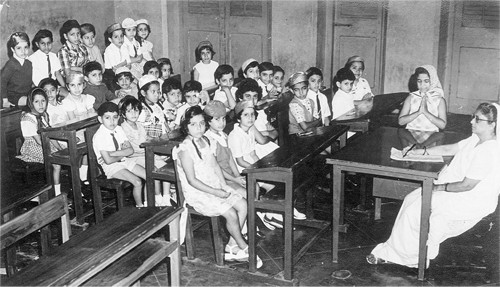
Peer with students circa 1970s
The children, in her view, are like "gai-golab (gentle as cows and fragrant as roses); intelligent, smart, sweet. All fault lies with the parents. Bachaao nu nakhot varéch (ruining the children’s future).” As the religious instructor at the Bengalee Girls’ School, B. N. Gamadia Girls’ School, Sir J. J. Girls’ School, Bai Avabai Petit High School, Ratamai, as she is better known, teaches the Parsi children Avesta prayers and Gujarati (reading and writing). While she insists there is need for annual assessment in these subjects the majority of the parents protested saying the children are already under excessive academic pressure and don’t need to be burdened further. "Children need good religious books which would interest them,” she realizes. She has developed a standardwise course for each academic year. Religious instruction includes the recitation and meaning of prayers, the significance of ceremonies, knowledge of Parsi songs and monajats. Looking at the callous disinterest shown by the parents "anyone else in my place would have stopped long ago,” points out Peer.
At Cusrow Baug where too she has been conducting children’s and ladies’ classes for several years she has noticed that parents from a neighboring building won’t send their children to the Sunday morning class although these children will be loitering or cycling on the roads. "Nowadays we don’t know how to respect our elders, how to live with our neighbors,” she regrets.
There are moments of gratification too when those who have learnt from her start sending their children to the class or having settled abroad invariably enquire after her welfare and the progress of the class or remember to send her wedding invites long after they have outgrown the class.
This thankless task often made her go out of pocket but she appreciates the cooperation and understanding from every member of her family, particularly her late husband Ervad (Dr) Peshotan Peer, son Ervad (Dr) Rooyintan, and daughters Hutosha, Tehmina, Havovi and Ketayun who take care of the domestic chores leaving her free to attend to other calls. Tehmina now assists her mother in many of the organizational responsibilities too. Whether at the prayer recitation competitions organized by the BPA or the drawing, rangoli, elocution, religious quiz, monajat and music competitions organized by the Iran League, Ratamai and Tehmina’s contribution is invariably recognized in getting the participants, suggesting the subjects and sharing in the administrative workload.
"Only money does not bring happiness,” states Ratamai happy that she has earned a lot of "maan (respect) from the Parsi community. Whoever shoulders such work in the future will feel a lot of satisfaction and happiness too,” she is sanguine. "With their microscopic and telescopic vision our forefathers put in so much effort and sacrifice to preserve our faith,” she reminds, adding, "Working for the community is a God given opportunity. However talented and intelligent you are, you can’t do anything unless He wills it.”
Ratamai feels duty bound to perform the role of a social worker and counsellor too. Entrusted with funds by different individuals she keeps a judicious account of all the monies distributed to deserving beneficiaries.
She respects the awards and felicitations accorded to her over the years. A silver salver was presented to her by the K. R. Cama Oriental Institute "for her invaluable services in the promotion of Zoroastrian education and values among the youth for several decades.” Likewise her services have been appreciated by the World Zoroastrian Organisation, the Youths Own Union (YOU), Zoroastrian Student Teacher Association, the Navsari Ava Baug and the BPA which created a record by presenting her, Peshotan and Rooyintan (three members from the same family) awards at the same time.
The World Zarathushti Cultural Foundation launched by Dr Homi Dhalla and the Zartoshty Brothers Fund managed by the Bombay Parsi Punchayet have also been encouraging her work. The financial support recently extended to her enables her to move around in a taxi at the age of 77, a privilege she may have denied herself earlier fearing the financial strain on the family.
Born in Navsari to Dinbai and Dosabhai Kanga, before marriage brought her to Bombay in 1950, she was a physical education teacher at the Bai Navajbai Tata Girls’ High School and had introduced the Girl Guides activity in that town, she notes. At the age of 17 she had started religious classes at the Shantadevi Mahila ane Bal Pustakal (Library) in Navsari, she says, acknowledging the inspiration she derived from Jerbai Tata and Baimai Daboo. In Bombay when she started the children’s class under the auspices of YOU in 1967 there used to be an average attendance of 60 kids. With the families shrinking in size and many relocating to the suburbs the attendance at these classes gradually waned over the years.
Ratamai ensures that she or one of her assistants is always present to conduct a class. Her enthusiasm and persistence undimmed over the years she says she now wants to introduce regular hum-bandagi for the children of the community. Anyone with knowledge of Hindi is welcome to learn Gujarati from her in 20 minutes, she assures. Often invited to give religious lectures in places like Surat, Poona, Sholapur and Bangalore, to recharge her own batteries she spends a month at the Cama Home at Bandra each year.
Deriving fulfilment from her self-imposed mission she notes, "My only wish is to be born again as a Parsi Zoroastrian and to once again give my services t
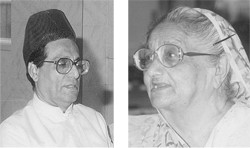
Dastur (left) and Peer: "inspiring youngsters”
Discipline should come from example
"The religious fervor among the youth today is perhaps much more than what it was when we were young,” observes Vispi Dastur, president of the 83-year-old Bombay Parsee Association (BPA) and coordinator and honorary treasurer of the 81-year-old Iran League, the two organizations which over the years have been zealously trying to create a community awareness among the youth by holding various competitions.
The annual prayer competition conducted by the BPA at the Byramjee Jeejeebhoy Parsee Charitable Institution is witness to the interest level among all age-groups: three-year-old children from the pre-primary classes to 85-year-old grandmothers. School children are expected to be proficient in the prayers prescribed for each academic year. While some parents may complain that it is the same students who walk away with the prize each year as the children of athornans invariably have an upper edge, there are other parents who view this exercise as a revision of prayers, both for themselves and the children! In fact the Madressa boys are assessed separately, explains Dastur. A kusti weaving competition on the same day sees young girls from the Bai Avabai Petit High School vying with experienced veterans.
Under the auspices of the Iran League are conducted competitions in Shahnameh recitation, religious quiz, essay writing, elocution, drawing, rangoli, Parsi songs/monajats, Gujarati language, western vocal and instrumental, Indian vocal music, etc for Zoroastrian school children, collegians, youth and elders at the Bai M. N. Gamadia Girls’ High School. In the younger age groups there is equal participation from both the sexes but with advancing age, very few men are willing to compete with the experienced females, mentions Dastur. Here too the judges are faulted for rewarding the same winners every year but when so few judges are willing to come forward the organizers are helpless, points out Dastur noting that "keeping everyone happy is a difficult task. We should take an overall view.”
Besides giving cash prizes to the first three winners in each category, there are trophies awarded. Beginning this year the trophy winners have been presented a special memento which they can preserve whilst the rotating trophy is returned at the end of the year. Dastur notes how happy he was to see one participation certificate framed in a Parsi household that indicated the family’s joy in being associated with the event.
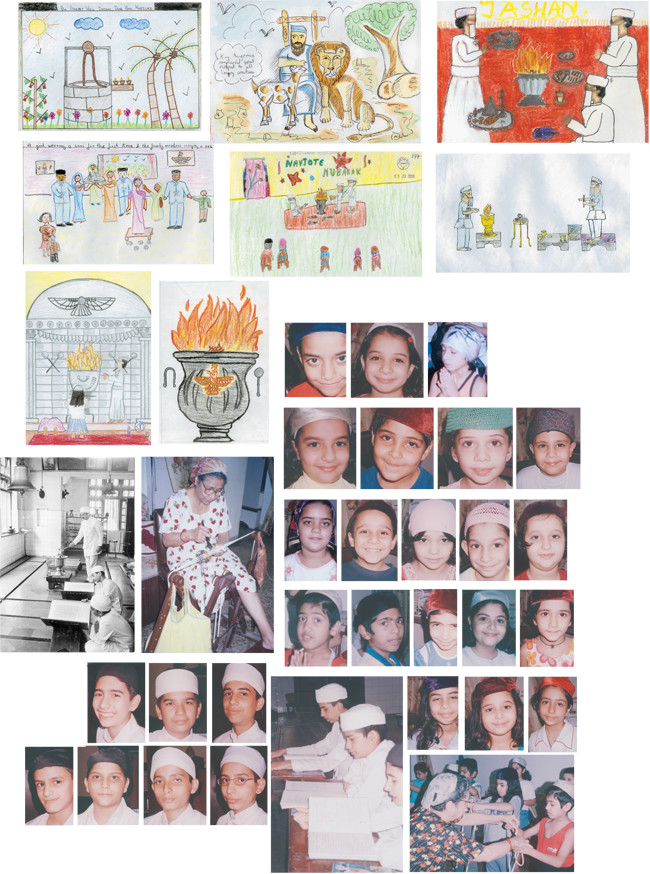
Selection from prize winning entries in this year’s Iran League drawing competition; Below From left to right Bharthania, Soonawalla, M. Daruwalla All photos by Simin Patel Karanjia photo: Homyar Mistry ; B. Gandhi, Jamasbi, Deboo, Engineer; K. Patel, Malaowalla, Katrak, M. Patel, N. Gandhi; Jodey Daruwalla, Johaan Daruwalla, Pauvri, Panthaki, Zenia Nejadkay ;Z. Patel, Dubash, Znoishta Nejadkay; Nargol-walla teaching the kusti rituals; Center left: Karanjia at Madressa with students and Nargol-walla wea-ving a kusti; Botom from left (top row): Motafram, Dastoor, Kham-batta; 2nd row: Panthaky, Bhadha, Ichhaporia, Mandviwala. Right: students studying texts
At the prize distribution function there are costs to be borne: for hiring the baug (albeit concessional), electricity and chair rental. Plus cash gifts and distribution of free dinner coupons to the winners and judges invariably requires a good reserve of funds. With donations having dwindled and so too the interest rates, it is difficult for small organizations to sustain themselves until some obliging donors come forward, Dastur explains the logistics. In days of yore there were benefactors like Dinshaw Merchant, Rustom Kooka who pledged their support year after year but such munificence is not assured now. "The prop of the community is the typical middle class lady,” says Dastur appreciative of the behind-the-scenes support rendered by the corps of Parsi women who do not seek any publicity. He gives particular credit to Rati Peer who with her team of volunteers solicits participation from the youngsters of different baugs and colonies.
"The idea is to encourage youngsters,” reiterates Dastur. And it is done in different ways: whether it is the two youngest boys from each madressa who are made to lead the humbandagi, or other members of the madressa fraternity who are invited to sing monajats, or the girls of the Avabai Petit School who sing Chhaiyé hamé Zarathoshti. The BPA has now instituted youth achievement awards for those excelling in academics and sports. As a founder member of FOZAWAC (Federation of Zoroastrian Associations for Welfare and Culture) it also takes pride in the different activities conducted to promote academics and sports within the community.
"Running down the kids and youth of the community is not a good thing. We have to encourage them. Competition now is becoming very severe,” impresses Dastur. In extracurricular activities the standards may have fallen as compared to earlier times when there was no lure of TV or pressures of studies, he states, adding, "The days of physical punishment are gone. Discipline should come from example and inspiration. Children should be allowed to show their originality.”
During the early years the Iran League had been striving to maintain cultural relations between the Zoroastrians of India and Iran, offering guidance and help to those who wished to visit Iran, conducting Persian and Gujarati classes, publishing books on the Zoroastrian religion and Iranian history, organizing lectures from visiting scholars and remitting financial aid to Zoroastrian educational institutions when permitted by the foreign exchange regulations. Its sphere of activities is now geared to the youth.
"Parsipanu jaalaavanné vasté (to fan the flames of community belonging)” the BPA has also taken upon itself the responsibility of maintaining all the Parsi statues in the city with the support of the Bombay Municipal Corporation and organizing a function at the war memorial at Khareghat Colony on every Fravardigan parav. As explains Dastur, ultimately the purpose of all these functions is to inspire the youth of the community, the "trustees of posterity.”
Priesthood beckons
"A decade back the students were not so keen to go into priesthood. They mainly obtained a graduate degree and then a clerical job,” explains Ervad (Dr) Ramyar Karanjia, principal of The Athornan Boarding Madressa, Dadar. Today, however all the boys wish to pursue part-time if not full-time mobedi. Most of the 29 students at the Madressa want to join the commerce stream after their schooling because "it is the general trend,” notes Karanjia. He recollects the time when he decided to join St Xavier’s College, Bombay, for a BA degree, despite getting a high percentage: "It is a common mindset that Arts is meant for those who can’t do anything else.”
Sixty percent of the Madressa students are from out of Bombay, informs Karanjia, adding that though previously the majority came from Gujarat, many students now come from Poona which is "the new Parsi base.” The boys reside at the Madressa, visiting their homes during their summer, muktad, Diwali and Christmas breaks. On the last Sunday of each month, their parents may come to visit. A picnic or outing is organized for the students on the weekends.
The boys study at the nearby Dadar Parsee Youths Assembly High School, free of cost. Karanjia mentions that the School, a "great support, without which we would not be able to manage,” has offered "totally free education” to the Madressa boys since 1966. While the senior students attend school in the morning and study at the Madressa through the afternoon, the reverse is followed for the juniors. The senior students are taught Math, Hindi, Marathi, Science, at the Madressa as well which serves more as tuitions to help them fare better in these subjects. In addition to the residential principal at the Madressa are four residential teachers, office staff, servants and a cook, with eight to 10 visiting teachers.
Commenting on youth in general and Parsi youth in particular, Karanjia observes that they "have a feeling for their religion and community.” When interacting with them at youth congresses and discussions he notices a "keen desire to know and learn.” But "where practice is concerned it is sacrificed, due to lack of time.”
Parsiana had an occasion to speak to some of the Madressa children:
Yazad Bhadha, 12 years, from Bombay, VII std
Bhadha hopes to practice mobedi part-time. Shah Rukh Khan, Hrithik Roshan and Rustom Pehlvan from the Shahnameh are all his idols. He is fond of reading Tinkel story books and his Bal Bharati text book. He says that it is "good that we are pure and we are standing first in all religions, but (we should) not marry inter-caste.”
Eric Dastoor, 12 years, from Udvada, VIII std
He wishes to pursue mobedi part-time. After completing school, he wants to join the commerce stream. He doesn’t enjoy reading books outside his curriculum much but follows the sports programs on television. Dastoor was awarded the Jamshed and Shirin Guzder Award for best youth at the Federation of Parsi Zoroastrians Anjumans of India, this August, for securing 79 percent marks in standard six. He believes that the Parsi community is "progressing nowadays, but needs younger mobeds because there is a shortage.” The weakness of the community, lies in the fact that the "population is less.”
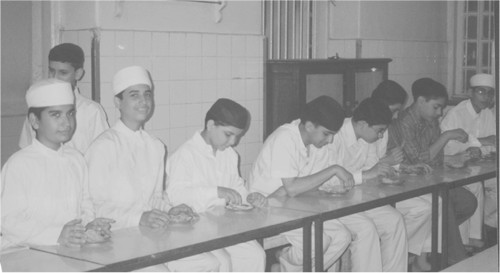
Young priests at the Dadar Madressa (Photo: Simin Patel)
Arzan Ichhaporia, 15 years, from Bombay, X std
With his father’s brother and mother’s brother, both part-time mobeds, Ichhaporia is inclined to take up the profession part-time. He enjoys reading novels and mystery books.He observes that the community "is small but spiritual and educated. It is decreasing due to inter-caste marriages. Girls are more educated and do not think the boys are capable.”
Arzaan Khambatta, 14 years, from Poona, IX std
Khambatta hopes to practice mobedi part-time, till he graduates, after which he may consider pursuing it as a full- time profession. He enjoys reading religious books and comics but doesn’t watch too much television. He is glad that the community is "sending more boys to practice mobedi,” but is weary of "more people marrying outside” causing our population to "vanish someday. That is the community’s weakest point,” he clarifies.
Yazad Mandviwala, 12 years, from Navsari, VIII std
He looks forward to practicing mobedi part-time, while he studies science in a Bombay college. Mandviwala likes reading Hardy Boys books and novels as well as watching National Geographic, sports and news channels. He feels that the community is "fighting amongst ourselves.” Ours being the "oldest community in the world, we must follow truth: wear our sudreh-kusti,” the sacred vestments that no other community wears.”
Urvaksh Motafram, 13 years, from Bombay, VII std
Motafram hopes to practice mobedi part- time. After his schooling, he wants to enroll in a BMM (Bachelor of Mass Media) course in a college in Bombay. He enjoys reading comics and the Shahnameh and watching most of the channels on television. "I am proud to be born in the Parsi community. "I have a good job (as a priest) even if I do not excel in studies.” Like most of his colleagues, he thinks the weakness of the community lies in the increasing number of "inter-caste marriages.”
Speetman Panthaky, 12 years, from Ahmedabad, VII std
Panthaky wishes to pursue mobedi part- time, hopefully in New Zealand, as his parents have suggested. Fond of painting, he wants to enter the commercial arts stream in Bombay after his schooling. He passes some of his free time reading Tinkel story books and suspense novels and watching Animal Planet and the Ten Sports television channels. "Ours is the oldest community in the world and the literature and religious books we have, I don’t think that other communities do.” Panthaky is confident that in the future "inter-caste marriages will be stopped.”
Dutifully praying
Like the soldiers and police wear theirs, the sudreh and kusti are our uniform, believes Jeroo Nargolwalla. Her eager students in the five to nine age-group feel the same, promising to wear their sacred garb throughout their lives. At her Godrej Baug residence Nargolwalla teaches approximately 20 of the colony students their navjote and other prayers plus Zoroastrian basics like the 101 names of Zoroaster, the names of the 30 days of the month, six ghambars, etc.
When Nargolwalla moved into her Godrej Baug residence with her husband Rustom, five years ago, a neighbor requested her to teach her son his navjote prayers. It has now progressed into regular prayer classes, held thrice a week, for an hour each, free of charge. Though the students attend the classes primarily to learn their navjote prayers, they often continue to come even after their navjote to learn to read and write Gujarati as well as revise their prayers. Since the children are taught Hindi in school, teaching them to read and write Gujarati is much simpler, she admits. Nargolwalla also weaves and sells kustis, an art she learnt from her mother in Nargol. At the classes, for a little while, she weaves a kusti in the presence of her students, while explaining the complex procedures involved and their importance in the making of the final thread.
Commenting on today’s Parsi youth, Nargolwalla remarks that their minds are not being occupied, either by praying or attending talks. Instead they while away their time, like the youth in her colony, smoking and abusing. She observes that there is a dearth of Parsis in the army, navy and other services. "First there was Field Marshal Sam Manekshaw, but now who?” Hoping to encourage community marriages, Nargolwalla plays match-maker "by just passing on phone numbers of prospective partners.” But the Parsi girls have too many "nakhraas,” since they are well educated and earn better, she observes. Parsi boys therefore do not match their expectations. Each one of us has to do something to stave off the dwindling population, she believes.
Although too young to make any profound statements, speaking to the young children of her class it emerged that praying has become a regular habit with them:
Anosh Bharthania, eight years, St Mary’s High School (ISC), III std
"I like the Parsi people because they are neat and clean. I go to the agiary once a month with my mother and pray daily.”
Jodey Daruwalla, eight years, Gopi Birla Memorial School, II std
"We should not tell bad words. We should speak good words and be good. I go to agiary once a week and pray once a day.”
Johaan Daruwalla, nine years, Gopi Birla Memorial School, IV std
"I like our religion because our religion is pure and no Muslims and Christians can come. Parsis are very sweet and big hearted. I go to the agiary with my brother on Saturday and Sunday and pray twice a day.”
Mehr Daruwalla, five years, Walsingham House School, pre I std
"I like the Parsi agiaries because they are nice, clean and neat. I like the people. On Saturday and Sunday I go to the agiary with mummy, daddy and brother. I pray.”
Jazreen Deboo, six years, Queen Mary’s High School, I std
"I go to the agiary on Saturday and Sunday with my daddy. I like going to the agiary at Godrej Baug and I like my friends in Godrej Baug.”
Tanya Dubash, seven years, The Alexandra Girls’ English Institution, II std
"I love to pray and go to the agiary. All Parsis are nice. I visit the agiary once a week and pray twice a day.”
Yohan Engineer, six years, Christ Church High School, I std
"I go to the agiary with my mummy, daddy and brother. I don’t pray at home.
I like the community because I like going for navjotes and weddings. I like the food especially the rice and daal. I like the colony because my friends are here.”
Berezida Gandhi, eight years, The J. B. Petit High School for Girls, III std
"I like going to the agiary and saying my prayers. I go to the agiary once a week and pray twice a day. I take part in the prayer and piano competitions.”
Niyosha Gandhi, seven years,The J. B. Petit High School for Girls, I std
"I like our religion. I go to the agiary once a week and pray twice a day. I take part in the prayer and piano competitions.”
Jamshed Jamasbi, six years, Cumballa Hill High School, II std
"Parsis are very good and nice. I pray for my family. I pray to all Gods — Hindu and Christian. I pray twice a day and go to the agiary once a week.”
Dilsaz Katrak, five years, The Alexandra Girls’ English Institution, higher KG
"I go to the agiary with my mummy once a month. I like the Parsi people because they are kind.”
Karl Malaowalla, five years, St Mary’s High School, prep III std
"I don’t like Parsis. I don’t like anybody. I like the agiary. I go to the agiary sometimes with mummy, daddy and my brother.
Zenia Nejadkay, five years, Walsingham House School, prep class
"I like navjotes because all my friends are there and I like my birthday because my mother celebrates it. I go to the agiary with my mother and sister.”
Znoishta Nejadkay, nine years, Walsingham House School, IV std
"The Parsis are very brave because they fought against the Muslims. I go to the agiary with my sister sometimes.”
Vahishta Panthaki, nine years, The Alexandra Girls’ English Institution , IV std
"Our religion is much better than the others’ because our sudreh and kusti protects our "ijjaat.” I go to the agiary thrice a month and pray everyday. I stood first in the prayer competition.”
Karishma Patel, six years, The Alexandra Girls’ English Institution
"I like to pray. I pray twice a day. I go to the agiary sometimes.”
Mehernosh Patel, five years, Cumballa Hill High School
"I like to go to the agiary. I go to the agiary with daddy. I like to go out with mummy, daddy and my sister to Breach Candy. I like to go to navjotes and weddings because my mummy-daddy take me.”
Zishta Patel, seven years, Queen Mary’s High School, II std
"I like my religion because it is very good and nice. I like the people. I go to the agiary alone or with my family and pray everyday but sometimes I forget to pray.”
Kainaaz Pauvri, five years, Walsingham House School, prep B
"I like the religion because of the people. I go to the agiary with my mama and pray at home, once a day.”
Benafsha Soonawalla, seven years, Villa Theresa High School, II std
"In school the teacher tells us to pray for our country, parents, teachers and Mother Mary and Mother Teresa. I pray to every God. I saw the story of God. God’s mother was Dogdo. I pray twice a day and go often to the agiary.”
◆ ◆ ◆
From the archive