
Comment
Icon kaun?
Even if the youth are seeking and finding newer role models to emulate, the future of the community holds promise
Pelvic thrusts in leather leotards, a mustachioed drag queen with a pronounced bucktooth — Freddie Mercury, aka Farrokh Bulsara, gave India and the world Zoroastrian population their first truly international icon. One star in the galaxy of celebrities that they could point to and proudly say, ‘Aapro Freddie.’ Freddie Mercury was truly the Queen!
Of course, before another one bit the dust, many stalwarts had already set standards of generosity and enterprise that others to follow would find difficult to emulate.
Dadabhai Naoroji ‘The Grand Old Man of India’ played an invaluable role in India’s freedom struggle. Philanthropist and patriarch of the Tata empire, Jamshedji Tata’s hands shaped the prospects of an emerging nation.
Scientist Dr Homi Jehangir Bhabha made a notable contribution to India’s atomic energy programme, while Sir Pherozeshah Mehta became the president of the Indian National Congress and later vice chancellor of Bombay University.
Financial wizard and economic critic Sir Dinsha Wacha was a prolific writer and business pioneer. J. R. D. Tata built an empire whose legacy continues to prosper.
Sometime in the 1960s, maestro Zubin Mehta stormed into the world of symphonies and philharmonics and held the world in thrall.
Polly Umrigar, Nari Contractor and Farokh Engineer have at various points wielded the willow, captained the Indian cricket team and kept wickets, setting an example for generations of aspiring cricketers.
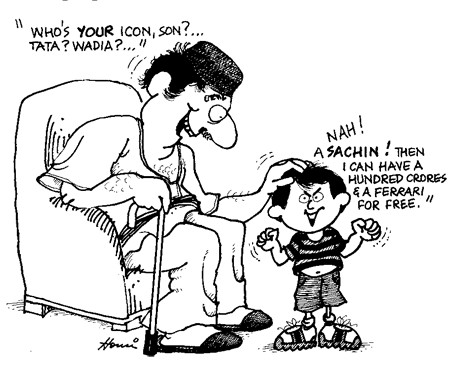
Tatas, Wadias, Godrejs, Jejeebhoys, Petits — these families built institutions, hospitals, schools and trusts and gave to Bombay and the Zoroastrian community a lot of its earlier glory. R. K. Karanjia, Jehangir Sabavala, Field Marshal Sam Manekshaw, Sohrab Modi — the list is long, with the possibility of having missed a name here or there. Remarkable people with extraordinary legacies and outstanding lives — individuals to look up to, emulate and hold up as examples for a community that believed in charity and altruism.
That was then, this is now. Generation Me is a lot younger, brash and bold, delving into less explored venues like acting, health and fitness and the performing arts. This is not a generation of bankers, industrialists or nine-to-five jobholders. Free spirits eager to break the mould or plain foolhardy and blasé, in-different to the future? We have many a shining example of our youth who people the city’s Page three pack, but are they capable of leading the brat pack?
We did a head count of some newer names that popped up as ‘outstanding’ slightly predictable, a trifle surprising, the list doesn’t take too long to compile — Ratan Tata, Cyrus Broacha, Cyrus Oshidar (there must be something about that name!), Sooni Taraporevala, Riyad Vinci Wadia, Kaizad Gustaad, Perizaad Zorabian, Arzan Khambatta, Shiamak Davar, Mehr Jesia, Tanaz Currim, Boman Irani, Shernaz Treasurywala. Per chance there must be other names that fit the bill, some we’ve left out due to space constraints. All emerging stars, forging a different path, not treading the road our forefathers chose. A deviant dream, an emerging generation. A jolly jokester for the MTV motley, an upcoming starlet, the ultimate ‘muse’ model, a ‘scrapture’ sculptor — notable names, but icons for Generation Now?
Naushad Buchia thinks not. The 25-year-old, who is currently doing a Human Resource course and running a part-time network marketing business, says, "There is tremendous potential in today’s youth but no will and determination to see it through.”
Freishia Bomanbehram, 22, assistant producer with Red FM, agrees, "There isn’t a single person we can really look up to. There might be loads of hidden icons — ordinary people doing extraordinary things — but no single individual comes to mind. A Cyrus Oshidar or a Perizaad Zorabian may possibly be style icons” but not in other regards.
Firoza Buchia, 23, a teacher training to be a yoga instructor, is of the opinion that even for the present generation it is the Godrejs and Tatas who set an example. "Which is not to say that the youth aren’t doing well. Among our contemporaries a few girls like Perizaad Zorabian and Parizad Kolah are setting a good example, though not of the same standards.”
Physiotherapist Firuzi Desai believes the sense of urgency and commitment is missing. "More and more young people want quick money, hence, boys and girls today are taking the easier option — models, air hostesses, stewards, dancers, even fitness instructors, for god’s sake! The emphasis on education is missing, which is why we see a decline on the professional level as well.”
Aashish Hiramanek, a 30-year-old independent communications consultant, agrees and says it’s usually professionals, industrialists and pioneers who are looked up to. "Nowadays, most of us, especially the men, are not inclined towards entrepreneurship. Today, it’s very rare to spot a Parsi who’s an outstanding businessman. We’ve lost our entrepreneurial ability. Though I still think there are some people like sculptor Arzan Khambatta who are doing great work and displaying tremendous potential.”
Adds Naushad, "Our generation has had it easy — there’s been no need for us to forge an identity like our forefathers did, so I guess the entrepreneurship has died.”
Expecting a good fight on my hands, I’m surprised to see the youngsters capitulate. No one to look up to, young people not motivated enough, no fighting spirit — the opinion and voices vary but the view remains the same.
Ashdin Doctor, a student of sociology and anthropology at St Xavier’s College, Bombay, believes one needn’t have a contemporary role model. The 20-year-old says role models needn’t necessarily be young: "Gandhiji will never cease to be a role model, even for the present generation.” Doctor’s idea of role models are the Tatas, "The Tata family has given us the Indica — a car manufactured wholly in India — which is just one example of their grit and determination. I don’t necessarily have a contemporary I look up to. I’ve seen Zubin Mehta perform live and I really admire him.”
But student Gulnaar Kavarana (name changed on request) doesn’t need an icon. "Why can’t I follow my own star? Why should I have someone to look up to?”
Bomanbehram seconds that. "I don’t think anyone in the present generation — be it a Parsi or a non-Parsi — has or needs an icon. We are a self-motivated and self-driven generation.” Though she does have her own icon in her aunt Dr Frene Ginwala. "She is the speaker of the National Assembly, Parliament of the Republic of South Africa. She is an amazing human being and a very strong woman who has been called ‘the sari in Parliament.’ She’s my idea of grit and strength.”
Naushad’s idea of an icon is "Somebody who dares to dream and teaches us to do the same. Because very few Parsi youth are willing to take a risk and do something different,” and then he says almost self-effacingly, "I will eventually join my father’s business.”
So what do our almost-icons have to say? The effervescent Zorabian says, "When I think of a successful, honorable, intelligent Parsi gentleman I think of Ratan Tata. He has taken his lineage to another level and I adore him.” In her opinion, today’s youth have definitely made a place for themselves in the world of entertainment. "We’ve gone from being stereotypical gag bags to being respected in our field. I was once offered a role as a Parsi girl with a fetish for pink shoes who spoke broken Hindi and I turned it down. I refuse to be compartmentalised. Now we have made it to the mainstream.” Among her contemporaries she thinks Oshidar and Broacha are doing a brilliant job. "You think MTV, you think Cyrus Broacha. Even in dancing, no one comes close to Shiamak Davar. They are all unique people. It’s too early to call them icons but there’s definitely great potential there.”
On the flip side is Oshidar, MTV vice president, creative, whose answer simply is, "I-kaun?” The problem, he says is not with the community but the country at large. "The youth across the country don’t have icons. The only icons you can think of are film stars and cricket players who are too busy lining their own pockets. For me, the last great sporting hero was Muhammad Ali — he stood for something, he had an opinion. We need another Muhammad Ali.”
Pretty Nauheed Cyrusi, 21 and on her way to attaining stardom, says, "The last of the real icons I can think of was Persis Khambatta. I’m sure Parsi youth are capable of producing other icons but the lack of names popping into my head is also because not a lot of Parsis are inclined towards doing business anymore.”
Entrepreneur Riyadh Cama (name changed on request) ties it in neatly: "Unfortunately, it does seem a little sad when the youth themselves have a diffident viewpoint. But, let’s face it — all the great people who made a name for themselves didn’t become legends at the age of 30. So, even though we might not have enough shining stars at the moment, maybe our youngsters will emerge winners in the end.”
Striking a balance is well-known fitness instructor Firdaus Anklesaria who says, "Of course, we have people to look up to in the form of Shiamak Davar, a modern day achiever who started his own dance academy. People like restorer Jimmy Mistry, fitness guru Mickey Mehta and martial arts expert Vispy Kapadia are all doing great work in their respective fields. Why Mehr Jesia gave the country its first super model!” But he has a word of caution: "Everything said and done, over the last 60 years, the kind of professions Parsis have been following have changed drastically. From heading businesses they are now doing mediocre jobs, opting for nine-to-five jobs and playing it safe. Lack of enterprise is bringing our community down. Parsi youth need to take an initiative and become pioneers in more adventurous fields.”
On a more optimistic note comes Cyrus Dastur, a 27-year-old who runs a theatre company called Two Plus Productions. "Of course, there are a lot of people with potential, you just need to look around and you will find them. Generally, people tend to look up to people we hear of or see in the papers ever so often. For example, a Malaika Arora, who’s in the news every few days but doesn’t have substantial backing, is looked upon as an icon. But there are people like Noel Tata who are not known but are doing great work and are very successful. Shiamak Davar too has achieved a lot and he’s not even a typical Page three person. People like Perizaad Zorabian and Shernaz Treasurywala are examples to follow for young women who are interested in the glamor industry. Most young people haven’t even heard of Dr Rusi Soonawala. A Jeh or Ness Wadia is known because of their lineage, but not many know that they might be training to take over their business. There is a fresh generation, slightly low profile but ready to take on the baton. Just because they are not in the news doesn’t mean they aren’t doing much.” Like Dastur says, seek and you shall find.
The question remains, is it a community/youth weighed down by its past or too nonchalant about its future? Nevertheless, it’s heartening to see a dwindling community showing some sense of promise in various fields — be it art, culture, medicine, films, etc. Much as today’s generation is still finding its feet and struggling to realise its identity, there’s a strong message here. There is potential just waiting to be explored. So whether we have a handful of Tatas, Godrejs or Wadias or many talented Davars, Broachas or Khambattas — the future holds great promise.
The future of the community lies not in endless, multitudinous discussions undertaken by some archaic and rabid minds on various e-groups where a lot of self-congratulatory bouquets and self-deriding brickbats are traded among a handful.
The future lies in Xerxes who wants to start a modeling agency, Zubin who wants to be in the armed forces, Delna who desires to be an actress or Mehnaaz who’s training to be a chef.
At the risk of sounding irreverent and being inundated with mails asking me ‘What do I know about the Vendidad’ and castigating me for ‘knowing nothing about our great religion’... I know this for sure — the future of this community lies in its — you guessed — future!
Desai wraps it up neatly: "We might not be able to fill the shoes of the stalwarts who preceded us but we are growing and we will get there.”

Kimi Dangor is a sub-editor-cum-features-writer with Sunday Mid Day, Bombay. She graduated in English Literature from the Maharaja Sayajirao University, Baroda and acquired her post-graduate diploma in mass communication and journalism from the Xavier Institute of Communications, Bombay. Kimi writes on fashion, food, travel, trends and personalities for Sunday Mid Day — a job she enjoys immensely.
Besides writing, her other interests include reading, travelling, theatre, art and music. She has also been, at various points in her life — a ballet dancer, gymnast, martial artist and a horsewoman.
◆ ◆ ◆
From the archive