
Books
The myth and the man
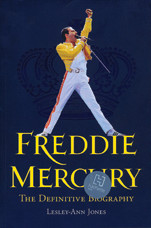
Freddie Mercury: The Definitive Biography by Lesley-Ann Jones. Published in 2011 by Hodder & Stoughton, 338, Euston Road, London NWT IBH, UK. Pp: 374. Price: Rs 595.
This reviewer stands ashamed that when he first heard about Freddie Mercury, he dismissed him as some eccentric Parsi bawaji seeking the limelight by publicly changing his name. Till one received this book for review, one didn’t realize that this queerly named man was the greatest rock front man of all time, also the most mysterious. His musical genius and matchless creativity earned him the adoration of millions. Few, however, gained entry into his private life to get to know the man he was.
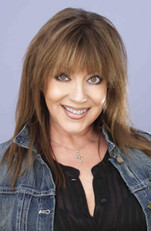
Biographer Lesley-Ann Jones
In this outstanding biography, former rock journalist Lesley-Ann Jones — who toured with his band Queen and formed lasting friendships with its members — mines mythology, drama and gossip to reveal a shy, endearing individual, Farrokh Bulsara, born to Parsi parents, Bomi and Jer, in distant Zanzibar, who fled to India when the country revolted and later settled in London. Both the parents and Farrokh’s younger sister Kashmira (Cooke) were surprised and overjoyed at his phenomenal success as a singer-composer with Queen.
Musically gifted from childhood, success came to Freddie easily: "I’ve created a monster,” he would say, "the monster is me.” Music was a drug, to him a stimulant. "But it gets tough when people spot me in the street and want him up there, the big Freddie. I’m quieter than that. You try to separate your private life from the public performer, because it is a schizophrenic existence. I guess that’s the price I pay. Don’t get me wrong, I’m no poor little rich guy. The music is what gets me up in the morning. I’m truly blessed.”
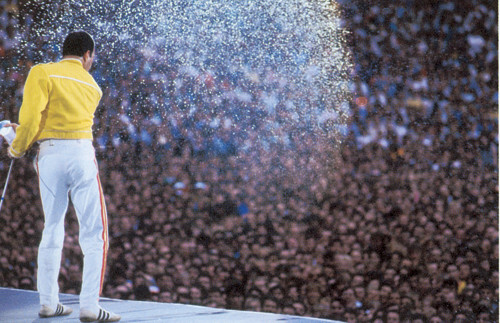
During the Queen’s Wembley concert in July
Times change. So do music tastes. In today’s troubled world, the serenity and ecstasy of Western classical music are increasingly being replaced by the frenzied appeal of rock music. Frenzy, according to the dictionary, is mental derangement, temporary insanity, a mania — all of which are exemplified by Freddie Mercury’s performances, particularly the one in Japan in 1975. Not even the bulk of their sumo wrestling security guards was enough to hold back a 10,000-strong crowd of hysterical teenaged girls. Mercury was forced to halt his performance in order to beg his fans for the sake of their own safety, to go back to their seats, take a few deep breaths and calm down, only then did he resume his performance. It was the same story in several countries when Mercury performed.
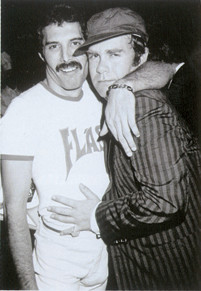
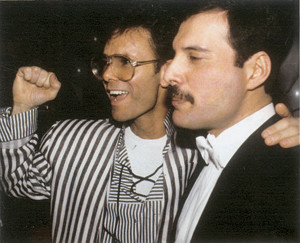
Singing legends: (left) Mercury with Elton John and (far left) with a bespectacled Cliff Richard
Mercury’s first band, formed with five school friends, was named the Hectics, the second Wreckage. In 1970, he teamed up with guitarist Brian May and drummer Roger Taylor, who were in a band called Smile. Freddie changed his surname to Mercury, and the band’s name to Queen. A year later, bass player John Deacon became the fourth member of Queen. As a songwriter, Mercury composed many hits for Queen, including Killer Queen, Bohemian Rhapsody, We Are the Champions and others.
The professional successes apart, Mercury’s personal life was also constantly under a spotlight. His guilt-ridden adulthood, the confused sexuality, led to several heartbreaks from which he found consolation in song writing. People loved Mercury’s soaring voice, his harmonies and humor. They also loved May’s guitar playing, while Taylor and Deacon seemed to be the glue holding everything together.
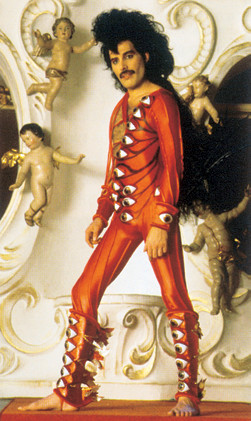
The rock icon in one of his weird costumes.
Mercury lived a fast and hectic life, presumably because he had a premonition of an early death. Born in 1946, he died at the comparatively young age of 45 in 1991. It fell to Peter Freestone, the musician’s personal assistant, who always made Mercury "presentable” to sign his death certificate, giving cause of death as AIDS-related bronchopneumonia as confirmed by Mercury’s close friend and doctor, Gordon Atkinson. Rapid funeral arrangements were made as Mercury had wished, but his parents were consulted. As Freestone put it: "We were burying a rock superstar but they were burying their son.” Mercury wanted everything to be done as quickly as possible.
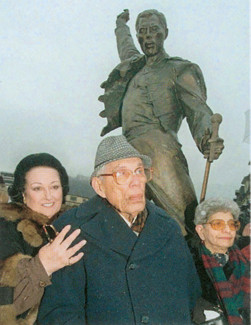
Opera diva Montserrat Caballe with Mercury’s parents Bomi and Jer Bulsara at the unveiling of their late son’s commemorative statue in Montreux, Switzerland
He was cremated at West London Crematorium, Kensal Green, at 10 a.m. on Wednesday, November 27, 1991. His remains were carried in a Rolls Royce hearse with four cars following to the tune of You’ve Got a Friend, sung by Aretha Franklin. There were some 14 friends and about 30 relatives present. Cooke said: "Freddie is still here in some ways because his music is still here. He was my brother but also a megastar. Simply speaking, I don’t know what it was like to have an ordinary brother. That makes my only brother’s death so extraordinary.” The floral tributes covered more than a quarter of an acre. His parents’ message read: "To our very beloved son Freddie. We love you always.” Mercury’s former girlfriend Mary Austin’s wreath was a pillow of roses with the note: "For my dearest, with my deepest love, from your Old Faithful.” A wreath from her little son said: "To Uncle Freddie with love from your Ricky.” Taylor’s wreath carried the moving farewell: "Goodbye old friend, peace at last!” All flowers were donated to London hospitals.
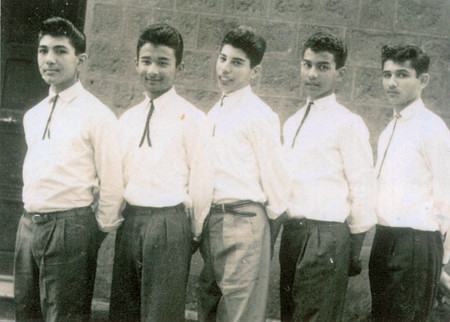
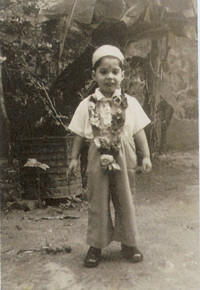
Mercury (3rd from left) as part of the band the Hectics and as a young four-year-old in Zanzibar
Queen’s 15th album, Made in Heaven, was released four years after Mercury’s death. Months before his final illness, he recorded as many vocals as he could, with instructions to the rest of the band to complete the songs later. The album debuted at No 1 in the United Kingdom. A statue of the rock icon by Irene Sedleka was unveiled in Montreux, Switzerland, by Jer on the fifth anniversary of his death. Beginning 2003, fans from around the world gather in Switzerland annually to pay tribute to the singer as part of the Freddie Mercury Montreux Memorial Day on the first weekend of September. The Mercury Phoenix Trust AIDS Charity was launched in 1992. A Freddie Memorial Plaque was unveiled in his English hometown Feltham.
This book is definitive because the author had unprecedented access to all the key figures in Mercury’s life — his family, his friends, industry executives, musicians, publicists, photographers and lovers. Mercury had enriched his sex quota by making love to men as well as women. He was bisexual in the richest sense of the word. The book is also compassionate and compelling in that it gives an accurate account not only of how the world saw Freddie Mercury, but of how the East Africa-born-boy-turned-legend saw himself. Mercury found consolation in song writing expressing his torment and elation in classic hits across the genre that resonate to this day. Most attractive of all, this riveting book is richly illustrated with multiple photographs of Mercury at work or relaxing at home with his friends. Though the musician died an untimely death, this book will keep his memory alive for a long, long time. As Jac Holzman, founder of Electra Records and the music executive who signed Queen, notes, Mercury was "cut off in his prime but preserved for all eternity.”
One of music’s most complex and best figures, Freddie Mercury, wherever he be, would be delighted to learn that Queen — which he nourished with his love and devotion — is more popular today than it was in his lifetime.
BURJOR K. KARANJIA
◆ ◆ ◆
From the archive