
Politics and Policy
Concentrating on education
Reelected Bombay Parsi Punchayet trustee Dinshaw Tamboly says the education portfolio will be his priority in his second term
"The logistics of transporting the Tavdi fire from Navsari to Bombay gave me more sleepless nights than anything, including this election!” Bombay Parsi Punchayet (BPP) trustee Dinshaw Tamboly reflected on his role in the establishment of the Jokhi Agiary at Bombay’s Godrej Baug, deeming it the most challenging — and the most satisfying — of his assignments during his first seven-year term in the Punchayet. He recalled the traffic jams that then prevailed on the highways of Gujarat where development work was underway. An accident anywhere along the route could have meant a pileup of traffic and precious time lost. Missing a boi would have been a disaster. At every major junction alternative routes had to be charted out in advance so that the fire could reach Sanjan in time for the Havan gah boi. The Sanjan-Bombay stretch the following night was fraught with similar peril. "We could have airlifted the fire but Dastur Meherjirana declared it had to be in contact with the earth,” Tamboly remembered.
The Godrej Baug agiary had remained a project in limbo until the Tavdi fire was identified as available for rehousing there. The financial barrier dissolved when Hongkong business magnate Keki Jokhi agreed to contribute 75 lakh rupees within 24 hours of an e-mail request from Tamboly. "There was divine help. Everything went like clockwork. Things just kept falling into place,” he notes reverentially.
As for the installation of the solar concentrators at Doongerwadi for which the man received considerable flak from detractors during the weeks leading up to the election, Tamboly thinks he has "played a pivotal role in ensuring that the estate and the system (of dakhmenashini) were not compromised.” He says he genuinely believes that anything could have happened if the matter had gone to court. "Minoo (Shroff) and I were pleading with the DDD-AG (Disposal of the Dead with Dignity-Action Group) not to move the courts... My policy is never to shut the door on dialog. Rather, to carry on the dialog to doomsday!”
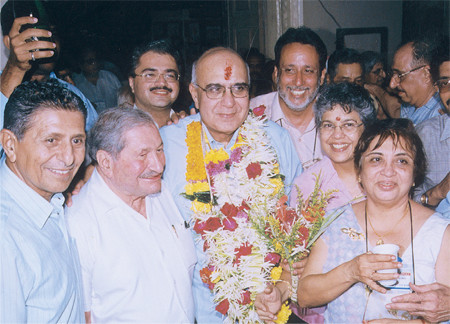
The victor (centre) flanked by (from left) Jimi Jesia, Guzder, Bachi and Mithoo Jesia
It is a matter of satisfaction that to date there are four concentrators on the Sethna dakhma financed through donations from NarYman Dubash, Shapoorji Pallonji, Khorshed Sodhi and Khorshed Hanson. "We always ask the family before placing a body under the concentrator. So far no one has said no,” states Tamboly. Not only are four more concentrators due for installation over Bombay’s Anjuman dakhma by the year end, support for their use is spreading among such conservative communities as in Poona, Ahmedabad, Navsari where they have been/are being installed, notes Tamboly.
Due to Tamboly’s Navsari connection (he is Bombay Dyeing’s sales agent there apart from his work with impoverished rural Zoroastrians in the area) he was also the trustee-in-charge of the construction of two buildings comprising ownership flats that the BPP built on its property there. The more than 40 flats of quality housing were sold at Rs 450 per sq foot with only six now remaining. The vast property in front of a maidan in the main part of the city was bequeathed to the BPP by Jamsetji Tata’s sister Ratanbai Bamji. It had housed the Choksey Rural Girls’ Home until that institution folded for lack of patronage. The BPP plans include the future construction of a sanatorium/dharamshala on the site, says Tamboly.
For the coming years Tamboly says he would like to concentrate on education — the portfolio he inherited from Dr Mehroo Bengalee, his predecessor on the BPP board. "In 1996 we were disbursing 18 to 20 lakh rupees every year. Today it is 80-90 lakhs.” And Tamboly hopes to increase this amount substantially — an aim with which his fellow trustees are in consonance, especially the budget allocations for those who seek to pursue the medical stream. One source of funds could be the sale of the Nirlon property, which the Punchayet had purchased in Goregaon, to the Petit Trust — a deal currently under negotiation. "The money that we get would be used for education,” notes Tamboly optimistically.
Procuring and budgeting more funds for the Punchayet to give as loans to those seeking self-employment will be Tamboly’s other major preoccupation. The World Zoroastrian Organisation (WZO)-India has a waiting list of such seekers, he says, adding that the Punchayet too has been giving these loans for the past several years and where the individual’s need is large (seven to 10 lakh rupees), the two bodies have been working in tandem, as the WZO’s ceiling is 2.5 to three lakh rupees. "There is a sea change in BPP-WZO relations! The WZO accepts the BPP as the apex body in India,” laughs Tamboly, responding to his detractors’ frequent allegations of conflicting loyalties.
The venture capital scheme for large businesses where the BPP would be an equity participant and work on the establishment of a management college are other entrepreneur focussed activities of the BPP with which Tamboly is involved.
"In view of the community’s demographics” the BPP board feels that 700 flats more would be enough to solve the housing problem. "The Petit Trust is going into housing in a big way. If the Nirlon deal goes through more than 400 flats (will be generated) in Nirlon alone... They want to build in Nirlon something far superior to Cusrow Baug, with a health club, swimming pool, etc. They say the poor of the community never had it so good!” says Tamboly, adding that "they will be using our list of applicants to house there.” Some of the money generated by the Nirlon sale would be used to develop a third building of about 100 flats at Panthaky Baug, he adds.
Is it possible for the Punchayet to evolve and stick to an objective housing policy? "Any policy needs to be flexible. Some people need to jump the queue,” responds Tamboly matter-of-factly. Denying the usual allegations of the trustees’ personal agendas, he explains, "I’d love to give flats to young couples. But we need a corpus, we need to generate funds. Some buildings are over 80 years old. They need massive repairs. The annual repair and maintenance bill is over one crore 40 lakhs!”
Originally the BPP shared the cost of repairs 50-50 with the tenants but their unpaid shares were borne by the Punchayet. Now the BPP has reduced its commitment to 25 percent but with reneging tenants it will end up paying more than 50 percent, notes Tamboly.
While the BPP’s original income of eight crore rupees has fallen to less than seven because of falling interest rates, salaries and the Doongerwadi deficit have increased. "We are barely able to make both ends meet. We need to keep generating funds. Initially I was against the security deposit but I have realized that it is a need of the times.”
The security deposit that the Punchayet charges — a lumpsum against the grant of a flat which would be returned to the tenant sans interest when he returns the flat to the Punchayet — is one of the points that the Alert Zoroastrians Association (AZA) has been criticizing. In Tamboly’s "personal opinion” the AZA has been playing the role of a good watchdog. "In any public activity, checks and balances are required. They (AZA spokespersons) go off on a tangent, get overbearing at times, but appear concerned for the community,” he states.
The world body is still in a conceptual stage, explains Tamboly. The federations of India, North America and the Zoroastrian Trust Funds of Europe (ZTFE) have been critical of the WZO’s assumption of equal voting rights for individual and association members. However, after years of bickering, threats of going separate ways have been brushed aside in favor of the WZOI, that is the WZO’s individual members and the WZOF consisting of anjumans and federations working independently within their prescribed arenas. A small board of six to eight members, comprising three to four members from each wing now seeks to form an umbrella at the top as a coordinating body, designated the International Zoroastrian Organisation (IZO).
It was as managing trustee of the WZO-India trusts that much of Tamboly’s social work has been executed. The total occupancy of the WZO senior citizens’ home in Navsari has prompted a donor from California to fund another. Tamboly says a property has been acquired in the vicinity of the earlier establishment where a smaller replica is being built. He is happy that the garden of the WZO’s Sanjan sanatorium is in full bloom, that an original squatter has finally been removed from its spacious grounds and a mango and chickoo orchard has been planted. It will take a few years for commercial returns from the fruit but once that happens the sanatorium will become self-sustaining despite its highly subsidized tariff, he notes.
In response to a query regarding the miserable condition of the BPP sanatorium next door, Tamboly notes, "The whole philosophy is different. There (his wife) Bachi had a free hand. Here all seven trustees have to get into the act. Also, the BPP has its own administration...(and hence) bureaucracy.”
It had been expected that Tamboly would walk back into the Punchayet unopposed. But he said he was not surprised to hear of Noshir Dadrawala’s candidature. It seems that the latter had written about his intention on a private website and some individuals subscribing to that website had informed Tamboly about it. "Noshir is the only person who can answer the question” why he withdrew. "Yazdi Desai, who eventually contested against me, has claimed that I had bullied Noshir into withdrawing. There is no truth is that statement!” he adds emphatically.
Tamboly says he does not know Desai, had not seen him until the day of the election. "He and his supporters did their best to project me in very poor light, to denigrate my performance for the community, to establish there was something devious in my attitude, that by raising and dispensing funds to various individuals and institutions, I was buying over their loyalties. The voters have given their verdict, but even that is now being challenged.
"Yazdi Desai has written to the board of trustees alleging that this is an indisputable case of me misusing a biased Parsi Press, my position and influence as a sitting BPP trustee. According to him the money donated through the WZO was used to unfairly manipulate the thousand odd voters in my favor. He has prayed that the trustees set aside my election, declare it void, and instead declare him as being elected trustee and grant him other reliefs as they may deem fit!
"It is for the other six trustees to go through his ‘Election Petition’ to them and respond as they deem fit. As far as I am concerned I have already given my written response to the trustees in which I have denied all allegations of unfair practice made in the petition. I will naturally see this matter through to its logical conclusion.
"The allegations against me are in extremely poor taste, but even more so is the allusion that a thousand odd voters have been unfairly manipulated. This, according to me, is nothing but an insult to the voters, their intelligence and their faculty of reasoning.”
That 94 individuals came together voluntarily from various baugs to work as his campaign team with "military precision” under Mithoo Jesia’s direction was enough recompense for Tamboly. That many of them, who had worked on opposing sides at other trusteeship elections, had joined forces to work for him made him feel "humble.”
Tamboly’s approachability has stood him in good stead. Apart from his professional work as import-export and management consultant, devotion to WZO activities, the Punchayet work takes a large slice of time per week. He estimates that each of the trustees spend between 20 to 25 hours a week on BPP work. Before their weekly board meeting at 5 or 5.30 which extends to 7.30 or 8 p.m. they meet at 3 or 3.30 p.m. to dispose of the various issues dealing specifically with housing. The pace can be gruelling, but Tamboly’s smiling demeanor is rarely breached. He spells out his view of the community, one that has helped to maintain his composure:
"As a community we are very individualistic. In our army there are only generals, no soldiers. We all perceive ourselves to be leaders, there are no followers. It is my experience that rather than quarrel amongst ourselves we must adopt a policy of live and let live.”
Dancing in the rain
The Punchayet’s youth wing, called Young Dimensions (YD) splashed into community focus with a Rain Dance on October 18, 2003. Nearly 300 participants attended the function at Pavanika, the Air Force Club at Colaba, says Tamboly who chairs the YD board which includes BPP chairman Minoo Shroff, co-trustees Silloo Kavarana and Dinshaw Mehta, Adi Engineer, formerly of Tata Power, surgeon Dr Rushad Udwadia, Diana Marfatia, principal of the Byramjee Jeejeebhoy Parsi Charitable Institution and team leader for the BPP’s annual Holiday Programme for Youth (HPY), and her team members Nozer Meherji and Hoshang Gotla. The community was informed via the Jam-e-Jamshed and the baug and colony associations.
As against the HPY Club which comprises alumni of the Holiday Programme for Youth, YD addresses itself to a more mature level, says Tamboly. "The idea is to keep the youth together” and a concerted effort is on to get them to join.
"We purposely kept the rain dance at a neutral venue” so that youths outside the baugs and colonies could be interested to come, says Tamboly.
A half-day seminar on fitness and mental hygiene later in November was also on the YD agenda, Tamboly informs us.
◆ ◆ ◆
From the archive