
Politics and Policy
Engineering a victory
Doongerwadi, the Press and the community’s perceptions of the candidates dominated this election
Rustom Tirandaz termed it "a landslide victory for (Maneck) Engineer. Today he has conquered me...”
Substantially before the counting of the votes had ended (442 vs 330) the trounced trustee had got up from his chair to shake hands with the triumphant challenger. Tirandaz’s sportsmanly acceptance of defeat is one of his endearing qualities, as had been evident even in 1995 when he initially lost the trustee seat vacated by former civil servant Jamsheed Kanga to solicitor Dadi Engineer.
In contrast to the three elections in 1995 marked by gentlemanly restraint, the current election had been presaged by mounting acrimony. The charges, accentuated by the Jam-e-Jamshed Weekly’s no holds barred criticism of Tirandaz, were abetted by the campaign of the Alert Zoroastrians Association (AZA) against the Bombay Parsi Punchayet (BPP)’s policies and actions. The AZA was itself born of the perceived injustice and lack of fair play when Maneck Engineer had challenged sitting trustee Dinshaw Mehta in 2001 and lost by a margin of 120 votes.
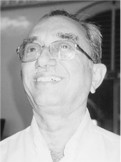
Maneck Engineer’s moment of triumph
Week after week the Jamé had strafed at Tirandaz (and through him at BPP trustee Mehta), refusing to publish his version or, as claimed by his supporters, letters in his favor until well-known social worker Mithoo Jesia noted in her letter to the publication (Oct 6, 2002), "What is, indeed, happening to our community? Why is it that every election brings out the worst in us Parsis? We think of ourselves as an intelligent, elite community. Yet we spare neither words nor efforts to tear to shreds the reputation or character of a candidate.”
Her letter, received earlier, had on the editor’s admission, nudged the Weekly into publishing Tirandaz’s article "Looking back — looking ahead” in its issue of September 29, 2002. An article co-signed by the management and editor of Jam-e-Jamshed titled "Tirandaz or Engineer? The time for reckoning is at hand,” in the issue dated October 20, 2002 had noted, "Engineer has enough experience in construction activities to be a good check and balance and if necessary an able foil to those who try to push through their own convoluted agenda that take the poor of the community for a ride all the time.” The front page editorial of the same issue titled "Did two eminent trustees walk out of BPP?” noted, "We are very surprised to be informed that Dinshaw Mehta has announced at Shapur Baug on October 18, 2002 that (trustees) Minoo Shroff and Dinshaw Tamboly will walk out if fresh blood is not introduced in the BPP.
"Knowing Mehta well, we will not be surprised if this is his way of not only getting Tirandaz re-elected, but also of creating a wave of discomfort for Shroff and Tamboly with the intention of driving them out.”
Though he was the unwitting beneficiary from the Jam-e-Jamshed campaign, an embarrassed Engineer, in a full page advertisement that appeared in the same issue, noted, "I wish to strongly and publicly clarify that I have no connection with the various issues raised against Rustom by Jamé.” Further excitement had been generated when Tirandaz’s three supporting trustees on the BPP board (Silloo Kavarana, Engineer and Mehta), in a panegyric dated October 18, 2002 sent to all Anjuman Committee (AC) members, referred to their man as a "galvanizing force in the BPP” and ascribed several BPP decisions/actions/achievements to him. The fat was in the fire when the other three trustees — Jamshed Guzder, Shroff and Tamboly — issued a letter of their own stating, "We are of the firm belief that as sitting trustees of BPP we should not involve ourselves in the process of campaigning for any candidate during an election. We have therefore not involved ourselves in any manner in the election campaign of any of the candidates...
"By way of abundant caution, we wish to reiterate through this communication that should any letter be released in support of any candidate by any of our colleague trustees, it should not be construed to have emanated from the full board of trustees.”
Election day (Saturday, October 26) arrived and with it the Jam-e-Jamshed Weekly datelined Sunday, October 27 claiming, "Owing to technical reasons we have been compelled to print our issue dated 27/10/2002, today.” It published the above mentioned letter and noted in its front page editorial, "This will also amply prove that the fight is not between Jamé and Tirandaz, as has been made out by Tirandaz’s supporters, but that Tirandaz himself has been the cause of the great divide in the BPP boardroom.”
Hence it was not surprising that in the first three hours of the election 537 votes had been cast. Thereafter the tempo slackened with only 239 more ballots in the box to total 776 (of the total AC strength of approximately 1,390) at the end of the day. Of these 272 were donor votes and 504 from the elected members indicating that Engineer’s low profile had appealed even to the elected members of the AC who were popularly considered to be Tirandaz’s supporters.
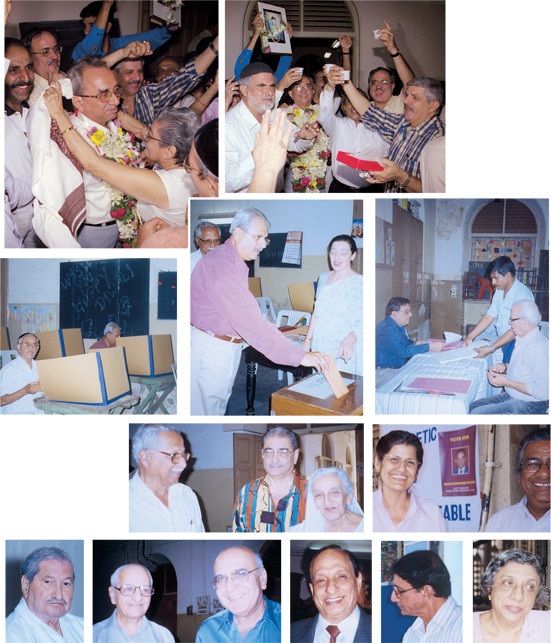
Top: Toasts, flowers and cheers for M. Engineer (left) garlanded by Ratu Dastoor and (right) Tirandaz (ext left) having a final say. Below: Polling booths and box with scrutineer Homai Modi (center) and Minoo Crawford providing duplicate certificates; Clockwise from right: Hormuzdiar, Behram Dastur and Kavarana; Arnavaz Mistry and Mehta; Sheroo Master, Rusi Bhumgara, Engineer, Tamboly, Shroff and Guzder
A civil engineer and architect, Engineer is currently vice president in charge of construction and property management at Godrej and Boyce whose candidature for trusteeship was proposed by the company’s managing director Jam-shyd Godrej and seconded by radiologist and community thespian Dr Jimmy Sidhwa. Rooting for their man were Godrej chairman Adi Godrej and social activist Pheroza Godrej, professionals, industrialists and businessmen like Khushrooh Byramjee, K. N. Suntook, Vice Admiral R. K. S. Ghandhi and a host of doctors including his fellow managing committee members at the Parsi Lying-in Hospital. Engineer, a trustee of the Batliwalla and Mewawalla agiaries not only enjoyed the support of the DDD-AG (Disposal of the Dead with Dignity Action Group), but interestingly, that of Iranshah high priest Dastur Khurshed Dastoor.
Arraigned against him were orthodox stalwarts of the Save Doogerwadi Action Committee and a long list of high priests and mobeds (with the exception of the mobeds serving the two Dadar agiaries as pointed out by Jamé) led by Dasturs Kaikhusroo JamaspAsa and Hormazdyar Mirza who supported Tirandaz in recognition of his high profile role in "saving” Doongerwadi and dakhmenashini from the DDD-AG who wished to use the bunglis for the funerary rites of those opting for other forms of disposal of the body like cremation or burial. Also rooting for Tirandaz were the Borivli and Suburban Zoroastrian Association and the Panthaki Baug Welfare Centre.
The orthodox/progressive stand-off was hardly reflected in the issues raised by the contenders. Engineer’s manifesto, which began with the words "I have a dream,” referred to the usual Zoroastrian themes of preserving the cultural heritage, forging unity in the community, improving the condition of the priests, encouraging entrepreneurship and early marriages, increasing the housing stock and preserving the old buildings by proper maintenance and repair, caring for the aged, infirm and poor. "In the current highly competitive corporate scenario, our youth sorely needs that edge to go the extra mile. Focused educational counseling and assistance to hone intellectual skills at premier institutions of higher learning could do wonders. We need to reinvent ourselves and breathe life into our educational and vocational aid programs. With astronomical real estate prices in (Bombay) we need to accept that our youngsters need affordable, quality housing. As a professional associated with the real estate and construction business I have the confidence to suggest that this is an achievable objective,” notes Engineer’s manifesto.
Tirandaz’s "refurbished and revised program for the community” included the total demographic study of the Zoroastrian community as a precursor for a referendum followed by universal adult franchise, "the setting up of a modern human resource development institute for management, marketing, finance, electronics, computer programing, production engineering et al” which he sees as a "world class minority institute with 50 percent seats reserved for Parsis,” community medical insurance, the transfer of an agiary to Borivli, the setting up of another vernacular/English newspaper and other ideas unsupported by any road-map to reach the vaguely ambitious goals.
With his penchant for public speaking Tirandaz addressed voters at the hustings and itched for a debate with his opponent while the retiring Engineer preferred to meet voters individually or in small groups. Frankly admitting to inferiority in debating skills, Engineer avoided a combined setting except for a meet at the Dadar Athornan Madressa organized by the Young Rathestars on October 13, 2002 with noted insurance executive Maneck Dastur as moderator. Initiating the proceedings Dastur decreed 15 minutes speaking time for each candidate followed by 30 minutes of questions from the floor. Engineer read a prepared speech (ending "on time, in time,” in Dastur’s words) without making any significant addition to his manifesto statements.
Tirandaz began by asking for 15 minutes more (a request which Dastur turned down) and reverted to his pet themes of tokham kyani, the Parsi-Irani ethos ("That ethos I’ve been elected to safeguard”) and universal adult franchise ("The matter is in the High Court. The day it is heard every single person will have the right to vote”). He remonstrated against the Jamé’s tirade against the BPP stating he had "never called Jamé a rag or toilet paper, but today I would not call Jamé a newspaper,” and registered his hope that some other Zoroastrian will come forward to establish a counter publication because "it is the right of the community to hear the other side.” On the issue of medical insurance for the community Tirandaz noted, "I’m a dreamer. I set into motion ideas...”
The sounding of the bell denoted Tirandaz’s time was up but he asked for a few minutes’ grace because he wanted "to publicly acknowledge (that) my wife and kids sacrificed life, property, reputation so that I can serve the community.” He spoke of "the suffering they went through (due to) unearned allegations,” and concluded, "Hope the better man loses.”
The lackluster question time was further marred by power failure. Nonetheless it was significant that when Tirandaz was questioned about the modalities of the community medical insurance scheme that he advocates, he passed the question over to Dastur! When Engineer was asked about the source of funds for the increased housing activity he proposed, he answered that the money could be raised from other trusts or cross financing by way of ownership flats (which the BPP has been doing anyway). In answer to a query Engineer stated that he would not have agreed to the DDD-AG’s request for the use of the Doongerwadi bunglis, but refused to opine on the BPP’s acquisition of the Nirlon property as he hadn’t studied the case. Engineer, who was the supervising architect for much of Godrej Baug, was asked why he had constructed "cubicles” there. According to the Urban Land Ceiling Act (under which the property had been acquired and then released by the government) only flats of 40, 60, or 80 sq meters are permitted, he answered.
Engineer’s reasonable composure and low key responses contrasted sharply with Tirandaz’s hyperbole. As solicitor journalist Berjis Desai, son of the late Minoo Desai, former editor of The Bombay Samachar, aptly summed up in his trenchant analysis of the election ("A first class comedy” in The Bombay Samachar’s ‘Parsi Tari Arsi,’ November 3, 2002), "Tirandaz was perceived by many as not preserving the decorum of the institution. Perhaps, his style, honed by BMC theatrics, did not go down well. May be, a good man has been felled for the wrong reasons. This was not so much Engineer’s victory but Tirandaz’s defeat.”
Even before the president of the election Rustom Hormuzdiar could announce the final tally, Engineer’s supporters had started cheering "Maneck Engineer zindabad (long live Maneck Engineer).” A portrait of Zarathushtra had been kept aloft over his head all the time, perhaps to signify that the victory was thanks to his blessings, perhaps to emphasize Engin-eer’s own religious orthodoxy.
Ere the traditional three cheers for Engineer and his key workers — Kersi Randeria and Yezdi Bhumagara — were sounded and the champagne flowed, Tirandaz had his say: "It was an acrimonious election but all that is over. I hope (that) hatred will be a thing of the past. I am down, but not for long. I will return.” The next election is due on December 14, 2002 and noted solicitor Burjor Antia has already tossed his hat into the ring.
(With inputs from Parinaz M. Gandhi)
Engineer being out of station Parsiana’s interview with him will be featured in January 2003.
◆ ◆ ◆
From the archive