
Events & Personalities
At the Sanjan Stambh
"We must really salute our ancestors for being so brave to preserve our religion, moral values and holy fire,” Keki Daruwalla, member of the National Commission for Minorities, Government of India, said on the occasion of the Sanjan Day celebrations held on November 18, 2011 at the iconic Stambh. About 950 Zoroastrians had come from Bombay, Surat, Navsari and neighboring areas to participate in the celebrations though it was a working day.
The annual function, which marks the supposed landing of the first Zoroastrians in the port town of Gujarat, 170 km from Bombay, commenced with two jashans, one performed by priests from Nargol and the other by those from Iranshah. The prayer hall was packed to capacity as Dastur Khurshed Dastoor of Udvada led the ceremony, along with four priests, as per a write-up sent by Pareecheher Daviervala who compered and managed the day’s program.
Gracing the occasion were a slew of dignitaries including Tushar Amarsingh Choudhary, minister of state for road transport and highways, Kishen Patel, Member of Parliament from Valsad, Dinshaw Mehta, chairman, Bombay Parsi Punchayet (BPP) and member, Maharashtra State Minorities Commission, along with BPP trustees Arnavaz Mistry and Khojeste Mistree, oncologist Dr Marzi Mehta and senior officials from the state, including police and district officials, the write-up mentions.
While commending the Parsis of yore, Daruwalla, a noted poet, writer and member of the Indian Police Service (IPS) who retired as chairman of the Joint Intelligence Committee in 1993, expressed concern about the community no longer riding the crest of success. He was unhappy that today India does not have a single Parsi Indian Administrative Service or Indian Foreign Service officer. In fact, there has been no Parsi IPS official since Daruwalla passed out in 1958. This alarming trend needs serious attention not only from youth, but also from their parents, he noted. Even the Indian Institutes of Technology have very few Parsis on their rolls.
The annual function, which marks the supposed landing of the first Zoroastrians in the port town of Gujarat, 170 km from Bombay, commenced with two jashans, one performed by priests from Nargol and the other by those from Iranshah. The prayer hall was packed to capacity as Dastur Khurshed Dastoor of Udvada led the ceremony, along with four priests, as per a write-up sent by Pareecheher Daviervala who compered and managed the day’s program.
Gracing the occasion were a slew of dignitaries including Tushar Amarsingh Choudhary, minister of state for road transport and highways, Kishen Patel, Member of Parliament from Valsad, Dinshaw Mehta, chairman, Bombay Parsi Punchayet (BPP) and member, Maharashtra State Minorities Commission, along with BPP trustees Arnavaz Mistry and Khojeste Mistree, oncologist Dr Marzi Mehta and senior officials from the state, including police and district officials, the write-up mentions.
While commending the Parsis of yore, Daruwalla, a noted poet, writer and member of the Indian Police Service (IPS) who retired as chairman of the Joint Intelligence Committee in 1993, expressed concern about the community no longer riding the crest of success. He was unhappy that today India does not have a single Parsi Indian Administrative Service or Indian Foreign Service officer. In fact, there has been no Parsi IPS official since Daruwalla passed out in 1958. This alarming trend needs serious attention not only from youth, but also from their parents, he noted. Even the Indian Institutes of Technology have very few Parsis on their rolls.
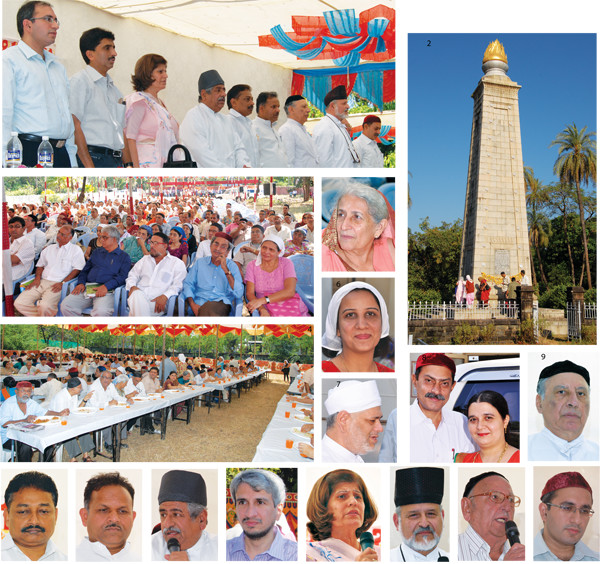
1. Speakers on the stage; 2. the Stambh; 3. audience; 4. at lunch; 5. Bapsy Daviervala; 6. Pareecheher Daviervala; 7. Dastur Khurshed Dastoor; 8. Dara and Tanaz Varvadevala; 9. Keki Daruwalla; bottom row from left: Tushar Choudhary, Kishen Patel, Dinshaw Mehta, Ardshir Daviervala, Arnavaz Mistry, Khojeste Mistree, Dosabhai Oliaji, Dr Merzi Mehta
Daruwalla informed the gathering that he was working closely with the Archaeological Survey of India and the Maharashtra government to help restore the Bahrot Caves and the road leading to them which was in urgent need of repair. He mentioned that he was in touch with the authorities concerned to ensure that the proposed amendments to the Direct Tax Code would not adversely affect Zoroastrian charities. Institutions such as the BPP, which had been in existence prior to 1961, would not be affected, according to him.
Dinshaw Mehta profusely thanked Bapsy Daviervala, president of the Sanjan Memorial Column committee for the enormous efforts she puts in to organize this annual function. Though happy to see the large turnout, he was disheartened that youth comprised barely 10 percent. Where is the community headed? he wondered sadly. Somehow this trend had to be reversed. The root cause of the problem, he maintained, was either late marriages or no marriages. Even when the BPP provides preferential housing for married couples and child support, there is often only one child. This is not enough to stem the declining population. Mehta noted that in Surat the Parsi population had shown a six percent increase based on special measures taken by the Surat Parsi Panchayat and the BPP would try and replicate the formula in Bombay.
Expanding on this theme, Dr Marzi Mehta spoke of the lesson he had learnt during a recent visit to Iran. The Zoroastrians there have a system where they reportedly expect every married couple to produce three to six children for whom support is extended by the immediate and extended family. With housing, employment and financial requirements taken care of, young couples are enabled to increase their families without worries. The oncologist also expressed his concern at the spread of cancer and spoke of his efforts to raise consciousness in the community by holding camps, the write-up mentions.
Choudhary and Patel lauded the achievements of the community and its contribution to the nation in the fields of education, business, charity and care of the downtrodden and hoped that the future generation would continue this trend. Arnavaz Mistry said ours is a jovial community that believes in solving all issues amicably, though of late there have been some differences. She also reminded those present that Dr Jivanji Modi had contributed to the building of the Sanjan Memorial Column in 1920 and the monument had been inaugurated by Sir Jamsetjee Jejeebhoy on December 15 of that year. Referring to the dwindling numbers in the community, Khojeste Mistree felt that our mindset needs to change towards large families as in the past. Issues like lack of adequate housing and finance cited by Parsis also apply to other communities who do not lack in numbers. We must marry early and ensure that there are a sufficient number of children per family, he exhorted.
Dara Varvadevala thanked all those who had contributed to the success of the function, including the Western Railway authorities for permitting special halts at Sanjan for the Gujarat Express and Flying Ranee trains, Paris Bakery and Agni Bakery for the rose falooda, Avan (Feroze Foods) for the cold drinks, the local administration, police and officials, teachers, volunteers and donors who assist significantly in defraying the costs of the function. And, of course Manek Tadiwala’s MEK Caterers of Udvada, for his excellent lunch, the write-up concludes.
◆ ◆ ◆
From the archive