
Comment
Dialog against discrimination
Zoroastrian problems need to be aired in Iran’s national parliament and other legal fora for the benefit of the minorities, opines the author Zoroastrian problems need to be aired in Iran’s national parliament and other legal fora for the benefit of the minorities, opines the author
In January 2002, Mohamad Reza Aref, the first Vice President to President Hojatollslam Khatami, issued a circular to all ministries, government organizations and institutions, the Islamic foundations, and governor-generals’ offices in the provinces throughout the country to apply their utmost care and supervision to ensure the rights of religious minorities (Zarathushtis, Christians and Jews) in all areas including employment and engagement in various professions (quoting from Persian newspapers).
In February 2002 the judicial authorities drafted an amendment to article 30 of the Islamic Criminal Code, thereby extending the blood money (dieh), payable to the Muslim victims of homicide, manslaughter and other bodily harm, to the victims of the same crimes if they be members of the recognized religious minorities. This of course requires ratification from the religious leader of the country (quoting from Persian newspapers).
In November 2001 during President Khatami’s visit to the US, to address the United Nations (UN) assembly on cultural dialog, a small number of Iranian immigrants were again invited to meet with him. My wife and I, this time also another Zarathushti Allahyar Dabestani, were among them. That occasion gave me a third opportunity to raise the issue of discriminatory treatment of the religious minorities in Iran with the President.
As in previous meetings, I was overwhelmed by the President’s humility, humane behavior towards all invitees, sincerity and frankness in his words and magnanimity towards me.
The time allocated to each speaker was limited yet he gave me as much of his time as I needed. I reminded him of the two questions I had raised in our first two meetings in 1998 (recorded in Humata, Winter 1998-99) and in 2000. I mentioned that according to his recommendation the two issues were subsequently raised by two successive Zarathushti representatives in the Majlis (Parliament) — Parviz Ravani and Dr Khosrow Dabestani.
However, no attention was paid to those complaints. While that was by itself regrettable, a most serious incident occurred recently. A Zarathushti man embraced Islam and after his parents’ demise, tried to deprive his siblings from inheriting their share of their deceased parents’ assets. His siblings took the matter to court. The converted person sought the view of the religious leader of Iran who edicted that ‘with a Muslim heir, kafers (infidels) do not inherit.’ Thus, not only have our complaints not been heeded, but to add insult to injury we are now degraded to the rank of kafer (recorded in Humata, Fall 2001).
I drew the President’s attention to the fact that religious minorities suffer discrimination in the job market in securing government jobs. This complaint was voiced by the Christian representative in the Majlis a few months earlier. I recapitulated that 51 years ago, in 1952, the Police Academy had excluded non-Muslims. The Tehran Zoroastrian Anjuman wrote a letter to Ayatollah Kashani who in turn wrote a letter to the President of the Academy admonishing him for including a reference to religion in the application forms. Ayatollah Kashani also emphasized that Zarathushtis are the natives of Iran; they are patriotic and honest — and there was no justification for excluding them from the police force. The Academy removed that condition from the eligibility requirements. After 30 years, in the Islamic Republic of Iran Zarathushtis and other religious minorities are regretfully being banned from entering the military and police academies as well as the civil service in many ministries. This is a backward and suppressive move.
President Khatami regretted that the request by Zarathushti representatives in the Majlis has remained unheeded. He asserted that there is no reason for any discrimination against Zarathushtis. He philosophically added: "By calling you kafer, you will not become kafer!” We know that in Iran many great philosophers and scholars like Avicina, Hallaj and others had been called kafer. Avicina, in reply to all such accusations composed a poem, the purport of which was that with his righteousness and observance of Islamic rules, accusation of infidelity is hard to stick; that if in those circumstances he be a kafer there would be no Muslim in the world! Then addressing me (by which I am sure he meant all Zarathushtis) Khatami said Zarathushtis should not take such insulting statements to heart.
I felt that this time Khatami himself was certain to take action to redress the situation. The two pieces of news mentioned at the top of this article, I am certain have been issued under his direction after the November 2001 meeting.
For a minuscule religious community like the Zarathushti community in Iran the most effective policy for removal of discrimination and inequality is ‘constructive engagement.’ This was the policy adopted by Maneckji Limji Hataria when the Zarathushti community in Iran was being suppressed in all avenues of life. That policy was followed by our late leaders Arbab Jamshid, Arbab Keikhosrow and Ardeshirji in a less oppressive era that followed. Similarly it was pursued by successive community leaders during the more religiously tolerant years. Indeed the same should now be our policy under the theocratic Islamic government.
Fear to voice grievances simply perpetuates discrimination while reacting emotionally endangers the community’s survival. Those who avoid ‘constructive engagement’ lack experience. As Zarathushtis, we have a duty to our community and a responsibility for the preservation of our religion and culture. We must be active and exercise our discretion wisely. I am proud that the community in Iran has reached the necessary awareness and maturity to act accordingly.
Let me end this article by another promising piece of news which demonstrates that the right action at the right time yields results. I trust such actions will continue through appropriate constitutional avenues.
On January 7, 2002 Khosrow Dabestani thanked the president of the judiciary for having placed the question of dieh of religious minorities on the agenda. He also expressed hope that a certain number of slots in the hiring of teachers by the ministry of education will be allocated to Zarathushti applicants. This is a good start.
Dr Dabestani should pursue the matter and extend it to employment in general, including the ministries, the public sector and all government agencies and request the revision of Article 810 of the civil code concerning inheritance. I was glad that in his speech Dabestani mentioned Cyrus the Great of Iran, the author of human rights, and also referred to the UN Charter of Human Rights of December 1948 as well as to the principles 13, 14 and 19 of the Constitution of the Islamic Republic of Iran. A1l our demands should be based on the domestic law and the international conventions and practices of civilized nations. As Khatami says, the minorities must voice their grievances through legal channels and the government has a duty to investigate and change the laws to achieve justice in compliance with international practices for all Iranian nationals, irrespective of the religion they choose to espouse.
This article has been reprinted from Humata, Spring and Summer 2002.
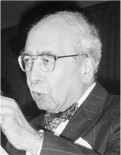
Scholar, author and activist Farhang Mehr was Iran’s former deputy prime minister who left the country during the Islamic revolution. A professor emeritus of Boston University, Mehr is presently editor of Humata, the journal of the Center for Ancient Iranian Studies.
◆ ◆ ◆
From the archive