
Cover Story
The inspector’s integrity
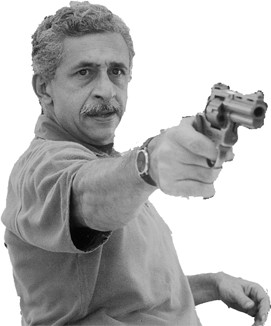
As the honest policeman, Inspector Bharucha, Naseeruddin Shah wins over the audience in the film ENCOUNTER the killing
"They have character and they are characters,” declares veteran cinestar Naseeruddin Shah to convey his respect and admiration for members of the Parsi community. It was not difficult therefore for him to project the Parsi traits in his recent role as Inspector Sam Bharucha in the Hindi film ENCOUNTER the killing which was released in Bombay on August 9, 2002. Over the weeks it has been screened in cinema houses throughout Maharashtra and Madras, and was due for release in Delhi in early October.
As an upright police inspector he feels responsible for the death of the young contract killer Lalya (enacted by Rahul Mehendle) in a police encounter, the first time someone has succumbed to his bullet during his career as a policeman. With no one coming forward to claim the body, Bharucha takes it upon himself to identify the villain’s family. And as he pursues his mission, surface the inspector’s qualities of punctuality, determination, fair play, courage and humaneness. Above all is his honesty to confront the misdemeanor, whether perpetrated by an unknown outsider or a member of his own family. "Hum Parsio ké liyé imaan aur jameer jaan sé badhkar hai (We Parsis value integrity more than our lives),” he announces to his detractors.
The film depicts the common stereotypes levelled against the police: "Yeh log apné baap ko bhi criminal hi samajté hai (the police think even their own fathers are goons);” "Méré dévtaa jaisé bachhé ko maar daalaa een policewaloné (my god-like son was killed by these policemen).” The refusal of most parents to admit that their children are being led astray was reinforced in ENCOUNTER. It also showed how children from stable middle class families can be drawn to criminal acts without any ostensible cause but the lure of power and pelf. And once drawn in the vicious circle it is almost impossible to extricate oneself despite the best of intentions.
That criminals lack a sound emotional and moral base to support them was known to Bharucha but what comes as a rude shock is his own son Jimmy’s (played by Amit Samgiskar) frivolous ways. Taking control of the situation he sternly reprimands Jimmy while wife Shirin (played by Roshan Tirandaz) tries to placate him. The mothers in the Parsi community are known to indulge their sons and grant them concessions...But Bharucha as the strict father can neither condone Jimmy’s lapses nor his own. "Maaraa ghér maa bhai paidaa thaieech né hoo laash paachhal doruch (my house is harboring a potential gangster and I am running after a corpse)!” he admits to himself later.
On another occasion he refers to Jimmy as "nafat nagaaro (shameless creature).” Such Parsi Gujarati phrases woven into the Hindi script makes the viewing a pleasure for Parsi audiences. But whether the non-Parsi crowds can relate to such idioms is not known. Relaxing in the comfort of his home in a sudreh-lenga while a buoyant Shirin exults looking at a television program where her husband has been interviewed, they get calls from colony neighbors ensuring that the Bharuchas do not miss the program. An ambitious Shirin impresses on her husband that his discipline and hard work is being wasted in the police force. Had he joined the armed forces he could have risen to be another Sam Manekshaw! The son though does not share the same enthusiasm for the TV program saying the regular lecture he gets everyday at home is now being given to TV audiences!
The relationship between the police and the Press can be nurtured to awaken public consciousness or to sow seeds of distrust. That a pesky press reporter (played by Tara Deshpande) is convinced to collaborate with the police instead of competing with them is due to Bharucha’s adroit public relations. She comes to the inspector’s aid by introducing him to a judge of the High Court, also a Parsi, who grants him an extension of time to dispose the corpse, not as a favor to a fellow Parsi but in appreciation of Bharucha’s good work as a police inspector, the judge makes it a point to clarify.
"Parsis are the only community that have a sense of doing what is right and abiding by it...Also they are the only community who still have a sense of civic consciousness,” Shah was quoted in a publication. In response to Parsiana’s queries on the e-mail, Shah asserted: "The Parsis are a people I admire greatly and it’s always an honor and a delight to portray one...Their habits of punctuality, scrupulousness, ethics, courtesy, consideration for the others, make them an anachronism in this day and age and therefore easy to ridicule. But their ability to work hard and be creative, as well as (their) business instincts make them a race worthy of admiration and emulation. What would (Bombay) have been without the Parsis? And of course, they are fun-loving, full of boisterousness and laughter, and also compassion and tenderness...
"Parsis are such an interesting people that they lend themselves to caricature easily and their behavior is so broad that it’s easy to make fun of,” comments Shah, disappointed that most often it is a caricature of a Parsi that one gets to see in Hindi movies. Another Hindi film which was a departure from the norms was Pestonjee, directed by Vijaya Mehta, where Shah had given a memorable performance as Pirojsha, the lead actor. "I find it flattering when I’m taken to be a Parsi in real life and addressed as ‘Nazru Dinshaw’ (by shifting the last syllable from his first name Naseeruddin to serve as the prefix for his surname Shah).” Looking forward to playing the role of a Parsi in future too Shah adds, "When I work, I consider it my responsibility to portray a character I’m playing objectively and truthfully, without falling into populist traps. Portraying a Parsi is not without its traps and I greatly enjoy it, more so because physically I can pass off as one without too much effort. I, in fact, suspect there’s a racial mix somewhere. Some of the ancient Zoroastrians must have come here by land by way of Central Asia, and some of them maybe remained behind en route. My ancestors came from Central Asia too!”

Top (from left): N. Shah with Tirandaz, Avtar Gill and Phansekar Alongside: Producer Jairaj Patil; Scenes from the film: Middle row: Samgiskar (left) and N. Shah, and a dance sequence Bottom row: N. Shah (left), and R. Shah studying the face of Mehendle
Viewing Shah as "one of the finest performers on this soil,” the writer and director of the film Ajay Phansekar mentioned that his real-life persona almost matches Bharucha’s image. "Very loyal to his work, disciplined, Naseeruddin accepted the role immediately,” says Phansekar. The comic caricature of Parsis on the screen is very common, remarks Phansekar who attempted for the first time to project the community in a different light. After two award winning films in Marathi, this is Phansekar’s first Hindi film. "I believe Parsis are very loyal, imandar (honest). That is why I wanted a Parsi police inspector.” His contacts with Parsis and Shah’s prior experience working for Pestonjee helped to project a realistic ambience of the community.
Veteran stage and TV actress Tirandaz who plays the role of Bharucha’s wife, lent credibility to the film too. Giving her credit for being "a fabulous performer,” Phansekar added that she was "powerful, considering that she had to face the camera with an actor like Naseeruddin.”
Tirandaz though had no qualms playing the role of Shah’s wife while his real wife Ratna Pathak Shah as the young criminal Lalya’s mother convincingly depicts the emotional trauma of a well- educated, middle-class mother who is unable to confront reality. Shooting with Naseeruddin Shah for the first time, Tirandaz found him "very accommodating, very conversational; a very good co-actor. As a Parsi he was too good.”
The director and the stars had done their homework well, observed Tirandaz. Having selected the Dadar residence of Aspi and Katy Bharucha as the home scenario for the inspector, the setting was very authentic. She had just offered minor suggestions like the positioning of the diva and the portrait of Zarathushtra within a particular frame or the use of Gujarati expressions as spoken by Parsis. With her considerable experience in Hindi films where she plays the part of Salman Khan’s secretary in Chori Chori Chupke Chupke, or Amisha Patel’s landlady in Humraaz...or enacts other roles in Lawaris and Betaabi, actually Tirandaz’s Hindi was found too shuddh (pure) for the Parsi ambience required in ENCOUNTER. She then chose to incorporate phrases like "Jauni, jauni (see) Sam” or "arré nahi ré (definitely not),” and was happy that the director did not mind her adding words to the script.
Busy with her home production Not Now, Sweetheart which has been staged five times in Poona and three times in Bombay, Tirandaz states that she has no public relations officer. Whatever roles she has got, even for teleserials like Koi Apna Sa and Kalerein are through word-of-mouth recommendations. "We have never had any difficulty with any producer of films anywhere,” she states. "We only ask for the basics.” Was shooting for ENCOUNTER any different from her earlier experiences? "Yes,” she responds, "the locales being so close to my house, I had to leave my place only five minutes prior to the scheduled time!”
For the audiences too this film had a different treat — although there were the song-and-dance sequences and violence that one expects from a Hindi film, there was not a single romantic scene. And after seeing the film once, you may not be tempted to view it again. The message was driven home effectively the first time — evil has to be overcome, not by shying away from it but by honestly encountering it.
◆ ◆ ◆
From the archive