
ART
The Spark reignites
Concerted efforts by the city’s art lovers resulted in the late sculptor Pilloo Pochkhanawala’s creation Spark once again gracing Bombay’s landscape
"Restraint and release is the life force of all art. Spark, which appears spontaneous to you, is ironically the one that has been planned to a very high degree because the material had very little possibility of a dialog.” Noted sculptress Pilloo Pochkhanawala had made this revelation during her lifetime, much before her 30-foot high metal sculpture Spark disappeared from the city streets in 1992 and reappeared in its new avatar 10 years later.
Originally commissioned for the BEST (Bombay Electric Supply and Transport) Undertaking in 1970, Spark graced the traffic island at Haji Ali for over 20 years. As reported in the Afternoon Despatch and Courier of February 16, 2002, "She conceived this majestic symbol to typify a ‘spark’ of electricity. Pochkhanawala spent many hours perched on a ladder at the site welding the steel sculpture together. And thus Spark was created — symbolizing a confrontation of manmade metal forged into a symbol of energy with nature and open space.” With the removal of the traffic island in 1992 the sculpture was probably sold as scrap or crumbled since it had already rusted in the saline sea breeze. This was probably Bombay’s largest and first modern street sculpture, observes Pochkhanawala’s nephew Dr Behman Davar. With the efforts of Pochkhanawala’s family, the Hongkong and Shanghai Banking Corporation Limited (HSBC) and some of Bombay’s art lovers, a scaled-down replica of Spark, four feet wide and 12 feet high, was created.
Saryu Doshi, director of the National Gallery of Modern Art (NGMA) explained that they initially thought of placing the sculpture inside the NGMA, but since the "high railing would not give the sculpture the prominence it deserves,” it was placed in the traffic island opposite the NGMA. On February 16, 2002, at a function held at the David Sassoon Library Garden, Doshi and HSBC chief executive officer Zarir Cama unveiled the sculpture. With the Kala Ghoda Festival and the Picasso exhibition simultaneously running in the vicinity, it was considered perfect timing.
"Though all the traces of the original sculpture were lost, Pochkhanawala’s family were in possession of Spark’s maquette (a preliminary model in wax or clay), mentions Davar. Using the maquette as a paradigm and under the guidance of Pheroza Godrej of Cymroza Art Gallery, Babulal and Rasik Panchal welded the new sculpture together at their workshop at Ghatkopar. Godrej mentions that it was a "real pleasure” working on the project especially since it was Pochkhanawala’s work they were recreating. Pochkhanawala’s valuable suggestions had helped her when the Gallery was in its nascent stages, she acknowledges. "Art work should never reach the stage when it needs to be restored,” says Godrej, adding "unfortunately there aren’t many sculpture restorers in the city.” Some of Pochkhanawala’s aluminium and stone works are displayed at the Godrej Bhavan, she says.
HSBC was "happy to participate in this project since environment and education are the two principal areas the bank supports,” conveyed Malini Thadani, manager, public affairs at HSBC. She mentioned that HSBC maintains almost all the traffic islands around the Regal cinema including the one in which Spark stands. "It seemed like a splendid gift to give back to Bombay,” declared Cama mentioning that aside from Spark the other projects HSBC was sponsoring included the sprucing up of the David Sassoon Library and the Elphinstone College in Bombay, both in the historic Kala Ghoda precinct. A copy of the original maquette, gifted to the bank by Pochkhanawala’s family, is on display at their office at Flora Fountain.
Art critic Nikky Ty-Tomkins Seth described Spark as "a dynamic explosion of steel rods which radiate outwards and upwards...a shower of electrical impulses made visible by the artist. It is in Spark that Pochkhanawala’s increasing concern with the interplay of form and space within a preset environment becomes evident. Originally conceived for the Haji Ali Circle at a time when trees and open space still held sway over the area Spark forced a startling visual confrontation.”
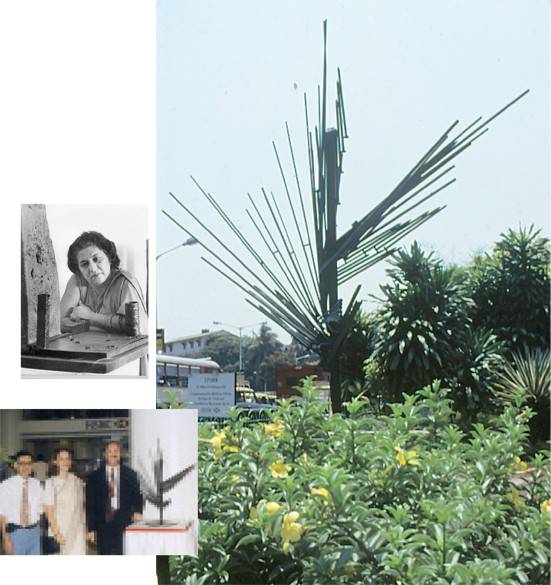
Below: Pochkhanawala; Bottom (from left) Davar, Godrej and Cama with Spark maquette. Alongside: Spark replica on traffic island between the National Gallery of Modern Art and the Prince of Wales Museum Photo: Varghese Fernandez
Creating a sculpture in blocks never appealed to Pochkhanawala. "I always follow the feel of the rhythm...a certain rhythm that gathers a cyclic energy is my way of expression,” she had explained. In an interview with Bombay magazine in 1986 (the year in which she died), she noted, "All my sculptures have met with a bad fate — the one at Haji Ali (Spark) has clothes drying on it, while my sculpture at Doordarshan and CEAT too (both presently standing at Worli) have not been maintained properly.”
Born in 1923 in Bombay, the self-taught sculptor had spent her early childhood in Zanzibar. In 1951 she went to Europe on a commercial assignment. Then in the advertising field, she had no thought of becoming a sculptor. But while visiting the museums in Europe she was left "mortified by the sculptures” and was "seized by the fear of the challenge of tackling something so difficult.” Inspired by the work of leading sculptor Henry Moore, Pochkhanawala was guided in her first explorations by senior sculptor Pansare who let her experiment with whatever material caught her fancy, states S. V. Vasudev in an introduction to a book titled Pilloo Pochkhanawala, published by the Lalit Kala Akademi, New Delhi.
Tracing the stages of development in Pochkhanawala’s artistic career, the period 1958-64 was marked by sculptures like Erosion and Time Destroys, reflective of the trying situations she faced in her own life. The depression gave way to hope, confidence and courage — Spark and Ascent were works of this period. Sculptures like Embryo and Unfolding, as the titles suggest, "seek the final adoration of art in an attitude of prayer and penance,” writes Vasudev. In the ’80s sculpting to her was an act of meditation since between the idea and the realization there is always a gap which the artist has to keep on filling. With 10 solo exhibitions to her credit, until 1982 her works had been displayed at 19 other exhibitions in India and abroad.
Over a span of 32 years, Pochkhanawala’s sculptures embraced a wide range of techniques and material — wood and stone, cement and steel, dripped lead and terracota, aluminium alloy and bronze, copper and ceramic.
"I think of people not as the masses and the elite, but as those who are responsive or unresponsive to art,” noted Pochkhanawala. "Their social, educational or financial background is of little consequence and has no bearing on their understanding of aesthetics.”
◆ ◆ ◆
From the archive