
Cover Story
A symbol in steel
The soaring inspiration of Mahatma Gandhi’s spinning wheel has been enshrined at Bombay’s Cross Maidan Garden
At the flick of a switch R. K. Krishna Kumar, director, Tata Sons Limited, unveiled The Charkha, Bombay’s newest edifice, in a bath of colored lights at the Cross Maidan Garden. Inspired by the spinning wheel that Mohandas Karam-chand Gandhi used as an emblem of economic freedom and dignity to galvanize a nation’s fight against colonial rule, the monument was dedicated to the country on the 142nd birth anniversary of the Father of the Nation, October 2, 2011. It also led to much soul searching among the speakers and the audience about the millions of Indians who still remain shackled to abysmal poverty 65 years after independence despite the billionaires the country has spawned in the past decade.
Born of the design competition "Notions of India,” launched by the Indian Architect and Builder, the Jasubhai Foundation and Tata Steel in 2007 to create a "powerful and expressive symbol for India,” as noted Jasubhai Shah, chairman of the Foundation, The Charkha is the brainchild of architect Nuru Karim. Krishna Kumar described it as "spectacularly beautiful… an iconic reminder of a previous era,” while Karim spoke of his effort as a "tribute to the freedom fighters and the diversity of the methods adopted by them.”
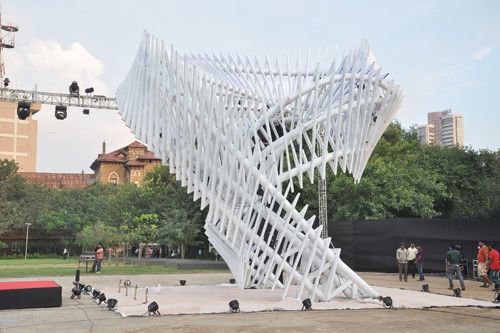
A complex assembly of steel pipes, ingeniously erected by the Sewri Engineering and Construction Company Private Limited, the structure was also meant to reflect the "reservoir of philosophies embedded in the country” welded together by the force of Gandhian discipline and "concept of self-sustaining ecologies,” noted the architect, adding, "The animated spinning wheel generates livelihood, there’s self-respect, dignity, an aspect of humanism…”
Quoting excerpts from Pandit Jawaharlal Nehru’s "India awakes to freedom…” speech on the midnight of 14th/15th August 1947 and its promise of development, Tata Steel’s Rajiv Mangal, executive-in-charge, Tubes Division of Tata Steel spoke of contemporary India’s rising influence in the world and their invitation to the architects and engineers of the country to hold a vision consistent with it. Four regional juries evaluated the 125 entries to crown Karim’s conception from the Ashok Chakra to the Gandhian charkha as one that captured the dynamism of the past and projected it into the future, he noted.
The Cross Maidan Garden was opened to the citizens of Bombay on June 28, 2010. This southern half of the Cross Maidan had deteriorated into an evil-smelling, encroached upon, municipal dump when the Government of Maharashtra by a resolution called upon the Organisation for Verdant Ambience and Land (OVAL) Trust to restore it into the garden it was always meant to be in Government’s own plans. The first call came hard upon their determined and successful renovation of the 22 acre Grade I Heritage maidan, the Oval which had similarly declined. Accepting the assignment the redoubtable members of the OVAL Trust, led by Shirin Bharucha and Nayana Kathpalia ("women of steel” as Karim described them), labored long and hard to ensure the success of their mission in the face of bureaucratic delays, encroachments and numerous other difficulties. (see "Another garden for Bombay,” Parsiana, September 7, 2010). The Charkha, at the time waiting to be assembled, was planned as the centerpiece of the garden.
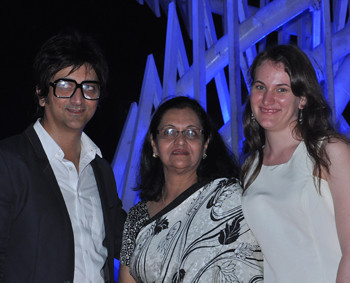
Nuru Karim with mother Shehnaz and wife Andrea
"The sea change has been made possible by the Tata Goup of Companies and the Tata Trusts with no quid pro quo,” Bharucha informed the audience. More importantly, even the "money for maintenance has been donated by Tata,” she noted, appreciating the support of chairman Ratan Tata and the advice and guidance of Krishna Kumar. The garden remains incomplete until the work on the water tunnel at its northern end, part of the MCGM project to shore up supply to South Bombay, ends next year, said Bharucha.
A greater bugbear is the line of unlicensed hawkers who have illegally set up shop in a recreation ground on the southern side of the Garden and a derelict toilet block on its southeast corner. Their removal is awaiting the orders of the Supreme Court and the Bombay High Court, respectively, she added. "Public spaces should showcase art, not just the politics of the moment,” said Bharucha appreciating the "imaginative, evocative” sculpture even as she praised Sushil Singh director of Sewri Engineering for taking on "the artistic challenge of Nuru’s dream, where several others had refused.” Bharucha later shared with Parsiana that Singh had worked "really hard to create The Charkha in his workshop and then setting it up at the site where the work was done night and day to meet the inauguration deadline.”
"If (artists) Picasso or Husain looked at something, they created their interpretation of it,” noted Shah in praise of Karim’s "innovative idea and fabulous design.” Adding a shade of reminiscence Shah said, "The charkha was symbolic of the Independence struggle. I grew up in a small town in Gujarat. The charkha was then part of every household. A historic metaphor has been resurrected.”
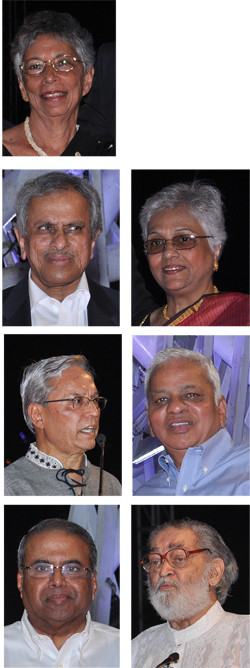
Anti-clockwise from top left: Shirin Bharucha, R. K. Krishna Kumar, Jasubhai Shah, H. M. Nerurkar, Gerson D’Cunha, Tata Steel deputy chaiman B. Muthuraman and Nayana Kathpalia
Admitting that his design presented a "most complex engineering project,” Karim was delighted at the "aesthetic tension” that his work created in an area abounding in "beautiful heritage structures.” Referring to the "terrific” vibes and energy that the project of setting up the sculpture created, Karim was all praise for the Sewri Engineering team that gave his vision a form and "rock stars Shirin and Nayana” who were always present to deal with the minutest details of the event.
"Every October 2nd we hear a lot of talk about Gandhi’s ideals,” began venerable thespian and adman Gerson D’Cunha. "But we need reminders; we are forgetful,” he added, approving the location of The Charkha on a spot where "five lakh people pass in the city between Churchgate and VT every working day.” The monument is 30 times the original size of the spinning wheel, its wood toughened into a material of today, he noted, hazarding the difference between the original symbol and the artistic recreation.
"Tata Steel has shown that steel can fashion the imagination of an architect” and give his vision permanence, continued D’Cunha. "The OVAL Trust was entrusted with the makeover of the Cross Maidan Garden. Now it has been made the custodian of the public structure…”
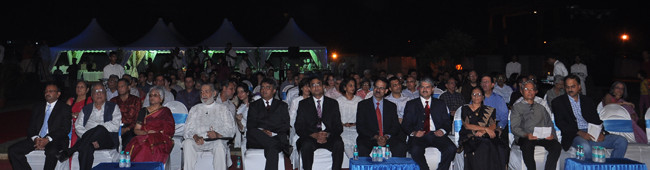
A select audience admiring The Charkha
In reflective mode D’Cunha noted, "Once, what Gandhiji thought, India did. Now other hands have seized the staff, (people with) narrow interests. In the midst of darkness he (Gandhi) saw the light. He asked, ‘When will we learn to rebel against ourselves?’ (We need to) commit ourselves to those principles.”
In his vote of thanks Tata Steel managing director H. M. Nerurkar compared Gandhi’s philosophy with that of Jamsetji Tata: "be the change you want to see.” He spoke of the Tatas’ "unique corporate structure of caring beyond self, upholding the interest of the country beyond all else. It’s in the DNA of Tata Steel. We always work for the benefit of the communities we serve. Profits, market dynamics will change, but values remain timeless (like the) charka. Our values are deep rooted in India,” he noted holding up as an example "the role of Shirin and Nayana in creating this verdant paradise.”
The Gandhian charkha was meant to symbolize the need for economic freedom along with political freedom as one without the other is meaningless, said Krishna Kumar, dwelling on the similarity of ideas between Gandhi and Jamsetji Tata. "Sixty-five years have passed but India is not fully independent, not free of ideologies and vested interests,” he ruefully observed. Citing the "deterioration in values and public conduct,” he spoke of the "progressive descent into a new dark age. The corrosive difference between the wealthy and the poor has become toxic. The central theme has become the celebration of wealth.” Acknowledging that urban India had moved forward to some extent, he was pained with the extent of rural poverty: "Gandhiji’s teachings have not been used to liberate that part of our country. A happy, free India is not part of the truth; there is no sunny upland for our people…
"Privileged to be a part of the Tata Trusts,” Krishna Kumar said they watched the struggle of the have-nots with dismay. "What can each one of us do to generate the reality Gandhi spoke of?” he asked and acknowledged that there is a "new surge of energy and dedication among young people. Some are shunning corporate jobs to work in rural areas… There is a new movement sweeping the world” seeking the redistribution of wealth, making the powerful accountable. "Sometimes I despair that the lights of our founding fathers are being put out one by one. But a new dawn is waiting to arise. Let us stand in support of the next generation seeking to uphold Gandhi’s dream.”
The event that had begun with a rendition of the Tata Steel anthem ended on the sonorous sounds of Jana Gana Mana before the audience broke rank to chat, discuss and sample the fine fare laid out for them by Fountain Caterers in a specially created pavilion.
◆ ◆ ◆
From the archive