
Events & Personalities
Conservation concerns
"Ninety-five percent of the trees planted worldwide die,” said Martin Palmer, secretary-general, Alliance of Religions and Conservation (ARC), an ecological movement set up under the patronage of Prince Philip, the Duke of Edinburgh, and the support of the World Wide Fund for Nature. Palmer was talking to core group members of ARC’s Zoroastrian chapter, the Zoroastrian Alliance for Religion and Conservation (ZARC) at Godrej Bhavan in Bombay last December. ARC examines the synergy between the environment and religion and how each could assist the other. Palmer made this observation about the trees in response to the efforts made by the house of Godrej to distribute saplings to the public for planting.
Convener Pheroza Godrej observed that they had selectively distributed 64,000 saplings only to those people they believed would ensure the survival of the trees. Another 23,000 saplings have been kept in the Godrej nursery at Vikhroli rather than be distributed to people who may not oversee their survival. Palmer lauded the efforts stating, "It’s not about numbers, it’s about survival.”
Another participant in the meet, scholar-teacher Khojeste Mistree noted that 2,200 trees have been planted at Doongerwadi over a 16-month period, thanks to the efforts of the Bombay Parsi Punchayet (BPP) and the house of Godrej. "The forest around the dakhmas is the best place we have anywhere in Bombay,” said Mistree. He noted that certain species of ants and butterflies that had disappeared from the Western Ghats were found at Doongerwadi. In an effort to preserve water, drip irrigation was being introduced at Doongerwadi. He termed the greening of Doon-gerwadi "a success story so far.” BPP trustee Silloo Kavarana mentioned the efforts of the Doongerwadi committee to beautify the grounds. Mistree and his wife Firoza spoke of efforts to plant bawal trees on community lands in Palghar, Talasari, Ahmedabad and Dahanu.
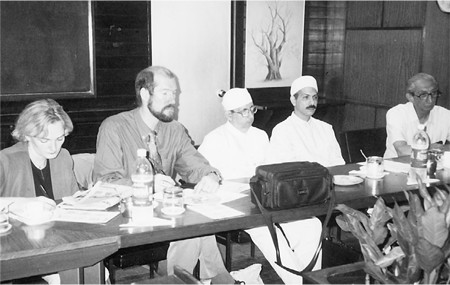
From left: Victoria Finlay, Palmer, Peer, Karanjia and Illava
Phiroze Illava of Mhow spoke of work undertaken by the Lions Club and other organizations to conserve water and related some of the ancient customs of storing rain water in manmade storage tanks. At a personal level he noted that he had a bucket bath once every two days instead of a shower to conserve water.
While lauding his intentions Mistree pointed out that what Illava was doing was doctrinally wrong as a Zoroastrian is supposed to have a bath every day in order to cleanse himself. Illava said he would opt for the daily bath using a quarter bucket of water instead of half. He also noted that in his toilet flush tank he kept an upright empty bottle of beer and another smaller bottle so that when the flush was pulled, one less liter of water would be washed away, the water being conserved in the bottles. Illava also mentioned that he had heard of a village where, the water being scarce, people had baths on a three-tier level. The person at the top bathed with fresh water which then flowed down to the person at the second level and finally trickled down to the third person who was at the lowest level. Thus three people bathed with water meant for one person. The persons kept alternating their positions so every third day each person availed of a fresh water bath.
Palmer spoke about people’s relationship with water, noting that scientists and technologists admitted that while they knew how to manage water they had lost the "relationship” with water, "its preciousness.” In traditional societies people viewed water as more than just a commodity. "Old traditions for conserving water can be preserved,” he said. Among Zoroastrians each fire-temple has a well/s whose water is used for ritual purposes. But as Ervad (Dr) Rooyintan Peer of the Dadyseth Agiary and Ervad (Dr) Ramiyar Karanjia, principal of the Dadar Athornan Boarding Madressa pointed out, some of the wells in the agiary precincts were polluted due to seepage. The gathering also noted that in order to raise revenue, agiaries had permitted contractors to pump water from the wells for sale. This was depleting the water table and by it the water supply and also affecting the sanctity of the premises.
Palmer described ARC as "a small group with big supporters.” He noted that after governments and multinational corporations, religious organizations were the third largest fund owners in the world. Palmer suggested that just as Parsis observe the sanctity of the water on Avan mah, Avan roz so also the birthday of the trees, Amardad mah, Amardad roz, could be observed, and involvement of other faith groups in this celebration was also recommended.
Lawyer and community social worker Keti Mehta noted that when efforts were first made to popularize the Avan roz nu parav (the day and month which are similarly named and coincide once a year) at a public function held at Bombay’s Radio Club adjunct to the sea, the response was poor but in due time the number of participants has increased to almost 2,000.
On the agenda for the same day were meetings by some ZARC members with representatives of the World Wide Fund for Nature, Bombay Natural History Society and Friends of the Trees, in order to involve such non-governmental organizations and create a network of conservation workers beyond the Zoroastrian community.
◆ ◆ ◆
From the archive