
Trusts
Preserving the Pavilion
The heritage structure of the Large Pavilion at Doongerwadi has been restored by the Pardiwala family
The sun’s rays glinted off the warm yellow exterior of the newly renovated Jamshetji Rustumjee Sethna Mandap, also known as the Large Pavilion at Doongerwadi where non-Parsis paying respect to their departed Parsi friends and relatives are seated. Built in 1938, the restored structure was inaugurated on the morning of November 16, 2023 at a well-attended function hosted by the Bombay Parsi Punchayet (BPP) to felicitate the donors, siblings Cyrus, Drs Dinshaw and Rashneh Pardiwala, who took on the project in honor of their parents Dr Roda and Noshir. A plaque commemorating the endeavor was unveiled by family patriarch Noshir. It was Roda’s birth anniversary; she had passed away a few weeks earlier. Her portrait, flanked by an exquisite white floral arrangement, was placed below the plaque acknowledging the family’s contribution.
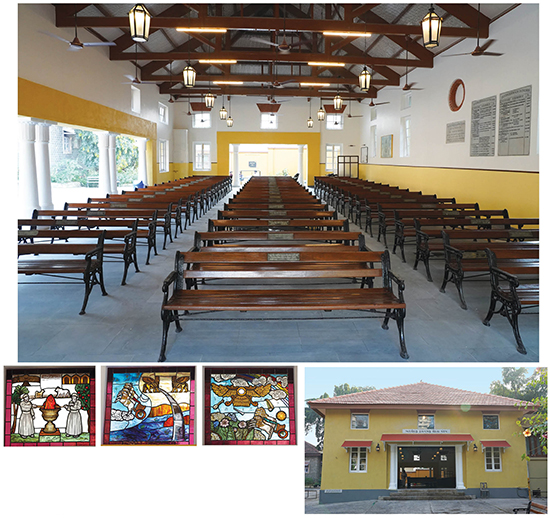
Clockwise from top: Interior and exterior of Large Pavilion after
restoration; stained glass panels
Rashneh, environmentalist, co-founder and director of the Centre for Environmental Research and Education (CERE), told Parsiana: "This project has truly been a labor of love in honor of our parents who taught us the importance of our faith, to always give more than we receive in this lifetime and the need to conserve our heritage.” The moving spirit behind the project, she believes that "every generation is mere custodians of assets built by our forefathers and we must protect and augment these before handing over the responsibility to the next generation.” For this project, "I personally supervised work at the site for the last month, staying there till 11 p.m. to ensure that it was completed on time and as per my specifications,” she informed Parsiana.
A jashan performed by four priests from the Vachaghandhy Agiary led by Ervad Marespand Dadachanji followed by a humbandagi opened the proceedings. Present were BPP chairwoman Armaity Tirandaz, trustees Anahita Desai, Dr Adil Malia, Hoshi Jal and Viraf Mehta, deputy chief executive officer Shehnaaz Khambatta and Doongerwadi staff led by manager Vistaspar Mehta. Former BPP trustee Khojeste Mistree and his wife Firoza also attended as did philanthropist Persis Vatcha, activist Pervin Jehangir, art historian Pheroza Godrej, among others. From the donors’ family Roda’s brother Dara Kooka and his wife Norma had come all the way from Nova Scotia in Canada for the occasion as had other relatives from abroad.
In her speech, Desai said that many may not be aware that "the entire 300 pages of the BPP trust deed is only about the Doongerwadi lands. No housing, no education, help, etc — just Doongerwadi. The 55 acres of land have been donated by philanthropic Parsis for the dakhmenashini system of disposal of the dead.” It is the BPP’s duty to "protect, preserve and maintain” these sacred grounds and this has been made possible by several donors who have provided the wherewithal for repairs to the structures over the years. Many of the former benefactors were present at the function. Capt Percy Master and his wife Arin, who are funding the ongoing repairs to Hodiwalla Bungli, also attended.
The CERE has been involved in the afforestation of the Doongerwadi estate. Rashneh spoke of how she had begun planting indigenous trees in a small section of Ambawadi eight years earlier. She is now improving forest diversity over the entire 55 acres and announced that "in the last monsoon the number of trees planted at Doongerwadi has gone up to 10,000.” During her regular visits to the site, she "was extremely troubled and concerned every time I passed the Pavilion… The supporting columns and beams had deep fracture lines. The entire south side wall had damp fungal growth due to groundwater rise and the teak roof batons, beams and trusses were slowly wearing down and needed to be salvaged.” She shared her concerns with conservation architect Kirtida Unwalla of K. Unwalla and Associates. When the latter visited the structure, she was perturbed at the extent of the deterioration. Putting their heads together, the duo worked on how to retrieve the Pavilion and took their plan to the BPP which was supportive of the initiative, though the matter of funding needed to be addressed. Rashneh discussed the matter with her brothers, and they readily agreed to join her in donating the Rs 85 lakhs required. Work started in January 2023, conducted mostly at night, and the Pavilion was fully restored and inaugurated 11 months later.
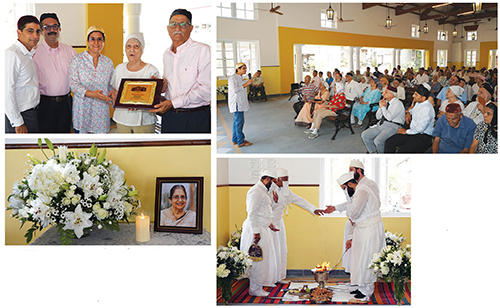
Top row, from l: Dr Dinshaw, Cyrus, Dr Rashneh and Noshir Pardiwala,
receiving memento from BPP chairwoman Armaity Tirandaz (2nd from r);
Rashneh addressing the gathering; 2nd row: Photo of Dr Roda Pardiwala; jashan
"Being on the Mumbai Heritage Committee was a great enabler for Unwalla because she knew all the formalities that had to be completed to obtain the permissions for the restoration as the Doongerwadi precinct is categorized as a Grade II B Heritage structure,” wrote Rashneh in a note sent to Parsiana. Rashneh has now created a handy manual of these requirements for the BPP to enable it to navigate permissions for future projects. "Special teams were brought in to work on different facets of the structure like roofers from Kerala, masons and carpenters from Rajasthan, while the antique lamps were handcrafted in Lucknow,” the environmentalist wrote. Tiles were brought in from Morvi, the beams were repaired and polished, as were the original sturdy teak benches with their cast iron sides and supports. An information poster and model of a dakhma have been placed in a museum section of the Pavilion.
"Keen that mourners get an insight into the Zoroastrian beliefs surrounding the last rites and the evolution of the soul” Rashneh thought of "conveying the message pictorially through stained glass panels” which Singapore based expert Swati Chandgadkar was commissioned to execute at her Bombay studio. After months of study and research, three panels were created depicting the journey of the soul after it leaves the body till it reaches the highest realm. The first one shows priests at prayer with a bull and a dog in the background, the second portrays Chinwat Pul, while the final one has a radiant farohar with a rainbow in the background.
After the vote of thanks by Tirandaz, a memento was presented to the Pardiwala family by the BPP. Also felicitated were Unwalla, site architect Purvi Doshi, Chandgadkar, CERE co-founder Kitayun Rustom and contractor Sachin Vishwakarma. Sumptuous refreshments were served to all by Bhesadia Caterers.
"Home, a free clinic”
In a later communication with Parsiana, Rashneh recalled, "I grew up in a household where Mum and Dad led a simple life and did not flaunt their wealth. Mum was a doctor and our home was a free clinic open 24/7 where anyone could ring the doorbell at any hour of the day or night and she was always happy to render medical treatment without charging a paisa... from neighbors, to their children, the building staff to even the taxiwallas and muttonwalla. Our dining table was often converted into an operating table for sutures, vaccinations, lancing of abscesses. Similarly, Dad still serves on the board of trustees of charitable organizations and renders free accounting services to the entire extended family.” He was a senior executive with the Great Eastern Shipping Company during his distinguished working career.
Cyrus, senior partner of PricewaterhouseCoopers Headquarters — Mergers and Acquisitions, lives in New York City (NYC). He was accompanied by wife Kimberly and son Becket. Expressing appreciation of his sister’s work, he said, "It was a privilege to be of service. When Rashneh identified the opportunity and spoke about her vision and why restoring the main pavilion at Doongerwadi would support those coming to pay their last respects for decades to follow, the decision was an easy one to make. Rashneh put her blood, sweat and tears into making her vision a reality. I could only support her from afar sitting in NYC. We are so very proud of her.”
Renowned orthopedic surgeon and head of sports medicine at the Kokilaben Ambani Hospital in Andheri, Dinshaw shared: "The aim of the project was simple — to bring back the main pavilion to its former glory with absolutely no compromises in quality of work. In a cosmopolitan city like Bombay, many non-Parsis attend Parsi funerals and this pavilion serves as their only glimpse to the Parsi Tower of Silence which is often shrouded in mystery. It was therefore important to create a beautiful and soothing environment, one that the community is proud of, and the restored Large Pavilion with its serene ambience ensures this.” His wife Farzana and older son Darius were present at the event. Younger son Jehan could not attend as it was his first day at college.
"The state of repair of the big pavilion was analyzed by a specialized team of conservation architects, structural engineers and contractors who undertook the work to complete it in 11 months,” noted Unwalla in a note sent to Parsiana. She explained that the Pavilion was "built in Art Deco style while stylistically assimilating Assyrian features in the columns capitals (the topmost portion of a column which is broader to increase its supporting surface).” Taking clues from inherent signs of fatigue, the evaluations were derived based upon the intrinsic logic of original construction techniques. The restoration involved critical repair methodology, involving complete replacement of columns. "The timber roof trusses being in sound condition, a simple augmentation of waterproofing membranes was undertaken and roofed over using Mangalore tiles. The existing flooring was replaced by using more enduring kotah stone,” Unwalla wrote. The architectural team led by Unwalla included architect Doshi, structural engineers Integrated Building Services, consultants WISETECH – MEP Consultants Private Limited and Archaic Conservation Cell were the contractors.
"What was most enriching was the process of learning about the Parsi rituals and culture while creating the three stained glass panels. And the challenge of incorporating all that knowledge into the complex medium of stained glass — with its demands of lead, glass, paintwork and, of course, ‘natural light.’ I hope my team and I have achieved this fusion aesthetically and in keeping with the Parsi tradition,” shared Chandgadkar.
Hands that helped
Many community members have come forward to fund repairs of the various structures at Doongerwadi, acknowledged Desai. Her list included the Bisni Dakhma repaired in 2020 from donations received from 19 community members and the Anjuman Dakhma repaired in 2023 by Parsi volunteers led by Bomi Mistry and Nozer Sutaria donations for which came from siblings Havovi and Jamshed Sukhadwalla. The netting for the Banaji Dakhma, which was used for Covid victims, was sponsored by trustee Mehta’s family. Repairs for the changing room, nahan khana, for khandhias near the dakhmas was undertaken from a bequest by the late Jal Sethna. The Sagdi Atash Dadgah was repaired and renovated by Shahrukh Daver’s family in memory of his parents. The manager’s office and mobeds’ waiting room repairs were sponsored by Drs Boman, Cyrus and Roshan Irani. The Lower Tarachand Bungli was repaired using a donation from Soonu Buhariwalla in memory of her husband who passed away during Covid and repairs to the two Bhabha Bunglis were sponsored by Noshir and Katy Gotla. The Bennett Bungli was repaired and renovated by the Zoroastrian Homeopathy Pharmacy family, the Calagopis and Adajanias, while work on the Allbless Bungli was underwritten by the Allbless family through Roshan Lentin. A new hearse van has been received from Homai Dadachanji.
Rashneh intends to restore the Small Pavilion with donations received from Zal and Avi Eranee, noted Desai in her speech. Earlier, the environmentalist had helped build the new toilet block opposite the main Pavilion from a donation by Vatcha, managing trustee of the Maneckbai P. B. Jeejeebhoy Trust Fund. Vatcha has also been supporting Rashneh in her plantation work at Doongerwadi, Desai mentioned. Rashneh has built a diva stand opposite the Anjuman Dakhma, a marble platform opposite the Banaji Dakhma and installed water pumps, etc.
◆ ◆ ◆
From the archive