
In Memoriam
Mentor to many
Died: Ervad Asphandiar Rustomji Dadachanji (pictured), 82, panthaky of Bombay’s Mody Sorabjee Vachaghandhy Agiary, trustee of the Athornan Mandal (AM) and Athravan Education Trust, and Sanjan’s Kukadaru Dar-e-Meher, on October 22, 2021, in Bombay, of abdominal sepsis.
.JPG) "He prayed like the buzorg (venerated) mobeds of Navsari,” wrote Dastur (Dr) Firoze M. Kotwal, High Priest of the H. B. Wadia Atash Behram in a note to Parsiana. He felt Dadachanji "exemplified all the virtues and exhaustive skills of a well-trained Bhagaria priest” known for his liturgical training and the recitation of prayers by rote.
"He prayed like the buzorg (venerated) mobeds of Navsari,” wrote Dastur (Dr) Firoze M. Kotwal, High Priest of the H. B. Wadia Atash Behram in a note to Parsiana. He felt Dadachanji "exemplified all the virtues and exhaustive skills of a well-trained Bhagaria priest” known for his liturgical training and the recitation of prayers by rote.
"I came to look upon him as a perfect example of a priest who exuded piety and devotion towards his kriya kaam (rituals)… He was an excellent yaozdathregar,” stated Kotwal who had first met Dadachanji in Navsari. Their friendship grew over the years. Describing him as the "chief ritual priest of the community,” Kotwal said that the senior priest’s "recitation of prayers was faultless… When he prayed or when he performed rituals, he had the ability to transform the ambience, creating a sense of holiness that few priests succeeded in.” The High Priest commended the three vendidad ceremonies performed at Doongerwadi after Dadachanji’s passing. "This was a singular tribute to his life as a priest, that despite a shortage of skilled priests, this ritual was done at Doongerwadi.”
Known to have performed over 70 nirangdin ceremonies in his nearly 70-year-old career, Dadachanji, with Ervad Adil Bhesania, was recorded performing the higher ceremony of the Yasna for the MUYA (MUltimedia YAsna) project for the School of Oriental and African Studies in London.
To Udvada High Priest Dastur Khurshed Dastoor, Dadachanji was "a walking-talking authority on the subject of religious rituals and Zoroastrian history.” Recalling a close association forged when working with him for the AM, Dastoor stated that Dadachanji’s "inputs were always valuable because he carried with him his experiences as a full-time practicing mobed… His contribution was very practical and applicable to every situation… His sense of humor would catch one and all by surprise.” The High Priest stated Dadachanji was popular among the laity because of his kind, comforting and wise counsel. "He would go to lengths to accommodate and adjust with the least amount of compromising on the religious principles of a particular ritual.”
Ervad (Dr) Parvez Bajan, panthaky at B. M. Mevawala Agiary called Dadachanji a good orator and reciter of the Shahnameh. "Above all, he had a jovial nature to mix with youngsters and the aged alike.” Bajan too called Dadachanji "a moving encyclopedia of Zoroastrian rituals and ceremonies.” The athornan fraternity has "lost a fine priest, a friend, philosopher and guide to all,” he stated.
"He prayed like the buzorg (venerated) mobeds of Navsari,” wrote Dastur (Dr) Firoze M. Kotwal, High Priest of the H. B. Wadia Atash Behram in a note to Parsiana. He felt Dadachanji "exemplified all the virtues and exhaustive skills of a well-trained Bhagaria priest” known for his liturgical training and the recitation of prayers by rote."I came to look upon him as a perfect example of a priest who exuded piety and devotion towards his kriya kaam (rituals)… He was an excellent yaozdathregar,” stated Kotwal who had first met Dadachanji in Navsari. Their friendship grew over the years. Describing him as the "chief ritual priest of the community,” Kotwal said that the senior priest’s "recitation of prayers was faultless… When he prayed or when he performed rituals, he had the ability to transform the ambience, creating a sense of holiness that few priests succeeded in.” The High Priest commended the three vendidad ceremonies performed at Doongerwadi after Dadachanji’s passing. "This was a singular tribute to his life as a priest, that despite a shortage of skilled priests, this ritual was done at Doongerwadi.”
Known to have performed over 70 nirangdin ceremonies in his nearly 70-year-old career, Dadachanji, with Ervad Adil Bhesania, was recorded performing the higher ceremony of the Yasna for the MUYA (MUltimedia YAsna) project for the School of Oriental and African Studies in London.
To Udvada High Priest Dastur Khurshed Dastoor, Dadachanji was "a walking-talking authority on the subject of religious rituals and Zoroastrian history.” Recalling a close association forged when working with him for the AM, Dastoor stated that Dadachanji’s "inputs were always valuable because he carried with him his experiences as a full-time practicing mobed… His contribution was very practical and applicable to every situation… His sense of humor would catch one and all by surprise.” The High Priest stated Dadachanji was popular among the laity because of his kind, comforting and wise counsel. "He would go to lengths to accommodate and adjust with the least amount of compromising on the religious principles of a particular ritual.”
Ervad (Dr) Parvez Bajan, panthaky at B. M. Mevawala Agiary called Dadachanji a good orator and reciter of the Shahnameh. "Above all, he had a jovial nature to mix with youngsters and the aged alike.” Bajan too called Dadachanji "a moving encyclopedia of Zoroastrian rituals and ceremonies.” The athornan fraternity has "lost a fine priest, a friend, philosopher and guide to all,” he stated.
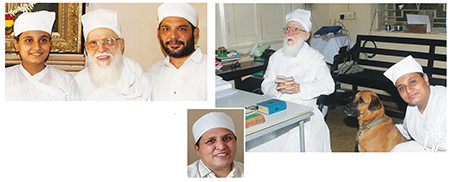
Top, from l: Varzavand, Asphandiar and Marespand Dadachanji;
Asphandiar with Varzavand; inset: Hormuz
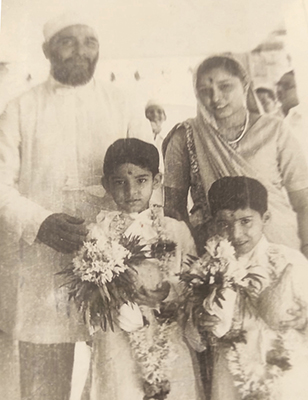
Asphandiar and Dhun with Marespand (l) and Hormuz at their navjote
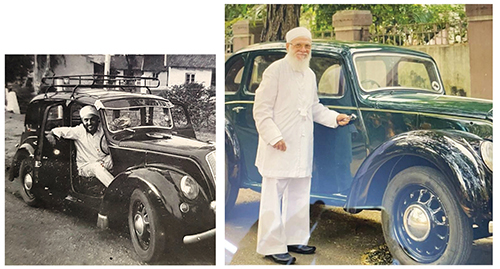
(Above) the senior priest and his vehicles, left, in Deolali, c 1973, right, in Bombay, c 2018
Bombay Parsi Punchayet trustee Noshir Dadrawala, who had accompanied Dadachanji on several tours to Iran, stated that the priest was a spiritual mentor to many. In the Iranian tours the priest’s "presence among the pilgrims had a serene effect on all, including fellow Zoroastrians living there… In the bus he would patiently answer queries on what to pray and how to live a pious Zoroastrian life… When I met him recently on a day which happened to be his roz birthday, he expressed a desire to visit Iran one more time.” Dadrawala said Dadachanji provided guidance to "both priests and laity in matters of religious observances without being pedantic.”
The senior priest was an "integral part” of the Vachaghandhy fire temple, trustee Mehernosh Kasad told Parsiana. He described the priest as very gentle, very kind and very soft-spoken. "His magnetism was of an altogether different level… Not just his ability to attract people, but also his approachability showed him to be a frank and open person…that helped one and all recognize him as the go-to person... (He was) perfect in his piety, with rituals and higher ceremonies, in his communication with behdins, and also with high priests and scholars,” Kasad narrated. Proud that the fire temple has "conducted the most navar and martab ceremonies in the country in the last three decades that Asphandiar has served here,” he ascribed this factoid to the priest’s "exemplary way of being around children (being ordained) — paying every attention to their care, and answering all their curious questions and most importantly being a part of their eagerness.”
Former assistant secretary of Nagpur Parsi Gymkhana Shernaz Davar recalled her family’s and the Nagpur community’s bond with Dadachanji in the 13 years that he was in that central Indian city, first as boiwalla and then as panthaky at their Hirabai Mullan Dar-e-Meher. "He won over the hearts of everyone with not just his hard work but also his simplicity, humility, sincerity and soft-spoken manners,” she narrated in an email to Parsiana. "It was in Nagpur that he acquired the first love of his life…his Morris (1948 model) car in 1973! A fortnight later he proudly drove to Vyara to get married to Dhun (née Buhariwala), his staunch pillar of support through thick and thin. And, it was in Nagpur that his second son Hormuz was born.” Davar recalled two nirangdin ceremonies that Dadachanji performed there. The first was in 1976 to mark the centenary year of Empress Mills. "He initiated it, collected funds to get the varasyaji to Nagpur and other expenses and along with Ervad Nadirshah Aibara performed the ceremony without taking any money for it.” The next took place after a gap of two decades. In 1999 another nirangdin was held in Nagpur, again performed by Asphandiar with Bhesania.
She recalled both Dadachanji’s religious classes for the community and his love for cricket. "He spearheaded an annual cricket tournament between the Jamshedpur and Nagpur Parsi cricket teams (that later evolved into the Parsi Pentangular, still being played). After the Dadachanjis left Nagpur, "whenever the Agiary faced an absence of priests, Asphandiar would inspire someone suitable to fill the post… Whether it was to enthrone our consecrated fire after the renovation of the Agiary or to guide our mobeds in performing the rituals properly or to give religious discourses…one call and he was there!” Calling him the "guiding star” for Nagpur, Davar stated that "although Asphandiar was my first cousin he was more than a brother to me…He has performed weddings and navjotes of three generations of my family.”
The senior priest looked upon his Morris as a member of his family. When they set out from Nagpur in 1982 to take charge of the fire temple in Colombo, a loading accident in the ferry at Rameshwaram damaged the car’s brake mechanism. "We rode the 350 odd km from Jaffna to Colombo only with Daddy’s skills and the use of the handbrake,” Hormuz recalled for Parsiana. Years later, Asphandiar would reminisce about the difficulties of driving in Sri Lanka. "Baddha jalébi jéva shabd hatta [the sign boards were written in a squiggly (Sinhala) script,]” he said.
Asphandiar took part "only for the joy of it but won many awards” in vintage car rallies in the city, Hormuz told us. Nitin Dossa, chairman of the Vintage and Classic Car Club of India informed Parsiana that "we used to call him a humble bawaji…. always smiling and giving blessings to all…In so many years I have not seen him getting angry or upset… His Morris 8 was his life. He would never drive or take interest in any other car. His wish was to see his grandson Varzavand drive the Morris.”
A note to Parsiana from Hormuz stated that his father was born in Navsari to Aimai and Ervad Rustomji on October 2, 1939. "To my father’s sisters Pervin (Master) and Kety (Kolah), their mother had said that an astrologer had predicted that my father will become quite popular ‘in white clothes.’ Our dear grandmother couldn’t imagine anything beyond the doctor’s white coat for her child… But he went on to become a very approachable priest always adorned in white.” Asphandiar completed his priestly training at the Dadar Athornan Madressa in 1953 and was ordained as a sampoorna navar and martab at the age of 13. He subsequently went back to Navsari, served at the Vadi Dar-e-Meher and the neighboring Mobed Minocherhomji Adaran before moving to Bombay in 1966 as bhantar cum Iranian and Indian history teacher at the M. F. Cama Athornan Institute in Andheri. A relocation to Nagpur in 1972, then Colombo, and a stint as a boiwalla at the Navsari Atash Behram followed, after which Asphandiar took over the reins of the Vachaghandhy Agiary. The priest has "helped, directed and given guidance for the consecration of the sacred fires at Godrej Baug, Salsette, Vasai, Sanjan…” His services would be summoned all over India whenever a sacred fire needed to be shifted and restored to its original abode.
Noting that Asphandiar "has the unique distinction of being the first mobed to perform the boi ceremonies of four different Atash Behrams” viz Navsari, Wadiaji and Anjuman in Bombay and one in Surat, Hormuz said that Asphandiar represented Zoroastrianism "in 2000 at the Alliance of Religion and Conservation in Nepal, where he met the Duke of Edinburgh.” The senior priest met Queen Elizabeth II at an audience with religious heads from the East. Asphandiar had served as a member of the Jashan Committee and the Iran League and chaired the Farohar Foundation in the past, informed Hormuz.
The much-loved priest is survived by his wife Dhun and sons Ervads Marespand and Hormuz.
◆ ◆ ◆
From the archive