
In Memoriam
Fulcrum for the Federation
"In 2024 AD this writer will either be 94 not out or already run out,” the jovial Keki Gandhi had predicted for himself when Parsiana chose to mark its 30th anniversary in 1994 by inviting stalwarts to foresee the future for the community in the next 30 years. When he was run out at 87 on September 10, 2017 in Dubai after delivering a constructive innings as joint honorary secretary of the Federation of the Parsi Zoroastrian Anjumans of India (FPZAI) for nearly 30 years, trustee of the Delhi Parsi Anjuman (DPA) and director, secretary and financial controller of Machine Tools India (MTI), there were three generations that had benefitted from his guidance, foresight and kindness as attested his colleagues, friends and family.
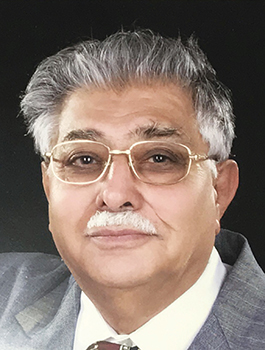 Since the FPZAI has not convened any executive council meeting for the last seven months, it was left to the Defunct Anjumans Committee of the Federation and the trustees of the Bombay Parsi Punchayet (BPP) to pass a condolence resolution at their meeting on September 23 to "place on record the valuable services rendered… He was an able administrator and with his corporate background he provided valuable advice in all matters.”
"The Federation was at its zenith when Keki was its secretary,” attested former BPP trustee Dinshaw Tamboly, adding, "Under Keki’s stewardship the Federation had become the binding force that kept all anjumans together, irrespective of their leanings — conservative or liberal — a forum where views could be ventilated freely and frankly, without fear or favor. Post 2008, after Keki was replaced as secretary of the Federation, the sheen and luster of the all-India body has been dulled and its vibrancy lost.”
"He guided me in the formation of the Federation of Zoroastrian Youth Associations (FOZYA),” acknowledged Jehangir Bisney of Secunderabad, adding, "What struck me most was his charming personality, ability to get everyone along with him and an unflappable nature. Very rarely did I see him lose his cool and even when he had to handle the various anjuman representatives at the FPZAI, he always had a smile on his face and conducted the meetings with finesse… His knowledge of community matters was amazing and for me he was the ‘Google’ of our community in the 80s, 90s and 2000s.”
While the community never managed to reach a consensus on the Adoption Act as applicable to Parsis, during Gandhi’s tenure as honorary secretary the Federation did manage to introduce amendments in the Parsi Marriage and Divorce Act as also the Indian Succession Act to bring parity between the males and females. To ensure that the Parsi aramgah in Simla remained in the hands of the community, he had worked out the logistics on a trip to the hill station. Keen to support every positive project, Gandhi had mentioned to Parsiana that his principle of "Fravarané (I accept),” had humbly stood him in good stead over the years.
Since the FPZAI has not convened any executive council meeting for the last seven months, it was left to the Defunct Anjumans Committee of the Federation and the trustees of the Bombay Parsi Punchayet (BPP) to pass a condolence resolution at their meeting on September 23 to "place on record the valuable services rendered… He was an able administrator and with his corporate background he provided valuable advice in all matters.”"The Federation was at its zenith when Keki was its secretary,” attested former BPP trustee Dinshaw Tamboly, adding, "Under Keki’s stewardship the Federation had become the binding force that kept all anjumans together, irrespective of their leanings — conservative or liberal — a forum where views could be ventilated freely and frankly, without fear or favor. Post 2008, after Keki was replaced as secretary of the Federation, the sheen and luster of the all-India body has been dulled and its vibrancy lost.”
"He guided me in the formation of the Federation of Zoroastrian Youth Associations (FOZYA),” acknowledged Jehangir Bisney of Secunderabad, adding, "What struck me most was his charming personality, ability to get everyone along with him and an unflappable nature. Very rarely did I see him lose his cool and even when he had to handle the various anjuman representatives at the FPZAI, he always had a smile on his face and conducted the meetings with finesse… His knowledge of community matters was amazing and for me he was the ‘Google’ of our community in the 80s, 90s and 2000s.”
While the community never managed to reach a consensus on the Adoption Act as applicable to Parsis, during Gandhi’s tenure as honorary secretary the Federation did manage to introduce amendments in the Parsi Marriage and Divorce Act as also the Indian Succession Act to bring parity between the males and females. To ensure that the Parsi aramgah in Simla remained in the hands of the community, he had worked out the logistics on a trip to the hill station. Keen to support every positive project, Gandhi had mentioned to Parsiana that his principle of "Fravarané (I accept),” had humbly stood him in good stead over the years.
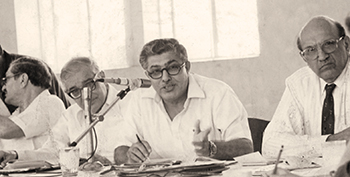
Keki Gandhi (top and above, at the mike) with (from left) Jamshed Guzder,
Dr Aspi Golwalla, Lt Gen Adi Sethna (retd) at a Federation meeting
"A visionary and an iconoclast, for him status quo was not an option,” declared DPA president Yezad Kapadia at the condolence meeting convened by the Anjuman on October 7. Kapadia appreciated that after stepping down from the Federation, Gandhi became a DPA trustee and "brought fresh thinking into the deliberations of the Anjuman.”
DPA vice president Ava Khullar referred to Gandhi’s concern about the declining Parsi population after Khullar had presented a paper at the North Zone Federation meeting in Delhi in 1978. He persuaded Khullar to collect demographic data from other anjumans to draw up a comprehensive picture of Parsis in India. She also referred to his resourcefulness in getting MTI to relocate from Calcutta to Delhi.
To DPA honorary secretary Adil Nargolwala who had attended his first Federation meeting over 20 years ago as a youth representative, Gandhi was "a mentor… a solid pillar of support that anyone could go to. I learnt dignity of labor from him. He had full respect for the lowest functionary.”
"He was an ethical individual whose mental clarity and intelligence helped him succeed in his endeavors to make the Federation a reality,” remarked Aloo Tata (née Vania) who had known Gandhi for nearly 60 years, from the time they were neighbors in Calcutta and he gave the Parsi women’s basketball team tips to improve their skills. They were neighbors once again in Delhi when Aloo, husband Hoshi Dubash and three young children migrated from Bombay in 1971. The following year when Hoshi, had a heart attack, it was Keki and his wife Margaret who helped Aloo’s mother-in-law look after the children while Aloo tended to her husband. Fifteen years after the passing away of Hoshi, when Aloo married Yezi Tata, managing director of MTI, she discovered "how deep was the affection and respect shared by Keka and his boss of over 40 years. Though they would have intense arguments, Yezi depended on Keki and used him as a sounding board.” When Gandhi started the Fed Newsletter, Aloo was roped in to write. "He taught me never to get angry and to disagree, agreeably. He was always seeking common ground and built friendships despite differences.”
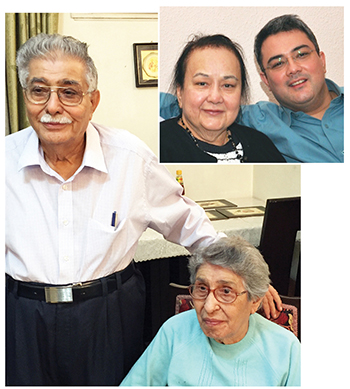
Keki Gandhi with sister Nergis who passed away
in October; (inset) Margaret and Homi Gandhi
For one who liked "to have his finger in every pie” as he had unabashedly admitted in an interview with Parsiana (see "Delivering the chosen message,” December 1988), he enjoyed his role as editor of the four-page Fed Newsletter with 5,600 copies printed monthly. He refused to carry controversies or appeals for donations or letters to the editor in his tabloid, "not because of my penchant for having the last word but because it is a newsletter and not a views letter,” he rationalized. "It gives immense job satisfaction to be able to bring out an issue every month when most other Zoroastrians, including myself, bring out the issue (children) that really matters only once in a lifetime,” asserted the editor. The Fed Newsletter, on his insistence, was distributed free, his rationale being, "All good things in life — air, water, sunlight, friendship, love, etc — must come free. How can you put a price to a labor of love?”
Known to selflessly give his time and support to those in need, his style of functioning was fondly recalled: "To many of my colleagues, MTI has been the only company they have worked in during their entire working career… Doesn’t this speak volumes of the type of people-person that he was and the type of work culture he had developed there?” commented his secretary Matilda Mathias recounting several instances in Gandhi’s life. Yet another secretary Sadhana Sharma who had worked with him for 21 years and assisted with the Fed Newsletter and transcript of minutes of Federation meetings referred to a remark he had once made, "‘The only assets of MTI are its staff members.’ He used to call everyone ‘béta (child) and anyone could go to him anytime with one’s problem and get a solution,” added Sharma. "Ha kéhvani khoti aadat pari gaieech (acceding to requests has become a faulty habit),” he jested.
"For me, Machine Tools was like a second home,” reminisced Farida Variava, referring to her frequent meetings with Gandhi when they were involved with the Delhi Parsi Amateur Society. In those days when they were all proud owners of two wheelers, if a car was required, invariably "it was Keka at rescue.”
"He was truly a children’s person,” attested Kerman Mehta and Rukshana Shroff, referring to Gandhi’s involvement when planning outstation trips for the Farohar children (community youngsters in Delhi who are given religious and cultural lessons). He would go "out of his way to help and ensure that everyone had a good time.” On one of the journeys he taught the Farohars their first funny song Do for Dorabji, sung to the popular Do re mi tune. "This became our signature Farohar song at most of our performances and has been a huge hit always,” they revealed.
Until the end he would maintain a vigil on Parsiana’s publication schedule too and in fact even a few hours prior to his demise he wanted to know when Parsiana would carry a write-up on the DPA function bidding farewell to their Dharamshala manager Dhun Bagli. Keen to buy a copy of Rohinton Nariman’s The Inner Fire, he had made the necessary enquiries with our Parsiana Book Shop but when he learnt that the copies with us were not autographed by the author, he chose to use his contacts with the Nariman family to procure an autographed book.
"I knew my father as the champion of lost causes,” stated son Homi who admired his "determination and will power... with a unique sense of humor.” The youngest of four children born to Jamshedji, who was a railway guard, and Jerbai, Keki graduated in commerce from Bombay’s R. A. Podar College of Commerce and Economics. After qualifying as a chartered accountant he worked for a few accountancy firms in Bombay before he joined MTI in Calcutta in 1957 and met Margaret who was serving as Tata’s secretary. After 49 years with MTI, he retired in 2006 to spend more time with Homi and his family in Dubai.
Even at a late age he kept himself updated with technology using the iPhone, iPad, laptop to send his emails and WhatsApp messages. For his family, friends and colleagues who had difficulty deciphering his illegible handwriting, it was a blessing. But his propensity to use self coined acronyms continued nevertheless. Until the end he did not lose his love for adventure, traveling on the Dubai Metro and Dubai tram, walking stick in hand; nor his enjoyment of good food, particularly kebabs and biryani despite heart problems, drug resistant chest infections and early stages of kidney failure; nor his interest in cricket and tennis, having played in cricket matches when he was in Calcutta and even losing his wedding ring on the field!
A storehouse of Gujarati idioms, Persian couplets, and Biblical sayings, Gandhi, who was buried at the Delhi Parsi aramgah was liberal in his religious beliefs. As the optimist had written for Parsiana, in a few years "Zarathushtra will cease to be the prisoner of bigots and will once again be revered by millions… Concrete steps will be taken to restore Zoroastrianism to its pristine glory and once again it will become a universal and living religion.”
◆ ◆ ◆
From the archive