
Events & Personalities
The soul of Sabavala
The muted shades of blues, greens and beiges of The Shadowed Strand greet you when you step into Colaba’s Akara Art gallery to view "Jehangir Sabavala: Pilgrim Souls, Soaring Skies, Crystalline Seas” exhibition. On view till December 10, 2020, the show is the first posthumous showing of Sabavala’s works in a commercial gallery. The artist passed away in 2011 at the age of 89. Strand, with Beached Boats and other paintings in the first of four sections of the show reflect the artist’s preoccupation with light in the 1960s and 70s, states a display panel by art critic, independent curator and Sabavala’s authorized biographer Ranjit Hoskote.
Fifteen of Sabavala’s works, many on display for the first time, are divided into four sections: landscapes and cityscapes; early cubist works; watercolors and human figures. The gallery’s press note states the works highlight the master’s fascination with the mystery of light and the expanse of space. His play of light is reflected in Santa Euphemia, which shows the "soft diffusion of a European morning,” while yet others reflect the "sharp angularity” of an Indian afternoon. Sabavala’s humans are reduced to shadowy figures in some of the pictures on display whereas The Women III shows five white clad women dominating the frame. "Some of the figures (in his works) may be monks, or pilgrims, others explorers or refugees… farmers or shepherds,” notes the display panel.
Fifteen of Sabavala’s works, many on display for the first time, are divided into four sections: landscapes and cityscapes; early cubist works; watercolors and human figures. The gallery’s press note states the works highlight the master’s fascination with the mystery of light and the expanse of space. His play of light is reflected in Santa Euphemia, which shows the "soft diffusion of a European morning,” while yet others reflect the "sharp angularity” of an Indian afternoon. Sabavala’s humans are reduced to shadowy figures in some of the pictures on display whereas The Women III shows five white clad women dominating the frame. "Some of the figures (in his works) may be monks, or pilgrims, others explorers or refugees… farmers or shepherds,” notes the display panel.
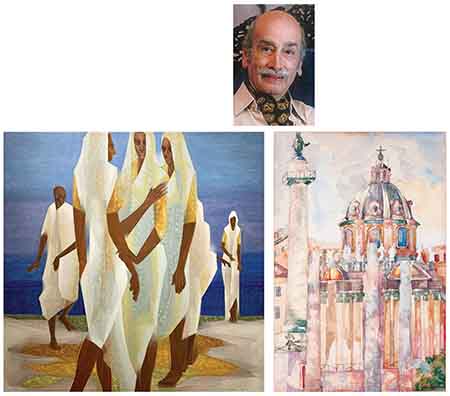
Jehangir Sabavala’s (top) The Women III, oil on canvas (above l) and Santa Euphemia,
watercolor on paper (above r) Images of paintings: Akara Art
"Any time is a good time to have an exhibition of Sabavala’s works. He was not a prolific artist and to put together 15 paintings is definitely an interesting proposition,” says gallerist Puneet Shah. It took him "a good four months” to put the show together, he communicated. "The lockdown gave us a good opportunity to research and reach out to people who possessed his works,” Shah told mid-day on October 28, before the show opened.
Hoskote told Parsiana on November 17 that Sabavala’s "legacy resides in his memorable and perennially sublime paintings, of course — but, equally, it resides in the example of his practice. In the 1950s and 1960s, he formulated a synthesis between his experiences in Europe and in India, the homeland that he embraced through travel, reading, and conversation with all sorts and conditions of people.” Hoskote had curated a lifetime retrospective of Sabavala’s work at the National Gallery of Modern Art, Bombay and Delhi in 2005-06.
Sabavala "did not commit himself to a faux nationalism that prizes kitsch authenticity, nor did he produce pale imitations of a pictorial language anchored in other histories and predicaments,” continued Hoskote. Calling him a "truly transcultural and cosmopolitan artist, at home among varied geographies, languages, and temperaments,” the critic stated, "this is an object lesson for today, when we are surrounded on all hands by competing claims to narrowness, which drive us towards a depleting and dangerous cultural polarization.”
"He was never a member of any group of artists, preferring to map his journey alone while remaining fully engaged with India’s emerging art scene, supporting discussion and debate, encouraging younger practitioners, and welcoming new writers on art,” Hoskote summed up.
Sabavala was educated at Elphinstone College and the Sir Jamsetjee Jejeebhoy School of Art, Bombay; the Heatherley School of Art, London; and at the Academie Andre Lhote, Paris. "Between 1951, when he held his first exhibition at the Taj Mahal Hotel, Bombay, and 2008, when his last solo was held in Bombay’s Sakshi Gallery, Sabavala progressed with grace and elegance from one theme and formal preoccupation to the next,” notes Hoskote. On his death, Sabavala’s wife Shirin donated his paintings, drawings, sketchbooks, papers, photographs and many books from his personal library to the Prince of Wales Museum of Western India (see "Celebrating Sabavala,” Parsiana, November 21, 2015).
Akara Art was established in 2009 as an art advisory and dealership by Shah. The gallerist seeks to "bridge the gap between genres,” by focussing on intergenerational shows and by bringing the modern and the contemporary together.
◆ ◆ ◆
From the archive