
In Memoriam
‘Aristocrat of the spirit’
Jehangir Ardeshir Sabavala’s life spanned many worlds. In all of them, he displayed a sensitivity not unmixed with a steely resolve to remain true to his core as a seeker of truth. He was an aristocrat of the spirit who embodied the best of what it means to be a Zoroastrian, a Parsi, an Indian and a citizen of the world of ideas that go beyond all these definitions.
It was of course as an artist of contemporary India that he distinguished himself creating a vision that was as distinct as the man himself. In his tireless explorations of the world around him and perhaps those within his restless mind, he created canvases of austere elegance, seeking for a meaning beyond the immediate boundaries of color, content and compositions to lay bare images of haunting beauty.
In their early years together as artist and elegant companion, Jehangir and his wife Shirin created their own private image for themselves in the arriviste world of Bombay’s fledgling art scene. They entertained in style. Niloufer Ichaporia King, the San Francisco based author has immortalized Shirin’s famous ‘Green Chutney Souffle’ in her book. To stretch the metaphor a little, like beating the egg whites of the soufflé itself, their lives were a delicate blending of both East and West, the slightly tart and sweet edge of the coriander chutney adding an element of the unexpected to the creamy blandness of the soufflé mix. To be invited to their home was to be reminded of the gracious lives of the early Parsi grandees who made up the elite of Bombay’s social life in the late 19th and early 20th century.
His mother Bapsy Sabavala was a famous hostess and patron of the arts. She traced her lineage to the aristocratic Cowasjee Jehangir family, whose munificence can still be seen in some of the buildings that overlook the Jehangir Art Gallery, where Sabavala was to exhibit with metronomic regularity. One still recalls a time in the mid-60s, when the artist appeared in a dazzling white suit with a red tie and handkerchief tucked in a breast pocket, Shirin by his side in a similar combination of white satin, with a touch of red. Together they gave a cachet to an art scene that in those days was barely there. On the morning of 89-year-old Sabavala’s demise, September 2, 2011 at the Breach Candy Hospital when he succumbed to cancer, it was with a sense of déjà vu that one noted how Shirin, now alone with their daughter, Aafreed, came back to take charge of the last rites, dressed in simple, yet splendidly accoutred black.
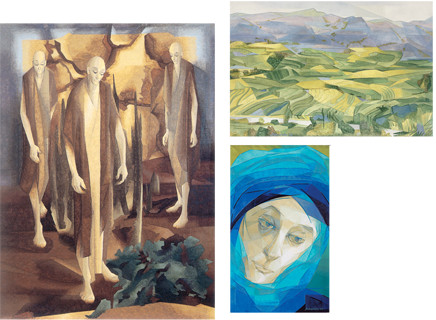
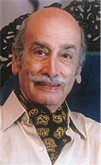
Jehangir Sabavala (top) and some of his masterpieces The Sorrowing Men (1974) (left); Rice-fields, Palni hills I (2008) (above); Blue mantle (2006) (alongside)
He and his brother Sharoukh were sent to Switzerland for their early education. For some time, Jehangir, with his striking good looks aspired to be an actor. He then switched roles and spent his time honing his skills in the elite studios of the Parisian ateliers. Learning to accept both the criticism as well as the advice of teachers such as Andre Lhote, a master of Cubism and by looking at the example of artists as far different as Rembrandt, Cezanne, Juan Gris and Lyonel Feininger, Sabavala imbibed a very rigorous training in the techniques of western art. The light filled landscapes of Feininger would with their limpid invocations of sea, sky and sailing boats find a resonance in Sabavala’s own canvases. The middle period of his life as an artist between the mid-’60s and ’70s saw some of his most luminous canvases. There were panoramic landscapes that stretched beyond the viewer’s eye into the farthest realms of the imagination, in gradations of color and texture that lingered in the mind like musical notes travelling through unseen distances. Some of these were peopled with shrouded forms, prompting him to give them titles of lost tribes, or ancestors forever on the move searching for a permanent shore. Others like the delightful Green Thoughts in a Green Shade recorded a sudden encounter that the artist made when he chanced upon an ambush of white butterflies in a forest clearing and created that moment of intense joy.
As he was to explain during the course of an extended series of conversations with Yashodhara Dalmia, recorded in her two-volume book, Journeys with Artists, Sabavala speaks of his own labored attempts at seeking out a language that would go beyond categories such as Impressionism, Cubism, Modernism, Nationalism and so forth.
"I didn’t fall into any schools or groups, and I became very individualistic... I analyzed once again, ‘What is this painting about? Apart from technique, the baggage you carry, what you have learnt. After all, isn’t it an amalgam of the attempt, a fusion of your mind, a fusion of the special quality of spirit and heart, which must creep into the picture to break the formality, the disciplines?’ And I thought to myself how interesting it would be to let myself go, and I found an immense response.” He goes on to add that he always worked towards a show, even in the days when it was difficult to find a gallery, particularly in cities outside of Bombay. Or as he explains, "I was one of the early ones who showed before the galleries; now it’s normal, but before it was very difficult for a painter to move from one city to another, alone, and I found a marvellous reception — a human, intelligent reception that I encouraged fully.”
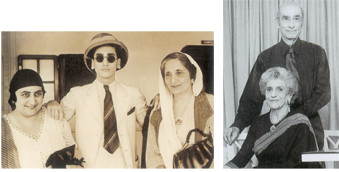
Above: Jehangir Sabavala in Singa-pore with mother Bapsy (left) and friend Piroja Taleyarkhan in 1939; (right) Shirin and Jehangir Sabavala at their home, 2002 Photo: Dayanita Singh
As against Sabavala’s own description of this need in him to "only connect” through his art, through his interactions with other artists, patrons and the general public, the late Dilip Chitre, poet and writer, who wrote an introduction to the paintings of the mid-’60s onwards, positions Sabavala as a Parsi, who would always be the privileged outsider. This is what Chitre has to say: "In an India, which has been communal, hierarchical, populist, and politically unstable for the last three centuries, a member of any slowly diminishing religious and ethnic micro-minority has a continuing crisis of identity... Ethnically they are visible as a different race both in India and in Europe and America. A strong sense of family and community binds them and pulls them towards India, their home. Yet the idea of being an exile from an original homeland must also survive in their mind even though they have no Zion to return to.”
Has the exile finally found his way to his original home? Or will haunting landscapes of Sabavala’s long journey into the secret world of his heart and mind remind us that that is where he belongs — in his art?
◆ ◆ ◆
From the archive