
Events & Personalities
Sabavala’s serigraphs
He has been painting since 1945, has exhibited globally and has to his credit 34 one-man shows and over 150 group participations, yet there is nothing but humility in Jehangir Sabavala, reported the Afternoon Despatch and Courier (ADC) dated April 3, 2007. A retrospective held recently at Bombay’s National Gallery of Modern Art showcased a huge body of Sabavala’s works from various collections around the world. It’s been a long journey from the time when a pencil sketch by the veteran artist sold for Rs 75 in 1953; today his paintings command astronomical sums.
A path-breaking show in Bombay from April 6-15, 2007 of a limited edition of Sabavala’s serigraphs came as good news for art lovers. Serigraphs look as good as oils on canvas but cost a fraction of the originals. Young and enterprising Lavesh Jagasia is credited with bringing Sabavala’s art within the reach of the common man, adds the ADC write-up. The Latin word ‘serigraph’ literally means to draw through silk. In fine art screen printing many near identical images can be made by inking and printing the same screen again and again. Of course, this can only be done with the artist’s authorization. The prints are limited in number to make them rare, are signed by the artist in pencil and numbered for identification.
This is a fabulous way to acquire art that one may fancy, Sabavala feels. The image in a serigraph is 99.9 percent true. For his exhibition Sabavala personally supervised the operations, scrutinizing each master print as it was sent to him from London where the serigraphs were hand pulled. The final serigraphs of 18 of his paintings were printed on special archival paper in two sizes, 22 x 30 and 44 x 30 inches, costing Rs 45,000 and Rs 75,000 respectively. The paintings were selected from some of the artist’s earlier series titled Purdah, Pilgrimage, Bird Forms, Sorcerer, Wandering Shades and others.
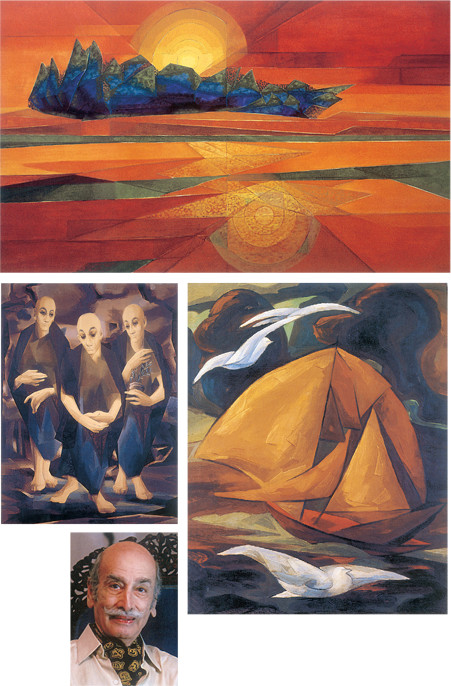
Senior artist Jehangir Sabavala and serigraphs of three of his earlier paintings
Sabavala has been quoted in the brochure of "Limited Edition Serigraphs” saying: "It has been a long and arduous journey, but one that has steadily evolved, without harsh leaps or suicidal reverses. My graph is easily deciphered from the start to where it stands today. I am essentially a figurative painter with a strong prediliction towards landscape. It is central to my work, and yet, the figure whether wraithlike or human, is often present as a part of the whole.”
Art historian Ranjit Hoskote writes about Sabavala’s tendency toward classicism in his introductory article in the same brochure: "To Sabavala beauty remains an experience of grace to be cherished, a state of illumination that gives us the strength to endure existence... The principal device by which Sabavala transmutes and idealizes the forms of nature in his paintings is a crystalline geometry, which dissolves bodies, objects and geographies, and reconstitutes them as prismatic structures... (He) conducts the visible in the direction of the visionary.”
Sabavala’s work was also in the news recently in a less savory context when a painting worth between 60 and 80 lakh rupees was allegedly ‘stolen’ from Mehar Devis’s Gamdevi home by her brother Rustom Mehta as the fallout of a family feud. As of now, a city court has decided that Devis is the real owner, but her brother is not happy with the order and plans to challenge it in the sessions court, reported Mumbai Mirror on May 15, 2007. Sabavala traced the history of the painting: "I painted Still Life With Apples in Paris in 1949… I consider it one of my best works. I then exhibited the painting in Bombay in 1951 or 1953 (I forget the exact date here) and a decent Parsi lady bought it…I sold the painting for Rs 250.” The painting changed hands before ultimately coming into the possession of Devis.
◆ ◆ ◆
From the archive