
Tribute
Kotval’s justice
On the 110th anniversary of Justice Sohrab Kotval’s birth, his children reminisce about him as a family man and recall his many notable accomplishments
Standing on the veranda of our house in Nagpur, we saw a bullock cart turn into our gate and wind its way down the driveway. The driver of the cart asked to see "Kotval sahib (sir),” and when Father came, the man immediately stooped to touch his feet — a gesture Father interrupted by holding the visitor’s hands in his own. The visitor was a tenant farmer who had tilled the same piece of land for years. The landlord had arbitrarily thrown him out, for a personal vendetta, knowing that the farmer had no means of fighting him in court. Father had defended this man and won the case, charging him no fees. Now, after a good harvest, this farmer had come with a bullock cart full of his best produce. Father gratefully accepted some of the produce and they parted with smiles and a namaste. Then he said to us, "It’s cases like these that make for the real joy of being a lawyer.”
So strong was Father’s belief that every man, rich or poor, should have equal access to the courts that, as a lawyer, he hired a tutor to teach him Marathi. His fluent Marathi then made it possible for him to represent people who were poor and did not speak English. Invariably, these clients were represented without fees.
So strong was Father’s belief that every man, rich or poor, should have equal access to the courts that, as a lawyer, he hired a tutor to teach him Marathi. His fluent Marathi then made it possible for him to represent people who were poor and did not speak English. Invariably, these clients were represented without fees.
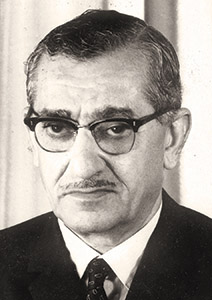
Justice Sohrab Kotval
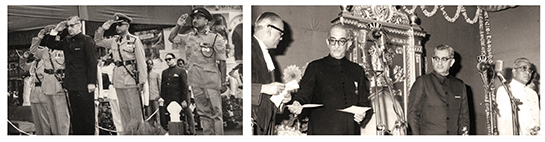
L-r: at Republic Day parade, 1970; Justice N. A. Mody, governor Ali Yavar Jung, Kotval and chief minister V. P. Naik
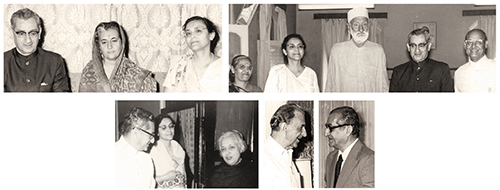
Top: Sohrab and wife Rati flanking Prime Minister Indira Gandhi; with Abdul Gaffar Khan (in white cap);
above: with Vijayalakshmi Pandit; J. R. D. Tata; Sohrab
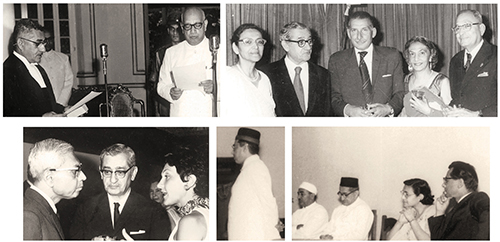
Top: Sohrab sworn in by governor Dr P. V. Cherian, Rati and Sohrab, Field Marshal Sam Manekshaw,
Homai Bode and Jehangir Shroff;
Above: Burjor Godrej, Sohrab, guest; Cawas Bhabha, Ervad Hormusji Pavri,
Sohrab, Rati with Jal Gimi in Nagpur
Growing up in Nagpur, we were surrounded by regular reminders of this. In the 1940s, Uncle Jaywant — like many intellectuals — was a member of the Communist Party of India. He and some others had been jailed because of their political beliefs. Most lawyers were unwilling to defend them for fear of being labeled communists, but Dad did so, successfully, and again without fees. Years later, Uncle Jaywant’s daughter Asha graduated from medical school the year Father was elected Vice Chancellor of Nagpur University but had not started his term of office. Asha arranged to defer receiving her degree to the following year so that "Kotval kaka’s (uncle)” signature would be on her MBBS degree certificate.
Dad’s years as vice chancellor (1961-1964) were brutal. He was elected after receiving more than twice as many votes from the University Senate as his opponent. He would come home after a full day at the courts, have a quick cup of tea and head for the University, where he would put in another three or four hours of work. He would return home for dinner, after which he would start work on the briefs for the next day at the High Court. In those days, university exam questions used to be routinely leaked — sold, is closer to the truth. These leaks were stopped soon after Father took office. In response, a gang of frustrated students threatened to beat up the vice chancellor, others threatened to throw acid on his face, yet others sent him the picture of a dagger dripping with blood. Such was Dad’s faith in doing the right thing simply because it was the right thing to do, that these threats did not deter him in the least. Though not a prayerful person, he believed, "One’s life and actions are the ultimate and only worthwhile prayer.” From 1956-64 he also served as Dean of the Faculty of Law in Nagpur University.
He was president of the Nagpur and Kamptee Zoroastrian Anjuman for seven years. Yet, on being sworn in as the Chief Justice of the Bombay High Court (BHC), when the Bombay Parsi Punchayet wanted to felicitate him, he declined the offer. He felt it was not proper for him to be identified with one community, as he represented all communities in the State of Maharashtra.
There was a stiff upper lip stoicism to his personality: one must carry on and do one’s duty no matter what the implications were to oneself. No doubt this character was formed by the example of inner strength and scholarship which he saw in his own father, Peshotan Sohrab Kotval who had completed his law degree at Oxford and was himself a successful lawyer and later a judicial commissioner (equivalent to a high court judge today) for the Central Provinces in British India.
Father, who was born on September 27, 1910, had lost his mother to childbirth fever when his youngest brother was born. Dad was nine years old then. The only time he mentioned that trauma was to say, "We were all devastated. One fine day, we suddenly found we were going to have no mother.” Not knowing how to best take care of the five children, Grandfather Peshotan arranged to have them attend boarding schools in Panchgani. The boys were sent to the Billimoria High School in that hill station. There was a great bond of solidarity among Dad and his siblings, no doubt forged by early experiences of shared grief and loss. The mutual caring was over-layered with a stoic self-reliance, and throughout his life Dad kept up small rituals such as polishing his own shoes.
Seeing how well Father performed in his BA, Grandfather Peshotan wanted him to go to Oxford for his law degree but Father, by then, was passionate about Indian Independence. He wanted to be a lawyer, fully trained in India, and refused to go to England.
Despite his seriousness of purpose and his stoicism, Father had a boyish sense of humor. One such ritual was him leading us kids in the summertime to suck the gotlu (seed) of a mango until it was almost white. Once, he ceremoniously washed the gotlu with soap and water and painted an old man’s face on it, to our great amusement! He was a good mimic and we learned about Laurel and Hardy by seeing Dad mimic them. He loved playing tennis and was part of his college cricket team. He also represented his college in debating competitions. He loved the outdoors and a long walk in the woods or by the sea always renewed his spirit. Walks with Father and family dinner conversations could be full of memorable life lessons: "A man’s character should be judged not by how he treats his friends, but by how he treats his enemies.” "It is important to get along with people, even those who may have harmed you.” "Just do your best and then forget about it.” "Justice must not only be done, it must also appear to be done.” "You should be able to walk away from money and status when a principle is at stake.”
Father’s tenure as a judge of the BHC (1955-1972) was often highlighted through retrospectives and articles in the Press. In 1958, he was chosen to be the One-Man Commission to report on the police firing in Ahmedabad which occurred between August 12 and 14, 1958 in connection with the "Maha Gujarat agitation” with massive riots and atrocities. He was chosen because the government needed someone who would not be pressured by high-powered politicians, someone who would be fair to the police, the public and the rioters — to Hindus and Muslims alike. Later, he was responsible for striking down the Bombay Land Ceiling Act as unconstitutional. The Sunday Standard (July 31, 1966) wrote: "So sound was the conclusion (of the judge) in this vital case that instead of challenging it in the Supreme Court, leave to appeal to which had been granted, the powers-that-be had to get the very law of the land changed to let the (ruling) stand.”
He would often be one of the first to arrive at the Court, and his grandchildren loved to see "Grandpa’s soldiers” — all the chopdars arrayed on the steps of the judges’ entrance, resplendent in their white, red and gold uniforms, holding long carved, silver maces.
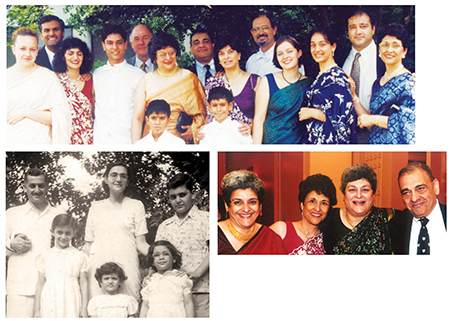
Top: a family function; above, l: Sohrab and Rati Kotval with
children (from l) Jeroo, Mehroo, Silloo and Peshotan;
above, r (from l): Mehroo, Silloo, Jeroo and Peshotan
During his tenure as Chief Justice of the BHC (July 31, 1966-September 27, 1972) he was a vocal proponent of "justice delayed is justice denied.” Over the years, he fought energetically for more funds. As a result, more judges were appointed to cope with the enormous backlog in the High Court. The lower courts, he recognized, needed both improved work conditions and better training in writing judgments, with refresher courses for judges. He was able to get the government to donate land to build the facilities and finally to finance the training courses for the lower courts. His efforts finally culminated in the inaugural of the Institute for the Training of Judicial Officers on September 3, 1972. It was located in Nagpur at that time.
When Governor Palathnikal Varkey Cherian passed away in 1970, Father as Chief Justice had to assume the duties of acting governor, and the family moved to Raj Bhavan temporarily. I was in graduate school in the US at the time, working toward my PhD, and received some petulant letters from Dad: "I am told when I should sit, when I should smile, where I should stand,” he grumbled. For a man who cherished the quiet privacy of his book-lined office, the regular flash of cameras was less than appealing. Yes, he hosted fascinating visitors (Abdul Ghaffar Khan), charming visitors (the King and Queen of Belgium), and important visitors (President V. V. Giri, Vice President G. S. Pathak and Prime Minister Indira Gandhi), but the deep satisfaction of knowing he had forged a better world by his work was absent. Further, he couldn’t go for his walks to Hanging Gardens, and he was putting on weight with all those banquets. He was delighted when Nawab Ali Yavar Jung was appointed governor, and the two families remain friends.
A year before he reached the mandatory retirement age of 62 for judges, the state of Maharashtra had created the position of Lok Ayukta — the very first in the country. This office was to investigate complaints against public officials in the state. Chief Minister V. P. Naik asked Father to resign a year early from his work as Chief Justice because his was the only name acceptable to members of all parties. They needed someone impartial and trustworthy, someone who could define the integrity and value of this position. Father valued his work as Chief Justice and did not wish to resign early, so the Maharashtra Legislature waited for a year until he could accept the job. As Lok Ayukta, Father recognized that many people could not afford to travel to Bombay, so against obstacles, he would travel to various parts of Maharashtra to hear complaints and to right wrongs. People from other states and countries asked his advice on how to set up a similar office. It was during his tenure as Lok Ayukta that father suffered his first massive heart attack in January 1975, while attending a cricket match — a game he so loved to play in his youth.
In October 1979, J. R. D. Tata requested Father to head a team of three to undertake what he called a social audit of various "livelihood programs” pioneered by TISCO (now Tata Steel). JRD requested a formal report including unbiased appraisal and feedback. The "Table of Contents” and recommendations of the final report read like the blueprint of what we, many years later, call Corporate Social Responsibility programs — the environment, pollution controls, employee education and safety, employment of minorities and women, consumer safety and a host of other issues. Fairness to all, inclusiveness and maintaining a broad perspective — these were the hallmarks of Father’s thinking.
In 1987, my family and I were visiting Bombay from the US when Dad had what turned out to be his last heart attack. During one of our chats in the hospital he made one request of me: that I should have my children navjoted. Before flying back to the US, we stopped at the hospital to say one last goodbye. A few days later, on March 6, 1987, he was gone. Dad was sure that doing the navjote would be fine with my husband Harry Taber and he was right. Harry not only supported it but encouraged it, and our girls had their navjote in Bombay in 1990.
After his death, one mourner wrote to our mother Rati that Father’s finest hour was when he delivered a judgment in favor of a Muslim petitioner during the Indo-Pakistan war. The government had impounded several lakhs worth of the man’s assets claiming that he was a security risk. At that time, the Chief Minister had visited father privately, urging him to accept armed guard protection since the Chief of Police had reason to believe that a pro-Muslim judgment could result in riots and personal attacks on Father.
On his dressing table, Dad kept a quotation from the first epistle to Timothy in the Christian Bible that serves as a fitting description for his life: "He fought a good fight. He finished the course. He kept the faith.”
Written by Jeroo Kotval with inputs from Silloo, Mehroo and late Peshotan
◆ ◆ ◆
From the archive