
Observation
Wedded to the divine
Belying his appearance, which was that of a destitute Parsi, Jimmy Shroff was an astute solicitor, self-effacing, generous and often to be seen praying in agiaries and atash behrams
To those who didn’t know him he would appear to be a destitute Parsi, out of work and out of luck perhaps, which was why he was ensconced in agiaries and atash behrams for long periods and wore only plain white khadi. The truth was that this gentleman was anything but what his appearance suggested. He was Jimmy Shroff, a brilliant solicitor and former partner of Little and Company, one of the top-tier legal firms of our times.
.jpg)
Through the length of Shroff’s working life, prayers were his constant. Not that he prayed for himself ever. He had no needs himself, no wish list. He was a bachelor to boot, and he was wedded to the divine. All his prayers were for others, and they were offerings to the dead, "our ancestors who watch over us and guide us through our travails,” he’d say.
On the birth anniversary of every agiary and atash behram Shroff would be present, praying and expressing his gratitude to those who had constructed the place of worship, and thanking equally the holy fire that might have brought peace and harmony into the lives of those who had brought to it their hopes and prayers. Almost every weekend he would embark on a trip of all eight atash behrams in India.
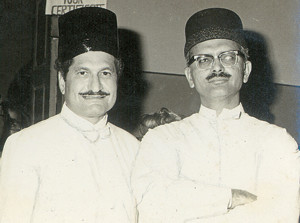
Jimmy Shroff (above and alongside, right), with Jimmy Guzder during the Bombay Parsi Punchayet trusteeship elections in 1975
"All matters dissolve in the crucible of time,” Shroff would say. "Simply repose your faith in the Almighty.” To harried clients who sought legal confrontation and arrived at his office fuming with feelings of outrage he was quick to recount anecdotes and instances where providence had played a major part in defusing crises and in dispensing justice. Shroff’s own ways were gentle and conciliatory, curious and affectionate, his humor unraveling in a flow that personified the fundamental harmony of man.
Originally a science student, Shroff grew up during a portentous phase of the freedom struggle, and so inspired was he by the lives of Dadabhai Naoroji, Pherozeshah Mehta, Mahatma Gandhi, and Jawaharlal Nehru that he chose to follow them in their vocation. He switched to law, turned vegetarian and committed himself to wearing khadi. Studying law also gave Shroff the latitude to woo law’s favorite handmaiden — literature — and while he pored over the dusty annals of judicial theory and practice he also read the works of Shakespeare and Marlowe, Keats and Shelley, Sheridan and Burke, Emerson and Hazelitt, and those of Lord Macaulay, with whom he identified the most. And equally he devoured Pyarelal on Gandhi and Nehru on India and Thomas Carlyle on the French Revolution and Abraham Lincoln on the evils of racism. It was not just the knowledge of the greats that Shroff imbibed but the values that defined these men, the idealism that made them stand up to the vicissitudes of their times. His briefs and arguments were tempered with their quotes, and he could rattle off speeches and constitutional judgments as easily as he could recite his prayers.
As a solicitor, Shroff was quick to make his mark. With his in-depth knowledge of law and his prolific insights he was able to impress the likes of senior counsels Hormusji Seervai and Nani Palkhivala, both of whom had great affection for him. As a teacher of law he was generous not just in the rapport he enjoyed with his students but in the way he graded them so that they might be encouraged to build strong, promising careers. A high point in Shroff’s life was when a former student of his, the renowned income tax lawyer Dinesh Vyas, glowingly acknowledged in a book Shroff’s contribution to his career. Gratitude pleased him like nothing else, for it showed the humility of a man.
In his capacity as a partner Shroff would make it a point to support junior solicitors and advocates with briefs and opportunities, which he did without reserve or exception, much to the discomfort of others not as liberal.
Bahram Vakil of AZB Partners recollects how during his first year as an associate with Little and Company Shroff had approached him at five o’ clock one evening, placed a file in his hands and said, "Can you take the 8.30 p.m. flight to Delhi? Read this on the plane. The matter is to be heard in the Supreme Court tomorrow… Accompanying me was a counsel from the Bombay City Civil Court for whom too it was a first in the Supreme Court. And the opposing counsel was none other than Fali Nariman. But of course Jimmy had chosen the perfect case for me. I can hear Jimmy’s chuckle even today. It was the chuckle of a man who knew what he was doing, helping to build the career of a junior!”
"In every sense, he was a true Zoroastrian,” says Dr Homi Dhalla. "No one who appealed to him went away empty-handed. No one who came to his door was turned away. Be it a young couple wishing to marry, or a widow needing money for her child’s education, or a fire temple in need of funds for repair.” If Shroff’s generosity was self-effacing, flowing compulsively and consistently from his heart, it was because he was perpetually grateful to the forces that had given him the means and the power to be charitable.
Shroff never forgot his roots. He came from a background that had faced rigors of adversity and hardship. His father Phirozeshaw had started life as an insurance agent, and "often the struggle was so intense, depending on how many policies could be sold.” Shroff would say that "we did not know whether we would have enough income to last out the month.” In addition to his day job, Phirozeshaw would give tuitions late into the night and early in the mornings, to augment his uncertain income. Nor did it help that their home served as a shelter to uncles and aunts and their families arriving from out of Bombay. "There were over 15 of us in a one bedroom apartment, and we stayed that way for three years,” Shroff would say. At that point, it was the kind protectionism and support of his joint family that saw Shroff’s own family through, and he never forgot that; he was all too eager to recap where he came from so that he might remember during every waking moment that divine grace that had transported him to better days, better times.
Shroff’s cousin, Bomi Shroff, former executive vice president and company secretary of Tata Power offers yet another story of Shroff’s largesse. "We were kids, my brother and I. We used to stay in Gwalior. We had come to Bombay for a visit. Jimmy had come to see us off at the station. Suddenly he rose to his feet as though to leave. My mother was concerned. She asked him what the matter was. Jimmy said he was leaving because I had not met him properly. With this, he started walking away. My mother chided me and sent me after him. Catching up with him, I apologized profusely, to which he winked and squeezed an envelope into my hands. He said he did not want to give this to me in front of the elders. And he gave me one for my brother as well. Opening it later, I was astounded. The envelope had 100 rupees in it, a princely sum for a boy of eight or nine, that too in the 1950s.”
Shroff believed that man exists merely as an instrument of the Lord and that his success is measured by what he has done to enrich the lives of others not as fortunate as himself.
A year-and-a-half ago, Shroff was diagnosed with a tumor. He took the news in his stride, accepting his lot with amazing equanimity. He continued to visit various fire temples, to pray for long hours, to lavish generosity on those less fortunate than himself. (On the urging of his spiritual mentor Minocher Pundole, Shroff stood against Jamshed Guzder in the 1975 Bombay Parsi Punchayet trusteeship election for the seat vacated by noted lawyer Shiavax Vakil. Shroff lost the election. — editors).
Throughout his illness he did not deem himself to be less privileged. He was grateful, in fact, that he was under the care of acclaimed doctors such as Boman Dhabhar and Cyrus Wadia, whom he described as men sent by Ahura Mazda himself. And he continued to express his unfailing faith in humanity. "Every soul is potentially divine,” he would say, quoting Swami Vivekananda.
Three days before Shroff passed away, I met an old college friend in the intensive care unit of the B. D. Petit Parsee General Hospital. "Who is that?” he asked of me, pointing to Shroff who lay in oblivious slumber. On drawing closer my friend’s face registered recognition. "I know him,” he said. "He is a deeply religious man, always praying. I have seen him at many fire temples and outside, too, distributing money to poor Parsis and to beggars. May I touch him please? He’s such a holy man.”
Needless to say, I consented. As I saw my friend draw up and place his hand lightly on Shroff’s forehead, covered with his beloved red prayer cap, and stroke the sleeping head gently, reverentially, not with the hand of a stranger but that of a respectful fellow Zoroastrian, I thought: This is not my maternal uncle (mama) who is fading. This is a man who belongs to all of humanity and to the divinity within. A man who has touched many lives, in ways unforeseen and unknown, in ways as modest as himself.
Murzban F. Shroff’s fiction has appeared in over 35 premier journals in the US and UK. He is the recipient of three Pushcart Prize nominations and the John Gilgun Fiction Award. His fiction collection, Breathless in Bombay, was shortlisted for the 2009 Commonwealth Writer’s Prize in the best debut category from Europe and South Asia. The book was rated by The Guardian as fourth among the Top Ten Mumbai books.
◆ ◆ ◆
From the archive