
Performing to please
The entertainment at the second Iranshah Udvada Utsav won bouquets, and a few expected brickbats
 criticism from the traditionalists. There were objections stated on social media on account of the British performer’s underplaying of his Parsi roots, and his gay orientation. "Aren’t there other sanskari (people with moral values) Parsis in India and abroad that such a controversial person should be given the limelight, and that too at a sacred place like Udvada?” asked a Facebook post from an orthodox commentator, adding that "to celebrate and commemorate his memory in Udvada and in the close vicinity of Pak Iranshah is a deliberate insult and demeaning the exalted status of the holy fire.”
 The 90-minute tribute to Mercury (1946-1991) by international performers Maryellen and All-Stars included nine-year-old Jeda, and Parsi vocalists Shazneen Arethna and Ervad Rushaad Dastur. The numbers presented included Queen’s (Mercury’s rock band) all time famous songs, Radio Gaga and I want to break free, followed by a performance of Bohemian Rhapsody by Dylan’s Salvation Singers Choir. The young ones in the audience, particularly the visitors from USA, UK and Pakistan who were part of the Federation of Zoroastrian Associations of North America’s Return to Roots program were dancing away and cheering for more. "One feels gratified to see the band so appreciated,” IUU core committee member Hoshaang Gotla told us, conceding that the music may not have appealed to the elderly and perhaps to members of local sister communities, who had adjourned for dinner while the music was on. "The concert would have been a total sell-out (if held) in Bombay,” he commented.
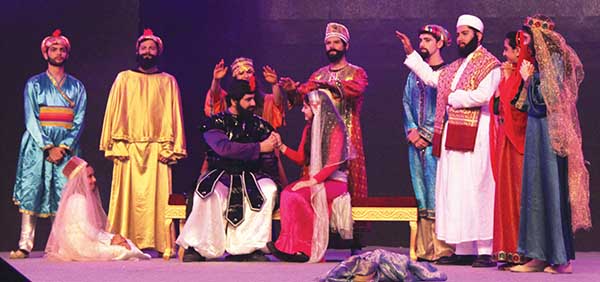
Rustom-e-Sohrab presented by the children of Mancherji Edulji Joshi Memorial Trust’s religion classes
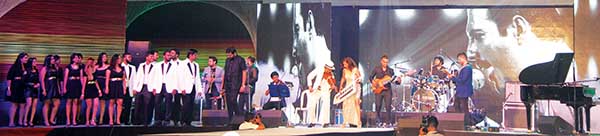
Tribute to Freddy Mercury
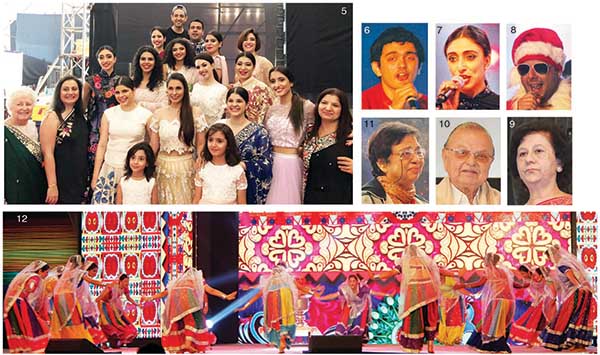
The trio of Dastur, his brother Ervad Parzaan and Delnavaz Patel were the voices behind the recorded prayers (Ashem Vohu, Yatha Ahu Vairyo and Yenge Hatam) that played at the beginning of each day and during breaks. Sung a capella (without accompaniment), the prayers were recorded over five or six hours. Dastur informed Parsiana after the event that all three had to recite the verses in 12 notes each, which were synthesized electronically.
Other entertainment for the 2,000 delegates and invitees included a fashion show curated by designer Ashdeen Lilaowala, rock and roll music from the all-boy, all-Parsi band the Big Red Bus, monajats, a specially prepared Iranshah no Garbo, and the play Rustom-e-Sohrab.
Key events of the Utsav were covered in our previous issue (see "Faith, fun and food,” Parsiana, January 7, 2018). The current article focuses on the Utsav’s lighter moments, specially the entertainment. The three-day event, jointly organized by the Foundation for Development of Udvada (FDU) with the support of the department of tourism of the Gujarat government, and the Udvada Samast Anjuman with corporate sponsorship saw visits by Vice President M. Venkaiah Naidu, union minister of minority affairs Mukhtar Abbas Naqvi, union minister for textiles, and information and broadcasting Smriti Irani, and Gujarat chief minister Vijay Rupani, among others.
The trio of Havovi Dastoor, wife of Udvada High Priest Dastur Khurshed Dastoor, who is also FDU trustee and IUU core committee member, and their daughters Parinaz and Shanaya were among those who walked the ramp in the "mothers and daughters” segment of Lilaowala’s fashion show. This raised comment from the traditionalist section of the community. Social media was buzzing the next day with comments on the "shocking disrespect to Shreeji Iranshah.” Activist Khushru Zaiwala asked, "Will the wife of High Priest of Tirumala, Vaishno Devi, or Ambaji be allowed to walk the ramp in the name of the Deity?”
Fashion-speak
"We had been preparing for the last six months,” said Lilaowala of the "30 looks (creations)” showcased in the fashion show The Daughters of Mashyoi. The designer told Parsiana after the event that "Each and every piece is hand-embroidered and takes an army of skilled craftspersons to finish. Some of the saris have 1,800 hours of craftsmanship.” The spectacle celebrated the "indomitable spirit of Zoroastrian women,” according to Lilaowala. Mashyoi (also referred to as Mashyana in some texts) was, according to Zoroastrian mythology, the first woman who, with the first man Mashya, gave rise to the human race.
The range on display included garas, jackets, lehenga sets and the couturier’s bridal collection. The show consisted of six segments, of which two were accompanied by dances and one by song. One part of the item showcased garas embroidered with flora and fauna and other Parsi and Chinese motifs, that the 37-year-old Delhi based trend setter is known for, with the models in this segment sporting blouses tailored to resemble sudrehs. Another segment represented "continuity and change,” as mothers and daughters, sisters, grandmothers and grandchildren walked the ramp, in "precious heirlooms, highlighting their strong bond of love and care.” Yet another slice of the show, in hues of orange, red and amber "recreated the eternal flame,” according to Lilaowala.
Songstress Delraaz Bunshah’s rendition of American songwriter and singer Rachel Platten’s Fight Song fit snugly in the midst of the fashion segments, with the performer in a black Lilaowala creation. To the designer, "this song reverberates with the power inherent in women as they overcome their struggles.” Bookending the four segments were two dance sequences created by the Shiamak Davar Dance Company representing the fragility of a butterfly emerging from its chrysalis; yet another fast paced number represented the community encouraging its daughters to achieve their dreams and celebrated the women excelling in (various) fields, and above all mothers and daughters.”
"We had 10 Parsi women who were modeling for us. None of them are professional models but can give any top model a run for their money,” revealed an exultant Lilaowala. He also talked of the heartaches of putting the show together: "I think the challenge was coordinating an event in Udvada from Delhi. Also all the girls are based in Bombay, so we had to do fittings in Bombay. As they have their own careers, they all met for the first time a few hours before the show in Udvada!”
Clad in a deep red Lilaowala creation, vivacious host for the evening, television personality Freishia Bomanbehram told Parsiana after the event that "to witness the energy from Parsis around the world coming together and celebrating is truly exceptional… and to be in the center of it made it even more special.”
Hormuz Ragina, lead vocalist of Big Red Bus whose rendition of La Bamba and a medley from singer Elvis Presley had both the young and the old tapping their feet, spoke to Parsiana after the performance. "We had a great time at the Utsav…We had a large crowd dancing with us for almost two hours… We felt more energy this year and definitely more kids and young people.” Besides the first edition of the Utsav in 2015, the band has performed at the World Zoroastrian Congress in Bombay and at the Holiday Programme for Youth (HPY) events.
Those on board the Big Red Bus include, besides Ragina, Sarfaraz Irani (lead vocalist), Peshotan Kapadia (rhythm guitarist), Danesh Khambata (drummer), Jahangir Pandey (base guitarist), Meheryar Tata (lead guitarist) and Kersi Gazdar (pianist). "Khambata and Gazdar are available (for marriage),” jokes Ragina, adding that "Khambata is married to his drums.”
On December 24, Khurshed released community historian Marzban Giara’s 320-page illustrated volume Valiant Parsis in war and peace. The book documents the lives and contributions of 550 Parsi officers and men of the armed forces, police and fire brigade. A special 24-page section has pictures of pre and post Independence medals, and life sketches of Parsi service chiefs — Field Marshal Sam Manekshaw, Admiral Jal Cursetji, Air Marshal Aspi Engineer, Air Chief Marshal Fali Major and others.
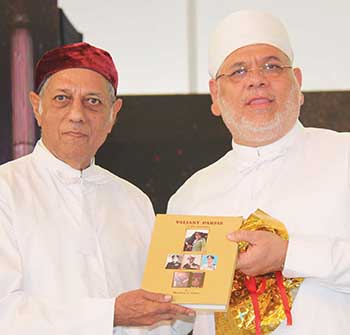
Dastur Khurshed Dastoor (r) releasing Marzban Giara’s book on valiant Parsis
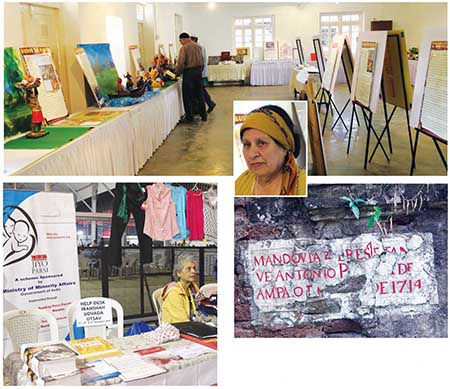
One hundred and twenty-four delegates took part in a 20-minute heritage walk scripted by conservation architect Jamshed Bhiwandiwalla on December 24 in batches of 20. Hosted by Surat based architect Delnaz Kharadi and architectural student Vibhuti Joshi, the batch that the Parsiana representative took included a visit to a private home that had a well with a Portuguese inscription in its backyard. Both hosts pointed out how the layout of the village, with its two main roads (Sea View Street and Meriwadi Street) connected by side streets and narrow service roads, and interspersed with open spaces, made for congenial community interaction. Gauging from audience reactions, many were hearing factoids about the journey of the holy fire to various places in Gujarat for the first time. "Where is Vansda?” asked an elderly Zoroastrian woman from Europe. (Vansda is in Navsari district, south Gujarat — editors). The itinerary included a view of the erstwhile Bhathela House where the holy fire is believed to have been first enshrined for a while. Now a private residence, access to the home was not permitted.
Khurshed had noted earlier that the Utsav was for "faith, fun and food.” The spiritual element was manifested in "A journey of devotion,” three monajats presented on the first day by girls of the Bai Avabai F. Petit Girls’ School. Two more monajats were presented by Mani Rao on the second day. Chicago based Rao is writing the prayers in English for the Zoroastrian diaspora, she told the audience.
The Petit School girls again took the stage clad in multi-colored ghagras (long skirts) and white odhnis (long scarves) to present Iranshah no Garbo. Choreographed by School superintendent Yasmine Charna, this dance was set to a specially composed song whose lyrics went "Mane jova gamme Udvada gaam (I love to see Udvada village)” with music from an old Hindi movie. Bomanbehram termed the girls’ performance "an amalgam of dance and devotion.”
"Fun moments with Yazdi Karanjia” a 10-minute interlude slotted between a panel discussion and presentations by overseas delegates provided mirthful moments. The Surat based dramatist related, à la Adi Marzban, fictitious humorous interactions with his wife Veera, and the travails of going shopping with her. The late stage director Marzban was known for his radio shows featuring his repartee with his wife Silla. "Our religious right is to keep smiling,” Karanjia said.
A somewhat lengthy play, Rustom-e-Sohrab in English and Gujarati, with elaborate costumes put up by the children of Mancherji Edulji Joshi Memorial Trust’s religion classes and directed by social worker and Dadar colony doyenne Mithoo Jesia came in for appreciation by the locals. "Bov sarras, bov jaanva mallyu (Very nice, we learnt a lot),” an elderly Gujarati lady was heard saying.
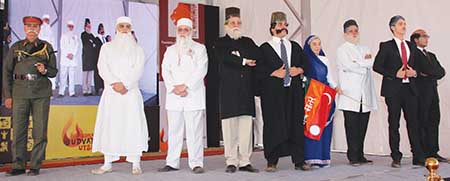
On the last day of the event, an audiovisual presentation titled Parsi lustre on Indian soil played before chief guest Naidu narrated the achievements of Parsi greats. Community luminaries were represented on stage by young people dressed and made up to resemble priest Nariyosang Dhaval, industrialists Jamsetji and J. R. D. Tata, thinkers Dr Sir Jivanji Modi and Dadabhai Naoroji, freedom struggle leader Bhikhaiji Cama, Maneckshaw and jurist Nani Palkhivala.
A specially curated exhibition on Iranian history and the Shahnameh in particular was open all days of the event at the Dastur Kayoji Mirza Hall. Over 25 panels depicting scenes from the epic, "created in the USA and shipped to India” were on show, organizer and Mazdayasnie Connection founder Silloo Mehta told Parsiana. Models of figures mentioned in the epic, crafted by a maker of Ganapati idols in Bombay, were also part of the exhibits.
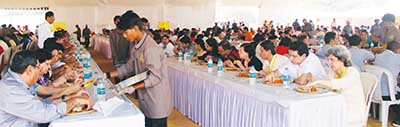
Over 25 stalls offering food, artifacts, gift items were put up in a separate enclosure, and included one that was disseminating information about the Jiyo Parsi program. "Good to be here, so much interaction with Parsis,” an Iranian man selling table linen remarked to Parsiana.