
Law
Balancing rights
The two Bombay High Court Justices weighed the essentials of the Zoroastrian religion and the greater good while deciding on the Metro tunnel alignments
The petition filed by community activists opposing the alignment of the Metro tunnels under the H. B. Wadia and the Anjumanna Atash Behrams failed to convince a division bench of the Bombay High Court that their beliefs were an integral part of the Zoroastrian religion. The petitioners Jamshed Noshir Sukhadwalla, Behruz Nariman Irani, Ratan Dorab Patel, Ervad (Dr) Rooyintan Peshotan Peer and Berjis Minoo Desai had contended the tunnels passing under any portion of the fire temples would disrupt the holy fires’ link with the magnetic core of the earth but were unable to substantiate the claim with any satisfactory scriptural evidence.
Chief Justice Ramesh Patil and Justice R. G. Ketkar in their 467-page detailed and reasoned judgment dismissed the petition on November 30, 2018 but instructed the Mumbai Metro Rail Corporation Limited (MMRCL) to take adequate precautions and constantly monitor the work undertaken to ensure no damage would be caused to the two structures while tunnelling/boring.
The conditions included: Ensuring there is no damage caused to the two atash behrams during the execution of tunnelling work; strict monitoring of vibration levels 24x7 using necessary devices and equipments; the presence of a specially constituted team of experts to be present on the spot 24x7 during boring of the tunnel; (TBMs) Tunnel Boring Machines to be slowed down during the tunnelling work beneath the two atash behrams; controlled blasting method for boring the tunnel underneath the two atash behrams; necessary equipments to be installed permanently in different places in or around the two atash behram structures to monitor levels of vibrations; continuous monitoring of water levels in the wells and installing requisite number of ground water charging wells.
Chief Justice Ramesh Patil and Justice R. G. Ketkar in their 467-page detailed and reasoned judgment dismissed the petition on November 30, 2018 but instructed the Mumbai Metro Rail Corporation Limited (MMRCL) to take adequate precautions and constantly monitor the work undertaken to ensure no damage would be caused to the two structures while tunnelling/boring.
The conditions included: Ensuring there is no damage caused to the two atash behrams during the execution of tunnelling work; strict monitoring of vibration levels 24x7 using necessary devices and equipments; the presence of a specially constituted team of experts to be present on the spot 24x7 during boring of the tunnel; (TBMs) Tunnel Boring Machines to be slowed down during the tunnelling work beneath the two atash behrams; controlled blasting method for boring the tunnel underneath the two atash behrams; necessary equipments to be installed permanently in different places in or around the two atash behram structures to monitor levels of vibrations; continuous monitoring of water levels in the wells and installing requisite number of ground water charging wells.
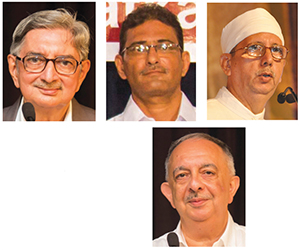
Clockwise from above left: Jamshed Sukhadwalla, Ratan Patel, Ervad (Dr) Rooyintan Peer and Berjis Desai
The justices noted that MMRCL has already agreed to move the tunnels 3.5 meters away from the original alignment.
As there is substantial overlapping in the two judgments Parsiana has selected passages from both that put forth their reasoning.
"The metro tunnel on the other side has already been constructed… therefore, it was submitted that now the realignment is not possible as the same will disturb construction of Kalbadevi station and it will further disturb the alignment between the two Metro lines going upward and downwards.
"The safe speed for safe operation of TBM (tunnel boring machine) is 10 m per day. TBM for the upline is 100 m away from Anjumanna Atash Behram and 200 m away from Wadia Atash Behram. It would take approximately 10 days for the machines to reach boundary of the Anjumanna Atash Behram and 20 days to reach Wadia Atash Behram from its current location. (MMRCL) counsel submitted that it is possible to reduce the speed of TBM to the extent possible. However, such reduction of speed increases the likelihood of squeezing of the ground, which may result in settlement of the ground at surface level. MMRCL has setup a detailed protocol for monitoring various structures involving installation of various monitoring devices such as ground settlement markers, building settlement markers, cracks meters, building tilt meters, building vibrations monitors, bireflex targets, optical targets.
"The protection guaranteed under Articles 25 and 26 of the Constitution is granted to the acts done in pursuance of the religious ritual and ceremonies, modes of worship, beliefs, practices which are integral or essential part (of the religion)… Whether such beliefs and practices are integral or essential part of the religion has to be determined with reference to doctrines, practices, tenets, historical background, etc... It has been, therefore, observed that what is meant by an essential part or practices of religion is a matter of elucidation. The essential part of religion means the core beliefs upon which the religion is founded. The essential practices mean those practices that are fundamental to follow a religious belief. One of the tests which has been applied is to see if the taking away of that part or practice could result in a fundamental change in the character of religion or its belief and if it does change, then such a part be treated as an essential and integral part. Belief must be of an essence of that religion...
 "Taking into consideration the material placed on record, documents the petitioners’ assertion made in the petition, affidavits, rejoinders, affidavits filed by the high priests, articles published in the journals, books, we are not fully convinced… that the entire atash behram premises are consecrated. Assuming that the atash behram premises are consecrated, the petitioners could not establish that by constructing a tunnel 60 feet underneath the atash behram premises would desecrate the atash behram, and due to which existence of religion itself would get endangered...
"We have carefully gone through the various charts, plans, photographs to appreciate the case of the petitioners. We are not persuaded by the petitioners to hold that in constructing the tunnel underneath the atash behram premises, protection guaranteed under Articles 25 and 26 of the Constitution of India would get breached.
Justice Patil cited an extract from a Supreme Court judgment by Justice Rohinton Nariman which stated, "What constitutes essential religious practice must be decided with reference to what the religious community itself says, yet, the ultimate constitutional arbiter of what constitutes essential religious practice must be the court, which is a matter of constitutional necessity.”
At the Court’s request the Victoria Jubilee Technical Institute (VJTI, renamed Veermata Jijabai Technological Institute) examined the MMRCL proposal to ascertain if there was any damage to the fire temple structures. The VJTI team included Prof Dr R. D. Daruwala, head of the electrical engineering department. The team concluded:
"The proposed tunnelling work (using TBM) and the proposed construction of Kalbadevi Station adjacent to Wadiaji Atash Behram shall not have adverse effect on the structures” nor the "level and quality of water in the wells within the premises of both Atash Behrams.”
There are four wells in the Wadia Atash Behram and three wells in Anjumanna Atash Behram. "The nearest well in the Wadia Atash Behram is 42 feet away from the nearest point of the tunnel while the Atash Behram (is) 15 feet away,” noted Patil. "These wells are in the top soil layer of about 20 feet deep while the tunnel is in the rock and is at 60 to 65 feet deep from the ground level. Thus, there is a clear vertical space of 42 to 46 feet of rock mass between bottom of wells to the top of the tunnel. It was noticed that in the absence of any metro related construction activity, there is a daily fluctuation in water level in the wells. The planners have taken into consideration the passenger movement during the normal operation as well as during a fire emergency. Station amenities and service are also taken into consideration.”
Noting that London developed its first Metro system in 1843 and "150 cities of various sizes all over the world had rapid transit rail for decades specially in Asia, Africa and Latin America,” he added, "Where heritage sites are located within the cities, the development of cities is planned in a manner so as to maintain balance between infrastructural development while retaining and maintaining heritage and important sites and structures. This is often a difficult balance to maintain. London, Rome, Istanbul, Beijing, Delhi and Jaipur are such examples where balancing exercise has been done effectively with the aid and assistance of the experts in the field and financial backing of central and state governments... No doubt, it is true that Mumbai is one of the congested cities of the country… Mumbai local trains are catering to more than 75 lakhs of people daily. There are about 2,500 to 3,000 deaths reported every year in the running of local trains in Mumbai. It is a matter of serious concern... The citizens of Mumbai do deserve efficient, suitable and environment friendly mass transport system. There is an acute need to serve millions... The state is duty bound to provide an efficient transport system to its people.”
MMRCL counsel stated that neither of the two atash behrams is "ancient” or "protected monuments” as prescribed under the Ancient Monuments and Archaeological Sites and Remains Act. They have not been notified as such and the petitioners are not entitled to take benefits of these provisions.
"It has also been brought to our notice that petitioners did not raise any objection when the contesting MMRCL called for suggestions and objections and fixed date for public hearing. The petitioners had an opportunity to place their case before the authorities concerned at the relevant time but they failed to do so.
It was also submitted by MMRCL that the petition is filed by individuals raising an issue when no leave of the court has been taken (to make this assertion). Others may not agree with the views expressed by the petition. "Therefore, the views expressed by the petitioners and some of the priests in the affidavits shall not be taken to be the views of the community.”
"There is no reference that seems to suggest that the karshas (aura magnetic circuit) extend indefinitely under the surface of the earth, nor is there any reference to suggest that they are intended to so extend beneath the marked area in order to protect any ‘link’ according to the petitioners which exist in the ceremonial fire in the fire temple and the fires that burn inside the earth. The petitioners have also not shown any basis which supports the contention that the fire which is ignited after following the required rituals is connected to subterranean fires beneath the surface or that the atash behram is required to be in constant connection with any electromagnetic field for receiving vibrations. In any case, assuming, though not admitting, that there exists some basis in the religious texts, such belief or any practice related thereto cannot be understood to constitute the essence of Zoroastrian faith, as it will at best be understood to be a belief or practice…
"It is submitted that there is no reason to conclude that the minuscule physical vibrations emanating from the Metro line would interfere with the spiritual vibrations emanating from the holy fires housed in two atash behrams. Certain practices even though regarded as religious, may have sprung from merely superstitious beliefs and in that sense can be only extraneous and unessential accretion to religion itself. Such practices can be abrogated and are not protected under Article 25 of the Constitution…
"Any demand of the petitioners for enforcement of their fundamental rights under Article 25 must be balanced against the rights of the citizens at large. The citizens have access to the benefits and conveniences of the city, as also to live a life of dignity, work in comfortable environment, and partake in the wealth of the city. The State is under constitutional obligation to ensure that the citizen is not deprived of these benefits and conveniences. Any right of the petitioners to practice their religion cannot be to the negation of the fundamental rights of the citizens. I accordingly hold that the fundamental rights claimed by the petitioners under Article 25 of the Constitution of India is subservient to other fundamental rights in Part III of the Constitution of India.”
The court turned down a request to continue the injunction against the Metro tunnelling and other work during the two-week period given for appealing the decision before the Supreme Court. The Justices stated, "We do not find it appropriate to withhold an infrastructure project of this magnitude any further.”
◆ ◆ ◆
From the archive