
Law
Monies for muktad
Monies willed for performance of muktad prayers in perpetuity are valid bequests
It is unfortunate that day by day Parsis are losing faith in muktad ceremonies, either because of the increasing costs of the ceremonies or because the laity are not satisfied with the services given by the priests. Many people prefer to do charity in the name of the deceased, instead of performing muktad ceremonies year after year.
The term muktad (derived from muktiatma to denote the passage of the soul from purgatory into paradise) is used to designate the last 10 days of the Zoroastrian year, starting from roz Ashtad, the 26th day of the last month Spandarmad up to the day of the Vahishtoisht Gatha. The object of these Fravardigan days is to remember and honor the farohars or the spirits of the dear departed ones. From passages of the Fravardin Yasht (Yasht XIII 40-50) we learn that the fravashis of the dead expect their name to be invoked in some of the liturgical ceremonies, especially the afringan ceremony where the names of the deceased members of a family are recited from a list called namagrahan. According to a passage in the Fravardin Yasht, the farohars of faithful Zoroastrians visit the homes of their survivors during these 10 days and nights when the priests offer prayers in memory of the dead. Hence in villages in ancient times, the muktad ceremonies were performed in the house of the deceased. With the passage of time and shortage of priests, the muktad ceremonies came to be performed in agiaries and atash behrams. In some cases the muktad ceremonies of a deceased person are performed at more than one place.
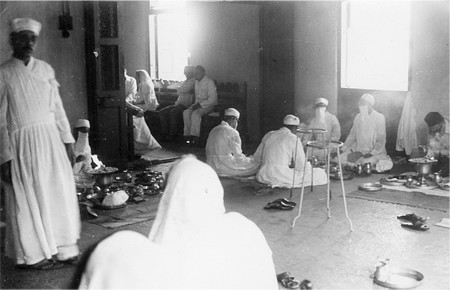
Priests performing muktad ceremonies
Muktad ceremonies or at all events the essential part of such ceremonies can only be performed by priests. The money paid to the priests for the performance of the muktad ceremonies forms a good portion of their ordinary income. The priests make a higher income during the Fravardigan days than they do during any other period of the year, and the muktad ceremonies form a sort of endowment which goes a long way to maintain the priestly classes whose existence is necessary to the community of Zoroastrians. According to the belief prevailing amongst the faithful followers of Zoroaster, the performance of muktad ceremonies confers public benefits on the Zoroastrian community, on the people amongst whom they live, and upon the country which they have chosen as their home. The fundamental principle underlying this belief is faith in the efficacy of prayers addressed to the Great Creator.
When Parsis prepare a will, they direct their executors to spend a certain sum for muktad and obsequial ceremonies. The performance of muktad and obsequial ceremonies is a religious duty imposed upon Zoroastrians.
The first case regarding muktad ceremonies and religious trusts came up before Justice Jardine of the Bombay High Court in Limboowala’s case where the judge declared trusts for baj rojgar and muktad ceremonies to be invalid. The learned judge held that the rule of law forbidding perpetuity applies to muktad trusts. As explained in section 114 of the Indian Succession Act, "No bequest is valid whereby the vesting of the thing bequeathed may be delayed beyond the lifetime of one or more persons living at the testator’s death and the minority of some person who shall be in existence at the expiration of that period, to whom, if he attains full age, the thing bequeathed is to belong.”
Thereafter another case came up before the Bombay High Court in Suit No. 267 of 1890, Dinbai vs Hormusji Dinsha Hodiwalla, where Justice Farran gave no judgment but merely recorded a decree declaring that the bequest under the will was void.
In Limji vs Bapuji (1887) I.L.R.II Bom 441, it was held that a trust for the performance of muktad and baj rojgar ceremonies comes within the category of trusts for the advancement of religion and not as valid charitable trusts.
Various judgements were overruled in the judgement delivered by Justice Davar in 1907, Volume X, The Bombay Law Reporter, page 417 in the case of Jamshed K. Tarachand vs Soonabai. Davar held that:
"Trusts and bequests of lands or money for the purpose of devoting the incomes thereof in perpetuity for the performance of muktad, baj, ijeshne and other like ceremonies, are valid ‘charitable’ bequests, and as such exempt from the application of the rule of law forbidding perpetuities.
"The performance of the muktad ceremonies is a religious duty imposed upon the Zoroastrians by the proved tenets of the religion they profess. The ceremonies themselves are acts of religious worship. They include worship, praise and adoration of the supreme deity, and a thanksgiving for all his mercies. They contain petitions for benefits both temporal and spiritual for all Zoroastrians — for all holy and virtuous men of all other communities — and they comprise prayers for the well-being and long reign of the sovereign, for good government by him, and for victory to him over all his enemies. The muktad ceremonies tend most unmistakably towards the advancement of the religion promulgated by the Persian Prophet Zoroaster, and the performance of these ceremonies is an act of divine worship in its highest and truest sense.”
The author is a solicitor practising in the Bombay High Court.
◆ ◆ ◆
From the archive