
Mehta, Matheran and Mahableshwar
Even while on vacation, Sir Pherozeshah Mehta fought for his rights
A section of a chapter "A Contested Election — Death of Dr Bahadurji — A Holiday Incident. 1898-1899” from Sir Homi Pherozshah Mody’s book Sir Pherozeshah Mehta: A Political Biography [Volume II (1921)] is reprinted here with minor editing. A copy of the book was kindly donated to Parsiana by Poona reader Diana Ratnagar. Mehta (1845-1915) was the municipal commissioner of the Bombay Municipal Corporation in 1873 and its president four times. One of the founders of the Indian National Congress, he was chosen president of the body in 1890. He was referred to as "The Lion of Bombay” and the "Uncrowned King of Bombay.”
.jpg) Parsis of every description congregate in such large numbers in the summer months. Plague was then at its height and was exacting a terrible toll. There was a general feeling of panic, which was aggravated by the stringent regulations for detention, segregation, medical examination and the like, which were put into force by a government faced with considerable difficulties in dealing with the situation. The hill was then under the charge of Maj Collie, who was somewhat of a martinet, and inclined to be arbitrary in his methods, but who was for all that, an able and conscientious officer.
Parsis of every description congregate in such large numbers in the summer months. Plague was then at its height and was exacting a terrible toll. There was a general feeling of panic, which was aggravated by the stringent regulations for detention, segregation, medical examination and the like, which were put into force by a government faced with considerable difficulties in dealing with the situation. The hill was then under the charge of Maj Collie, who was somewhat of a martinet, and inclined to be arbitrary in his methods, but who was for all that, an able and conscientious officer. It was hardly surprising that the two men, each with a will of his own, should come into collision over such a ready source of friction as the plague regulations. Collie had issued an order that visitors to the hill were to call daily at the superintendent’s office for examination, or in the alternative, might be examined by him every other day on payment of a fee of Rs 50. These regulations were irksome in themselves, and as often happens, they were improved upon by zealous subordinates with the result that there was general dissatisfaction. Prominent visitors, among them Budrudin Tyabji, then a judge of the High Court, complained about the inconvenience and annoyance to which they were subjected, but Collie declined to relax the rigor of the precautions he deemed necessary for the safety of the hill.
Such was the state of affairs when Mehta appeared on the scene. As he was riding up to Matheran, a form which all visitors were required to fill in was handed to him at the spot known as the ‘Dusturii.’ He entered up the details, scratched out the declaration regarding the 10 days’ attendance at the superintendent’s office for purposes of examination, and returned the form. The challenge was thrown, the duel begun. Collie insisted on Mehta’s attendance at his office, and on the regulations being observed in their entirety. Mehta with equal emphasis declared that there was nothing in the plague rules posted up by the superintendent, which made it incumbent on him to present himself for examination. He had no objection to anybody going to his place to make inquiries! He took his stand on the regulations, and not, as some people wrongly supposed, on a pass which enabled him and his family to travel throughout the presidency without being subjected to detention or surveillance. A long correspondence ensued, and as may be readily imagined, it was not Collie who scored in this duel of words. The stern disciplinarian found that though he could impose his will upon high and low, rich and poor alike, he was no match for the formidable lawyer and politician. Mehta carried the day, and Collie found himself powerless to enforce his orders.
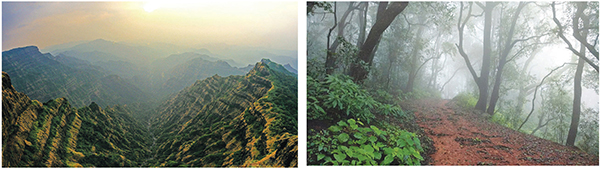
Above (l): View from Arthur Seat point, Mahableshwar; (r) pathways in Matheran Photos: Wikipedia
The matter did not end there. Mehta wrote a strong letter of remonstrance to the plague commissioner, who hastened to express "official regrets,” and gave an assurance that instructions had been issued to prevent a recurrence of the trouble and annoyance to which the visitors to Matheran had been subjected. Mehta also wrote to the private secretary to the governor, and sent the whole correspondence to the Press for publication. Thereupon, a great many people came out to give vent to their indignation, and the unfortunate superintendent, who had had an opportunity of placing his own version before the public, got a very rough handling in the papers. This was too much for The Times of India, then under the editorship of Lovat Fraser, a brilliant writer, but a confirmed and bigoted opponent of Indian aspirations. In a scathing article the paper dealt with the merits of the controversy, and charged Mehta with having "allowed himself to be betrayed, in his letter to the governor, with serious misstatements, more often into significant omissions of salient facts, and more than once into quotations which do not err on the side of ingenuousness.” It condemned the loose talk about drawing a line of distinction between prominent citizens and those in a lower grade of society, and inquired where the demarcation was to be made. Were they to stop short at gentlemen who had climbed to the dizzy height of a seat in the Viceregal Council? The article went on to say that Mehta’s lurid pictures of the miseries attendant upon the registration of names were largely the products of his own exuberant imagination, and observed in conclusion:
"The interests of the public demand that the task of excluding plague from our health resorts should receive even more consideration than the dignity of members of Council. It is unfortunate that Mr Mehta’s own trivial grievances should have so large a place in his interest in plague matters. Still more lamentable is it that he should have found a prominent Government official ready to accept his ex-parte statements untested, and by plain implication to condemn a conscientious officer unheard. But we still find room for the hope that when the Bombay Government sets itself to deal with this question, it will take steps to remove the impression which has got abroad that it will not stand by its own orders regarding plague, and will abandon its officers to the first plausible person who heads an attack upon them.”
This outburst provoked a sharp reply from Mehta, containing insinuations concerning the origin and authorship of the article, which, he suggested, must have been inspired by Collie himself. Exception was taken by the editor to these passages as violating the well-established rule of English journalism that the personality of the writer of an editorial article should be kept out of controversy. As Mehta would not consent to leaving out the offending portions, The Times of India declined to publish the letter, and hoped its readers would not be inconsolable at the exclusion of a communication which extended to two columns, and ended by threatening a second. Mehta passed on the correspondence to The Bombay Gazette, whereupon there was a further exchange of recriminations and personalities.
While other people protested and sank into silence, Mehta returned again and again to the attack, until he had exhausted all the weapons in his armory. Some years before, when the authorities at Mahableshwar shut the door in the face of Indian visitors, and debarred them from the use of the tennis courts and the library, largely endowed by the subscriptions of Indians, Mehta promptly challenged their right to do so, and made things so uncomfortable for them that they had to abandon the courts. His spirited attack on the caste barriers set up by the white Brahmin in this country was the topic of the hour on the hill. The echoes of the controversy were even heard in Bombay, and gave some people an opportunity of criticizing the troublesome visitor, and moralizing on the relations betweem the two races.
When the Bombay Government on one occasion paid no attention to the representations of the Corporation, Mehta prevailed upon it to appeal to the Imperial Government, and when the latter upheld the decision of their subordinate, the issue was carried to the Secretary of State for India and pressed home till it was brought to a satisfactory conclusion. When Lord Sandhurst as president of the Council disallowed a question concerning one of the Kathiawar states, Mehta did not hesitate to challenge the ruling and approach the Government of India.
When the Plague Committee appointed by Government played fast and loose with the money of the Corporation without rendering proper accounts, he threatened that no further advances would be made till all accounts of the sums allocated up to date were settled. When the committee appointed by the Bombay Government to report on a proposed increase in the city police force, following on the Hindu-Mohamedan riots of 1893, adopted an arbitrary procedure and put up a hasty report without allowing Mehta, who was a member, an opportunity of fully stating his case, the committee generally, and its autocratic secretary, James Campbell, in particular, got a trouncing long remembered by all who witnessed the combat. In these and innumerable other ways, Mehta showed the stern stuff of which he was made. If, as a leader of men, he has not been equaled by anyone, either before or after him, the reason must be sought, apart from his unusual gifts of intellect, in the fearlessness which distinguished him from early life, and which was never confounded with mere bluster and aggressiveness. During his strenuous career, he provoked many jealousies, made many enemies. Harsh things were thought and said of him. But no opponent, however bitter, lightly ventured to cross swords with him, or fail to recognize that the formidable Bombay leader had a masterful personality, and that it was no mere gift of tongue or intellectual suppleness that raised him so immeasurably above his fellows.