
History
No mandate for Mehta
Around Jamshedi Navroz 107 years ago, Parsis rejected the trusteeship candidature of Sir Pherozeshah Mehta to the Bombay Parsi Punchayet
A chapter "A communal controversy: Pherozeshah and the Parsis” from Sir Homi Pherozshah Mody’s book Sir Pherozeshah Mehta: A Politicial Biography Volume II (1921) is reprinted here with minor editing. A copy of the book was kindly donated to Parsiana by Poona reader Diana Ratnagar. Mehta (1845-1915) was the municipal commissioner of the Bombay Municipal Corporation in 1873 and its president four times. One of the founders of the Indian National Congress he was chosen president of the body in 1890. He was referred to as "The Lion of Bombay” and the "Uncrowned King of Bombay.”
.jpg)
Portrait of Sir Pherozeshah Mehta by N. Writer, circa 1908,
courtesy Elphinstone College Photo: Varghese Fernandez
Sir Pherozeshah Mehta returned to Bombay in February 1911 (from Europe) and found himself in an atmosphere of fierce passions and animosities. For the first time in his many-sided career, he found his name on the lips of every Parsi, and his views and principles the subject of heated discussion in every Parsi home. The occasion was the election of three additional trustees on the board of the (Bombay) Parsi Punchayet — a body which administers the charitable funds of the community – as sanctioned under a scheme framed after a protracted and costly litigation, which seemed to have brought to the surface all the bigotry and fanaticism of which the community was capable. The election of the trustees assumed, for a large section, the importance of a life and death problem, and it was the one topic of conversation wherever Parsis gathered in any numbers. The orthodox party wanted the nominees of its own choice to sit on the board of the Punchayet, in order to conduct its affairs according to its own pet notions, and to preserve inviolate the manners, usages and superstitions handed down from generation to generation.
In this state of affairs, while Mehta was in England, he received a wire in November 1910, from six Parsis, among whom were some representatives of the orthodox section, asking his permission to put forward his candidature. He consulted some friends, who persuaded him not to reject such an opportunity of serving his community, and under a belief that his co-religionists wanted him, he signified his assent. He did not know the exact position of affairs, and those whose duty it was to enlighten him before they secured his assent very reprehensibly failed to do so. A violent Press campaign was at once set on foot by his opponents, and when Mehta returned, he found he was up against another caucus, equally energetic and unscrupulous as the one which had attempted to overthrow his supremacy in the Bombay Municipal Corporation. It would have been well if at this stage Mehta had rescued himself from the unfortunate position in which some of his over-zealous friends and admirers had placed him. If he had declined to have anything to do with an office which could not confer upon him any greater distinction than he enjoyed, and from which a section of the community was determined to exclude him (he would not lose his political standing). But, either from an imperfect realization of the forces that were arrayed against him, or because he was a fighter all his life, he declined to reconsider the position and withdraw his candidature. The result was a complete defeat, though his old colleague, H. A. Wadya, who had been put up as one of the rival candidates, and who did not feel very happy in the position he occupied, advised the electorate to vote for Mehta in preference to himself. It was a foregone conclusion; it did not, at least, surprise those who knew anything about the organization of the so-called orthodox party, and who were aware of the ease with which the electorate could be manipulated under a scheme directly circulated to facilitate an overwhelming representation of the ignorant and illiterate.
The defeat of Mehta was hailed with exuberant joy by his opponents, and trumpeted in glaring headlines which proclaimed that the community did not want him, and would be quite happy to jog along without the assistance of the "Indispensable.” It was intended to serve as a rude rebuff to one who was never tired of declaring that he was an Indian first and a Parsi afterwards. As a matter of fact, the defeat was in no sense a verdict of the community. The vast majority of the educated classes, the men of light and (learning), voted solidly for Mehta, and had it not been for hired voters who composed the bulk of the electorate, he would have emerged triumphant, despite the machinations of his puny opponents. The scheme of election provided ample scope for manipulation, and the victory went to the party with the superior organization and the less scrupulous methods. It was not a clean fight, and what was practically the only defeat at a poll sustained by him during his long and eventful career, could in no sense be regarded as a judgment of the community on its most distinguished member.
In this state of affairs, while Mehta was in England, he received a wire in November 1910, from six Parsis, among whom were some representatives of the orthodox section, asking his permission to put forward his candidature. He consulted some friends, who persuaded him not to reject such an opportunity of serving his community, and under a belief that his co-religionists wanted him, he signified his assent. He did not know the exact position of affairs, and those whose duty it was to enlighten him before they secured his assent very reprehensibly failed to do so. A violent Press campaign was at once set on foot by his opponents, and when Mehta returned, he found he was up against another caucus, equally energetic and unscrupulous as the one which had attempted to overthrow his supremacy in the Bombay Municipal Corporation. It would have been well if at this stage Mehta had rescued himself from the unfortunate position in which some of his over-zealous friends and admirers had placed him. If he had declined to have anything to do with an office which could not confer upon him any greater distinction than he enjoyed, and from which a section of the community was determined to exclude him (he would not lose his political standing). But, either from an imperfect realization of the forces that were arrayed against him, or because he was a fighter all his life, he declined to reconsider the position and withdraw his candidature. The result was a complete defeat, though his old colleague, H. A. Wadya, who had been put up as one of the rival candidates, and who did not feel very happy in the position he occupied, advised the electorate to vote for Mehta in preference to himself. It was a foregone conclusion; it did not, at least, surprise those who knew anything about the organization of the so-called orthodox party, and who were aware of the ease with which the electorate could be manipulated under a scheme directly circulated to facilitate an overwhelming representation of the ignorant and illiterate.
The defeat of Mehta was hailed with exuberant joy by his opponents, and trumpeted in glaring headlines which proclaimed that the community did not want him, and would be quite happy to jog along without the assistance of the "Indispensable.” It was intended to serve as a rude rebuff to one who was never tired of declaring that he was an Indian first and a Parsi afterwards. As a matter of fact, the defeat was in no sense a verdict of the community. The vast majority of the educated classes, the men of light and (learning), voted solidly for Mehta, and had it not been for hired voters who composed the bulk of the electorate, he would have emerged triumphant, despite the machinations of his puny opponents. The scheme of election provided ample scope for manipulation, and the victory went to the party with the superior organization and the less scrupulous methods. It was not a clean fight, and what was practically the only defeat at a poll sustained by him during his long and eventful career, could in no sense be regarded as a judgment of the community on its most distinguished member.
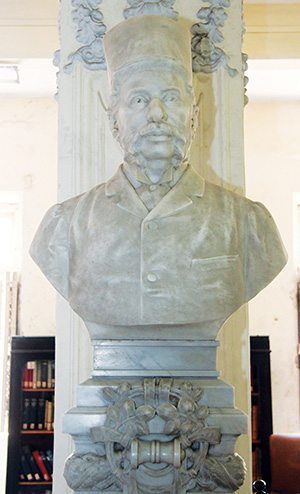
Bust of Mehta at Ripon Club Photo: Jasmine D. Driver
.jpg)
Mehta at his table Photo courtesy: Rajan Jayakar
It would be useful to examine here in brief the contention put forward by Mehta’s detractors that he had shown himself studiously indifferent to the interests of his co-religionists, and that he had given to the country what was meant for his community. It may be admitted that he felt very cold towards many of the questions which agitated the minds of Parsis, and which made them the laughing stock of other communities, who could not understand the fanaticism and bigotry occasionally displayed by the most civilized and progressive race in all India. He was positively hostile besides to the promotion of communal interests as such, holding that the fortunes of the Parsis were linked with those of other Indian nationalities. Nothing could have been more emphatic than his famous declaration that a Parsi, was a better and truer Parsi the more he was attached to the land which gave him birth, the more he was bound in brotherly relations and affection to all the children of the soil, the more he recognized the fraternity of all the native communites of the country, and the immutable bond which bound them together in the pursuit of common aims and objects under a common Government.
But for all that, ever since the beginning of his career, Mehta took a keen interest in the questions which affected the larger interests of the community. One of his earliest public appearances was at the time of the Parsi-Mohamedan riots of 1874, when he came forward boldly to protest against the conduct of the Government and the Police. The community had been thrown into a ferment over the manner in which it had been treated by those responsible for the public peace, and in the Press and from the platform, Pherozeshah scathingly condemned their weakness and want of sympathy. When some three years later, the question of the leadership of the Parsis arose through the death of the second Sir Jamsetjee Jejeebhoy, Pherozeshah was again to the fore, and his lucid and convincing exposition of the need for a titular leader had not a little to do with influencing the minds of those who were opposed to the principle of the appointment, and entertained serious misgivings as to its practical operation. Again, when the community was thrown into a ferment over the attack made upon its honor in a report made by Ommaney, the Inspector-General of Police, to the Government of Lord Reay, Mehta kept a cool head and used his best endeavors to prevent his co-religionists from playing into the hands of those who resented the action of that courageous Governor in connection with the Arthur Crawford inquiry, and who did not scruple to employ every device to discredit him. The role he played was very unpopular — the calm voice of reason is seldom appreciated in moments of excitements — and he was bitterly attacked in the columns of the Rast-Goftar and other papers. His view, however, was characterized by his usual sagacity, and it was not the first time that he found himself going against the currents of popular opinion.
The same sanity of judgement and independence of thought characterized his attitude towards the Rajabai Tower tragedy which had created an extraordinary sensation in the community and upset the balance of mind of even the thoughtful. Mehta came to the conclusion that the two unfortunate women, who were the victims in that tragic affair, had lost their lives through an accident, and he did not share the general belief that it was the result of a crime of a particularly detestable character. When, therefore, the late Dr (Kaikhusrao) Bahadurji went to him with a deputation, saying that the community would worship him if he took a lead in the matter, he declined to entertain the request, whereupon that high-souled but impulsive doctor left in anger, warning Mehta that the Parsis would be greatly incensed against him for taking up such an attitude.
A more popular part was reserved for him when the Improvement Trust (IT), some two or three years after its inception, notified the Chowpatty street scheme, which contemplated the acquisition of several of the properties vested in the trustees of the Parsi Punchayet. Representations were made by the latter, in which they submitted that the feelings of the community would be greatly offended if the lands were taken over as proposed. No satisfactory settlement was arrived at, however, and at the eleventh hour the trustees decided to requisition the services of Mehta. The secretary of the Punchayet, the learned Dr Jivanji Modi, thereupon saw him, and asked him to draft a representation. Mehta declined on the ground that he had already been fighting the IT over the question of the Chowpatty and other schemes, and that it was an invariable principle with him not to accept any professional engagement in a matter with which he had anything to do in a public capacity. It was on that principle that he had refused the ‘general retainer’ which the IT had offered him as counsel, thinking that it would interfere with the independent exercise of his duties as a member of the Corporation.
Though declining to mix himself up with the negotiations which the Punchayet was carrying on with the IT, so long as he was fighting the battle of the public over the same question in the Corporation, Pherozeshah agreed to go through the correspondence which Modi placed before him. Into the subsequent stages of the matter, it is not necessary to go. Suffice to say that the trustees of the Punchayet were not able to get the scheme modified in any material particular. There was an uneasy suspicion in the minds of many that the IT had got the better of them in every way, and a loud demand arose for calling a public meeting to give expression to the general dissatisfaction at the manner in which the sentiment of the community had been flouted. Pressure was brought to bear on Mehta to give up his cooperation and support to the movement, and as the matter had passed out of the hands of the Corporation, he yielded, though he made it clear that it was a forlorn hope and that they were fighting a lost battle.
The meeting was held on July 6, 1902 for the purpose of memorializing the IT and the Government against the acquisition of the lands vested in the Punchayet. The principal resolution was moved by Mehta, whose presence in a purely Parsi gathering must have been a somewhat novel experience to one who seldom attended a Parsi meeting or a wedding or a funeral. The resolution stated that the deepest religious feelings of the community were concerned in the maintenance and preservation in their integrity of the properties in question, that the Chowpatty scheme was not an ‘improvement’ scheme as such, and that, in consequence, properties should not be compulsorily acquired unless they were grossly insanitary, and that the scheme should be modified in view of these considerations, particularly as the feelings of the community were certain to be seriously injured. The resolution was passed, and a small and influential committee was appointed with Mehta as one of the members to take the necessary steps to safeguard the interests of the Punchayet. The committee did the best it could under the circumstances of the case, and though it was too late to save the properties, it secured modifications in several important particulars. Its recommendations were accepted by the trustees, and formed the basis upon which the properties were ultimately acquired.
Such were among the services which Mehta rendered to the Parsis from time to time. They go to show, at least, his living interest in questions that affected their well-being, and dispose of the absurd charge that he was indifferent to the call of his community. It was a disingenuous cry manufactured in order to prejudice his candidature for the trusteeship. The fact was that the part played by him at the time of the memorable (Parsi) Punchayet (Petit vs Jeejeebhoy) case (of 1908) some years before had greatly offended the extreme elements amongst the orthodox sections of the community. It was a disingenuous cry manufactured in order to prejudice his candidature for the trusteeship. From the time of (a previous) Towers of Silence case in the 1870s, which first brought him into prominence, he had had several opportunities of studying the constitution of the board entrusted with the funds and properties of the Parsi Punchayet, and he had early come to the conclusion that the system of appointing the trustees which was in vogue was injurious to the best interests of the community, and was in the nature of a usurpation of its inherent rights. His was the hand which guided the movement, which culminated in the long and bitterly contested litigation, which ultimately secured to the Parsis a privilege persistently denied to them. He was always proud of the part he had played in the matter, and even such a staunch exponent of orthodox opinion as the Sanj-Vartman had admitted at the time that he had done a service to his community.
The action of the ‘orthodox’ party, which succeeded in keeping him out of the trusteeship, was, therefore, as foolish as it was unworthy. By what strange process of reasoning, if reasoning there was, the electors were induced to reject the services of the finest intellect the community had ever produced, they alone could tell. A Calcutta journal was led to remark that the Parsis had provided no more characteristic farce for a generation, and we might well leave the matter at that.
◆ ◆ ◆
From the archive