
History
Trials and tribulations
Parsiana publishes extracts from author Sapur F. Desai's book History of the Bombay Parsi Punchayet 1860-1960
"If one looks carefully one can see that all Parsi history is a case of challenge and response.” So observed Sapur F. Desai in his book History of the Bombay Parsi Punchayet 1860-1960. Covering the major community events of those 100 years Desai adds, "In no sense would I call the present work a history except that it is a record of some facts and topics of interest involving the trustees.”
This year is the birth centenary of Desai, amongst the Punchayet’s most illustrious secretaries. "The Parsi Punchayet has been fortunate in having, not only eminent trustees, but quite a few energetic and erudite secretaries. The names which readily occur to one are: Nusserwanji Behramji, Sir Jivanji Jamshedji Modi and Dr Jal F. Bulsara. The late Behramji earned a name for himself in connection with the Towers of Silence Case and the Mahomedan riots of 1874. Modi lent luster by his ability and erudition to the office of secretary he held for a number of years. Bulsara was one of the ablest secretaries the Punchayet had and later became the deputy commissioner of the Bombay Municipal Corporation and, later still, an adviser to the United Nations with his seat in Bangkok. The last of the race of scholarly secretaries of the Punchayet was Desai, the author of the present work, who retired a few years ago after serving the Punchayet for 40 years. It was in the fitness of things that the Board of Trustees assigned to him the task of compiling this voluminous work,” wrote B. K. Boman-Behram, then chairman of the Punchayet in his forward to the book.
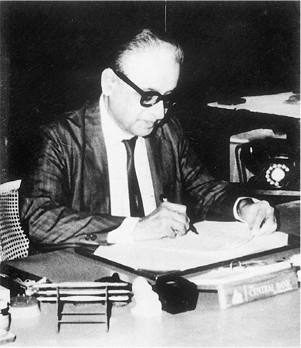
Desai at his desk at the Punchayet
Desai in his prologue pays tribute to "My illustrious predecessor in office... Modi had written the Parsi Punchayetni Tavarikh to commemorate 100 years of trusteeship (1823-1923) and it was published by the trustees in 1930. His history began with the faint beginnings of Parsis in and around Bombay and ended in 1859 with the death of the first-ever Indian Knight and later Baronet Sir Jamsetjee Jejeebhoy. Modi’s work is a historical documentation, a voluminous work of a thousand pages, printed in Gujarati in two parts. He has followed a chronological order — from the early beginnings to... 1859. His account embraces, in each period, events concerning social and religious life of the community.
"When the late lamented Lady Hirabai Cowasjee Jehangir, the first ever lady president of the Parsi Punchayet, conveyed to me her and her colleagues’ decision to ask me to write history from 1860 to 1960 I was fairly hesitant. I did not have that scholarship and ingenuity to delve into historical records that Modi had. But I had second thoughts. Modi happened to be my wife’s grand-uncle and it was he who was responsible for my joining the Punchayet office way back in 1932. He had written his history at the fag end of his career and it fell to my lot after my retirement to continue his work.”
From Desai’s 433-page book Parsiana has selected subjects that would be of interest to our readers. In the edited excerpts that we are presenting we have retained the spellings of names and places as in the original but the English spellings and usage have been amended as per Parsiana’s style. We are grateful to the Bombay Parsi Punchayet for giving us permission to reprint passages.
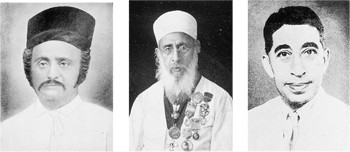
"Erudite secretaries”: (L toR) Behramji,Modi and Bulsara
Every July Parsiana publishes extracts from out-of-print publications so that information on our past is made available to the contemporary community. Our July 2001 issue focused on the Qissa-i-Sanjan (the story of the Zoroastrians’ arrival in India over a 1,000 years ago), in July 2002 we focused on the Arda Viraf Nameh (a treatise on the after life) and in July 2003 we carried extracts from the Rivayets (questions and answers exchanged between the Zoroastrians of Iran and India).
Readers will also get some insights on the prevailing social and economic conditions by perusing S. F. Markham’s report of 1932 on "problems affecting the Parsi community.”
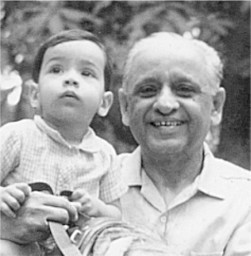
Desai’s daughter Armaity, noted social scientist and former director of the Tata Institute of Social Sciences, and son Xerxes who conceived Titan Industries, a Tata company of which he was the managing director, have penned a brief eulogy at Parsiana’s behest:
"Our father was a person of great erudition, a scholar with a lifelong commitment to the welfare of the Parsi community and an enormous sense of purpose. A progressive liberal at heart, his values were lofty, his integrity solid. Yet, he was warm, gentle and caring – at home and at work – and had a remarkable knack of winning the trust and affection of people. Material benefits never interested him, and the only legacies that he sought to leave behind were the benefits of excellent education for his children, the books that he wrote and the continuing impact of his pioneering work through the medium of the Parsi Punchayet.”
Trespassing on Doongerwadi
On March 27, 1873 two persons, Cooverji Pragjee and Jacob Jamal with their men entered illegally upon (two) plots (at Doongerwadi) and took possession. They even put up tents and structures and kept passing and re-passing over (another) plot... as though the whole land belonged to them. The entry was made at 1 o’clock in the presence of the police. Between this date and April 4, the trustees of the Parsi Punchayet tried in vain with the police commissioner to get redress but to their regret they failed. They had no other alternative left open but to meet a bare-faced aggression with an equally brazen attack to remove the cause of aggression. A so-called master builder and inspector of masonry, John Duffy, had been employed by the two men. He had built a chawl within less than a week and put up a tent for himself with scanty furnishing. The intention was to clear the land of trees — mangoes, toddy, brab, drumstick, bamboo, coconut, etc and build bungalows for Europeans.
On April 4, the aggrieved tenant of the Punchayet, Maneckji Dorabji, organized an encroachment removal party as done earlier and in spite of a number of men employed by Pragjee and his colleague Jamal the Parsis broke down the chawl, cut down the tent and burnt all burnable articles on the nearby waste burning ground of the Municipality. On hearing of this the police arrived and arrested a number of Parsis not from the plots in question but from the inner compound and even the sagdi, a holy place, where fire keeps burning for 24 hours, and where no foreigner or for that matter a non-Parsi would dare enter. Police commissioner Frank H. Souter had the audacity to enter the raised garden ground bringing his horse over the steps, where the sagdis are situated. Later when questioned in the court why he took this extraordinary step and did not get off the horse and walk up, he admitted in the court of law that he could not easily mount the horse which was a tall animal! It is difficult to find a more callous disregard of the religious feelings of a part of the native population.
April 4 was the day of Shehenshahi Meherangan, a holy festival, when many Parsis and Iranis go to Doongerwadi for prayers. Besides that afternoon there was also a funeral. As such there were quite a number of Parsis. Since some of the men who had taken part in removing aggression had entered the inner compound, when the police made indiscriminate arrests, they arrested anyone and everyone they could lay their hands on and that too from a holy place, where so many had gathered for prayers. They had marched 61 men of the two aggressors also to the police station but they were released the next day without placing them before a magistrate. Some arrested Parsis were hand-cuffed as though they were common felons, and taken to the police office at Mazgaon, exposing them to the jest and ridicule of the populace. Indeed it was quite an unprecedented show of authority by the police who could have behaved with equanimity and impartiality in the circumstances. But it seemed to be a prejudiced authority that was displaying its temper to a law-abiding class of citizens for standing on its rights. There was nothing against some Parsis so they were released but a criminal case was brought against 50 persons of whom 45 were Parsis. The lower court had committed them to the session.
The case was heard from July 7 to 16, 1873 before Justice Green. Topmost lawyers were engaged for the accused... Big wig, big wit and top brass of the forensic tribe had been got together at a tremendous cost, over Rs 30,000 to defend a case which could have been safely dealt with by the police in its own right or at best disposed of by the lower court, but that was not to be.
The charges against the accused were:
–"That you... and other persons aforesaid committed an offence of being members of an unlawful assembly...
–"And you also stand charged along with other persons unknown, on the date aforesaid, unlawfully assembled together at Bombay, and that Rustom Khodadad, then and there used force, in prosecution of the common object of that assembly, by striking one Janoo Cristna, and thereby that you and other persons aforesaid committed the offence of rioting,
–"And you also stand charged with having at Bombay, on the date aforesaid, unlawfully assembled together, and that Cowasjee Hormusjee then and there used force, in prosecution of the common object of that assembly, by striking one Siddanshaw Sultanshaw, and that you thereby, and other persons aforesaid, committed the offence of rioting.
–"And you also stand charged with having together with diverse persons unknown, at Bombay, on the date aforesaid, with intent to cause damage to Jamal and Pragjee, caused the destruction of a chawl, tent, and furniture of the value of Rs 1,050, and that you thereby, together with other persons aforesaid, committed mischief, and thereby caused damage to the amount of upwards of Rs 50.”
These were formidable charges under section 141 of the Indian Penal Code.
Many things were brought to light during the trial, chief among which was the partial attitude of the then police and its partisan behavior. Could one imagine that police without any investigation or asking the aggrieved party give an escort to the aggressors to survey the land as though it were their own, chalk out boundaries, and do structural planning prior to March 27, even allowing the use of bataki. Any officer in his senses would first think and act only after making due inquiries. The very fact that police protection was sought and aggression carried out under their nose was sufficient to show the land was in dispute and under the same pretext the same Souter had withdrawn police protection given to the Punchayet by him only a few years ago for the self-same land. All this was brought out in the trial and one can deduce any conclusion from this action of a high-placed officer. But we refrain from doing so.
The protected hearings lasting whole day, did work havoc on the usually calm and placid legal personalities. Thomas Chisholm Anstey had a sharp tongue and was a past-master at the use of appropriate words at appropriate times, with the result that he came into conflict with not only the legal brass on the other side but also the judge. Since the frequent breezes in the court had something to do with the winding up by the judge we shall quote here a few of them.
One such incident happened at the time when Anstey was cross-examining deputy superintendent Brown. He was trying to get out of him that he had said in the lower court that it was arranged that when Pragjee and Jamal went with their men to the spot, they "should have our support. Brown was hedging the question. Then Anstey put to Brown what was stated in the lower court to a question from Jefferson: "It was arranged that on the day they went to take possession the police should be on the ground to prevent a breach of the peace?”
Brown: "Yes, I said so.”
At this stage the judge said, "I don’t think it differs materially from the answers he has given you.”
Anstey: "My Lord, I must object to my cross-examination being interrupted in this manner.”
The judge: "I merely made an observation.”
Anstey: "I can understand a court interposing on behalf of a prisoner, but not in this manner.”
The judge: "I interposed on behalf of the witness whose evidence you are leading.”
Anstey: "Well, My Lord, I again object to having my cross-examination interrupted in this way. No court has a right to do so.”
The judge: "I shall interpose in any way I think fit, Mr Anstey.”
Anstey: "Then, My Lord, it shall go further than this, that is all. Justice shall be done to the prisoners, and a conviction shall not be obtained if I can help it. I repeat my objection to these interruptions, and ask Your Lordship to take a note of it.”
At another stage Anstey snubbed Fergusson, the prosecution counsel, saying, "But no doubt every objection will be made that mediocrity can command.”
At one stage, during a breeze, when the judge told Anstey, "I shall have to fine you,” Anstey replied, "If you fine me I shall take the opinion of another court, that is all.”
Souter was cross-examined at great length by Anstey. After dodging for a while he admitted that the Punchayet secretary had a talk with him between March 27 and April 4. Nusserwanji Behramji had seen him with a letter from Sir Jamsetjee Jejeebhoy. He also admitted that the people who had encroached on the Punchayet property were in the employ of Jamal and Pragjee. Indeed it was a startling admission. In spite of his knowledge of the gathering storm he had taken no action. On March 29 he had told the Punchayet secretary that he would not interfere unless there was a breach of the peace.
Could a high government official, (giving) an indifferent reply injuring the feelings of a religious body, be ever tolerated — an official who belongs to the arm of the law? And this shows the man. He was asked, "When you rode your horse up the steps, did it not occur to you that you might be, without knowing it, doing something highly offensive to the religious feelings of Parsis?” The cold and calculated reply was: "Certainly not; that would not affect me in what I considered to be discharge of my duty.” Anstey in his address posed a question if Khan Bahadur Akbar Ali, a detective, could ride a horse in a cathedral on the pretext of arresting somebody there!
In his address to the jury Anstey was rather sarcastic and said, "Gentlemen, the case of the defence is in one point of view — or rather the case of the prosecution and the defence is in one point of view — the most ridiculous, ludicrous case that ever was brought into court for a judge and jury and a large bar to waste their energies upon.” This was a dig at government and its administrative department, and the judge repeated this in almost identical terms in his summing up for, of course, different reasons.
Anstey showed to the jury that the officialdom was unaware of a Government proclamation of 1792 prohibiting any obstruction into temples, tombs or religious places. The proclamation (dated February 29, 1792, signed by the secretary William Page) was put into the hands of witness Brown who read it and said he had never seen it before. It read: "Whereas it has been represented to Government by the caste of Parsis that a European inhabitant of this island, unobservant of that decency which enlightened people show to the religious ceremonies of the natives of India, had lately entered one of the repositories of their dead, to the great distress, inconvenience, and expense of the said caste; the acting president in council has thought fit to reprimand the person alluded to for his improper conduct; and in order to mark in the strongest manner his discountenance of such unwarrantable proceedings, and to deter others from the commission of like indignities in future, he hereby causes it to be signified, that whoever shall obtrude themselves on the temples, tombs or religious ceremonies of the natives, residing under the protection of this Government, will be suspended (from) the Honorable Company’s service, if in their employ, or if free merchants, mariners, or others be adjudged to have forfeited their licences, and will be sent to Europe.”
At one stage in the evidence it was brought out that Jamal... had once been convicted of gross fraud, bribing, etc.
Even the witnesses could not identify all the accused and their stock reply was that on April 4 when they were arrested they were in dirty shirt (meaning sudreh) and pyjama and when they appeared in the dock they were well-shaven, looked fairer, had worn coat, pant and pugree and were not easily identifiable. In the place of those identified in the lower court different persons were identified in the High Court and as a result before the address began nine persons had to be discharged. Anstey cited the case of Baynes vs Brewster (11th Vol, Law Journal; also repeated in 2nd Vol, Queen’s Bench Reports, pg 375) and said, "The case which I have cited is the strongest evidence that the Bombay constables, particularly Souter, acted not only with criminal neglect of their respective duties, but out of personal feelings. Whether among these personal feelings of the worst kind — I mean spite, malevolence, contempt of foreign religions and a foreign race — it is not for me to say.” Referring to his not getting off the horse when Souter rode up the sagdi steps and his reply blaming riding a "high horse,” Anstey said: "That proves what I say, that the man is vain, imperious and weak, and he thought he was at liberty to do exactly as he liked.” Anstey could not have been more forthright when he further described Souter as being "unfit for his post.”
Anstey then read from Spiegel’s last edition of the Vendidad, eighth Fargard, and showed "how the Parsis reverence their enclosures for the sacred purpose of receiving the dead, and praying for the souls of the dead.”
For two full days, July 14 and 15 Anstey addressed the jury and on the third day in consultation with other defence lawyers Anstey informed the judge that they did not wish to lead any evidence on behalf of the defence.
The learned judge then took over and started summing up. The temper of Anstey during the trial had tampered with the reasoning of the judge. This recoiled on him and Green took the opportunity to retaliate tit-for-tat. It was obviously in bad taste except that he was perhaps within his rights when he made the reference which we quote later. Anstey made no protest. The judge first sang his own praise showing how impartial he was and then he referred to a meeting of the "natives” of Bombay, including "all the various sections of the community” held in 1865. He presumed someone presided and it could have been Sir Jamsetjee Jejeebhoy (IInd Bart). It seems the meeting drew up a memorial in which they sang praise of British justice, "the graceful recognition which that meeting gave to the general independence and impartiality of the judges of this court.” He had a lurking fear of coming into conflict with "any portion of the community, whether European or native, as to my impartiality in the administration of justice,” as Green put it. He referred to the memorial of 1865 and said the memorialists had shown "general confidence in the administration of justice by the High Court, as they had previously done in the Supreme Court” but "that confidence had been to a great extent undermined by recent occurrences.” One would wonder why this kind of preface in a summing up but the cat was soon out of the bag, when he referred to the memorialists’ request to remove a certain judge from the Bench. Green then read from the memorial:
"Your petitioners regret that they are unable to confine their complaint of Justice Anstey to his proceeding on Civil Side of the High Court, but are obliged to extend it to his conduct as a criminal judge. He has exhibited in that capacity an unseemly desire on several occasions to secure the conviction of the accused, and has manifested an eagerness to convict which would be unbecoming in a prosecuting counsel; but in a judge cannot, they think, be too highly reprobated. The punishments which he has awarded have, many of them, been conspicuous for unusual and indiscriminate severity. In some cases they have been accompanied by observations which could not fail to create an impression that the judge took a vindictive pleasure in sentencing the offender, and inflicting the heaviest pains and penalties permitted by the law. The lamentable consequence is, that a sympathy for culprits, most injurious to the interests of society, is created amongst the public; the natural detestation of crime in the public mind is weakened; and the more lenient of the community are induced to abstain from prosecuting offenders. Juries, too, it is to be apprehended, will hesitate to convict from fear lest the offence charged should be visited by a wholly incommensurate punishment.”
This was clearly an indictment of Anstey and, it seems, the public of those days was fearless enough to express its thoughts and sentiments. Obviously the language is of an Englishman and is highly critical, but coming as it did a decade later from one who himself adorned the same Bench surpasses one’s imagination, unless it were to damn Anstey in the eyes of the jury. We shall see how this boomeranged on the judge himself.
The judge then started analyzing the proceedings before the Court and traversed the gamut of charges against the accused. He expatiated on what assembly is unlawful, whether the charges of criminal offence against Duffy could be sustained, though according to him yes, whether the prisoners were guilty of assaulting Cristna and Sultanshaw, though he felt no. Then there were two charges of unlawful assembly, one of rioting and one of committing mischief and causing damage to property above the value of Rs 50. He thought the case could have been disposed of in the lower court and at any rate "it is hardly a case for exemplary punishment.”
Referring to Souter the judge said, "The attack made on him by the learned counsel, who addressed you in defence of the prisoners, is a most scandalous and disgraceful one.” Anstey had called him a liar and the judge said there was nothing in evidence to justify that statement. The Judge then went through prosecution evidence.
The Jury retired at 10 minutes to 12 and returned at 10 minutes past 1 and returned a unanimous verdict of not guilty in respect of all the accused. The judge then told the jury that he rejoiced at their finding the prisoners innocent but "At the same time I must state that as to certain of them I do not find myself able to agree with your verdict. But of course it is your verdict and cannot be altered, and I have no doubt that it has been honestly arrived at.” This again displayed indiscreet superciliousness.
He then gave a homily to the prisoners before setting them at liberty about enforcing one’s real or supposed rights and incurring "the risk of coming within the cognizance of the law.”
Let us close this unhappy episode with the following statement from The Times of India:
"The prisoners were then set free en masse. They were instantly surrounded by their friends, and congratulated on what not a few persons called their ‘escape.’ They were nearly mobbed going downstairs, and even in the street they were followed by a crowd who evidently regarded them as heroes. It was very amusing to see Khushroo Hormuz, the mallee [Khushroo Mali (Irani) was being paid a monthly salary of Rs 7 plus food at the Parukh Dharamshala and was allowed to sleep in the sagdi], shuffling happily along in his big boots, while a Parsi on each side of him had an arm round his neck.”
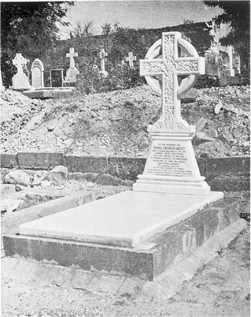
Anstey’s grave at Bombay’s Sewree cemetery
Then followed a spate of criticism from English and vernacular papers. Judge Green came in for a lot of castigation, as also Souter and the government of the day. The papers were The Times of India, Indian Statesman, Argus, Jam-e- Jamshed, The Bombay Samachar, Akbare Soudagar, Gujarat Mitra, Echo Portuguese, Rast Goftar, The Hindoo, Patriot, and others. All the papers hailed the unanimous verdict of the jury, largely composed of foreigners as a resounding victory of the people and a vindication of their rights as against the arbitrary behavior of the police, who are not masters but servants of the people. By a process of innuendoes it was argued that government was badly advised to go in for this trial but later seeing its folly had tried to wriggle out by weakening prosecution and not going into appeal...
The Punchayet trustees were recipients of a large number of letters of congratulations from Parsis all over India, Aden and Hong Kong.
The trustees received a requisition signed by about 5,000 Parsis asking for an Anjuman meeting to protest against encroachment by non-Parsis "on our property” and the conduct of the police and to send a memorial to government. The requisition was signed by Sorabji Jamshedji Jejeebhoy and Naoroji Maneckji Wadia under cover of their letter of August 5, 1873. The first signatory was a brother of the Second Sir Jamsetjee and the second a well-known businessman and philanthropist. The trustees decided after due deliberation in their meeting of September 1, 1873 that since they had already been victorious in the criminal court and had filed a suit in the Civil Court for recovery of land and damages, it was not necessary to call an Anjuman meeting or send a memorial to the government. They preferred to get justice through the court of law. The requisitionists were not satisfied with the reply and Sorabji Jejeebhoy and Wadia called a protest meeting in the Albless Baug on September 22, 1873, where they passed a resolution to say that the reply given by the trustees was not proper and that their resolution be forwarded to the trustees to be recorded in their Daftar. In their meeting of September 30, 1873 the trustees declined to record their resolution in the Daftar.
The total cost of the criminal suit came to over Rs 32,400, Rs 26,900 were paid from General Fund No 1 and Rs 5,500 from Insaaf Arji Fund No 13.
It is said the case had brought on a great strain on Anstey and on the 26th day of the successful end of the case Anstey died. He lies buried in the Sewree cemetery. The Parsis had accompanied the funeral cortege in jamo-pichhori in their cars. It was contemplated to raise a memorial in honor of Anstey but somehow the idea did not work out. However, 27 years later Framji Cowasji Mehta, proprietor, the Kaiser-i-Hind resuscitated the idea, collected Rs 937-8-0 and the following column near the tomb was raised:
"To The Memory of Thomas Chisholm Anstey/Born in London 1816/Died 12th August 1873/Lawyer, Jurist, Politician/M. P. for Yougal in Ireland/Attorney-General for Hong-Kong/Advocate and sometime Judge/High Court, Bombay/This Memorial Raised by the/Parsi Community of Bombay/To Mark their Sense of Gratitude/for his Zealous Services in their Cause/in the ‘Towers of Silence’ Case in 1873 ‘Whatever good any man doeth/The same shall he receive of the Lord’/RIP,/Epheps, VI 13”
Marriages with ‘aliens’
Sir Phiroze Sethna was concerned with the growing trend in the community to contract marriages with ‘aliens.’ He wanted an Anjuman meeting. That was the year 1932. Earlier in 1919, concerned as the community was over a similar trend, an Anjuman meeting was held on February 2, 1919. The concern was only for women marrying outside the community. The marriage the other way about was clinched and had passed muster with the judgment of Justice Dinshaw Davar. It was on a requisition signed by 8,500 Parsis that the meeting was convened. The main resolution declared that any Parsi woman marrying any non-Parsi under any existing law should be debarred from any privileges applicable to a Parsi and if she wished to re-embrace Zoroastrianism she should be precluded from doing so. Copies were sent to all anjumans and trustees of religious and charitable trusts.
When Sethna wanted an Anjuman meeting his attention was drawn to these resolutions and it was decided to give newspaper publicity to the same. It was also decided to get copies of intention of civil marriage by Parsis from time to time from the registrar.
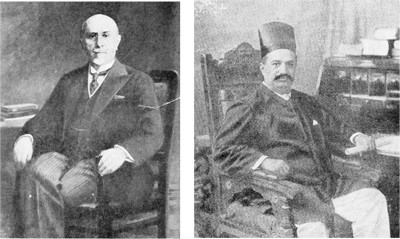
Sethna (left) and Dadachanji: called for an Anjuman meeting to show contempt of women marrying out
With his letter dated November 4, 1932 Faredun K. Dadachanji sent a requisition to the trustees signed by over 4,000 Parsis asking to call an Anjuman meeting to declare their contempt at women marrying non-Parsis and to take steps to prevent such occurrences. Draft resolutions were called for from the sponsors for approval. Some trustees took strong exception to the fourth resolution which precluded women, who were married out of the fold, to re-embrace Zoroastrianism. It was felt the resolution had no legal effect. Three trustees were against calling an Anjuman meeting and three for. It was explained by one of the colleagues that since they had called for resolutions for approval and also names of speakers, it implied a tacit understanding to call a meeting and if they did not it would create complications. Sethna then suggested that in the first resolution the condemnation should be for men also marrying outside the fold and and the fourth resolution precluding women from re-entering the fold should be entirely deleted, not even substituted by another.
Dadachanji declined to make any changes and, a solicitor that he was, kept arguing, but Sethna would not budge. Bar his objections he agreed with the rest of the resolutions. Dadachanji was informed of the trustees’ resolution not to call a meeting until the resolutions were changed. Lengthy correspondence, interviews, newspaper writings and veiled attacks ensued. The question at issue now was whether the trustees could decline to call a meeting on a requisition, approval of resolutions and names of speakers being only a formality. There was accommodation insofar as the first resolution was concerned but for deleting the fourth resolution there was a lot of opposition. The last sentence in this resolution drew the community’s attention to the Anjuman resolution of 1919. Some trustees were for dropping this sentence but ultimately it remained and the Anjuman met on July 16, 1933.
One of these resolutions appointed a committee of 61 to go into the reasons why Parsi women married non-Parsis and suggest remedies to counter the same. This committee appointed sub-committees affecting social, educational, economic and moral questions. The committee on social affairs blamed parents for their carelessness and among other remedies suggested navjote registration. The committee on education found no fault with the present education but suggested a special college or polytechnic for Parsi women to give them education in home-making, etc. The economic committee did not see any connection of such marriages with the economic condition of women, nor the question of dowry. Even the current depression was not found to be responsible for such marriages. Parents were advised to send their daughters to work in Parsi-owned or Parsi-managed firms, etc. The morals committee saw nothing wrong with the morality of women.
On reading the report the chairman of the board Muncherji Khareghat gave his views to the following effect:
–By registering navjotes how could a woman be estopped from marrying a non-Parsi? It is doubtful if government would pass a law for registration of navjotes.
–There is no doubt about children of such marriages not being initiated by navjote but re-embracement by the Parsi woman is a fine point of law, although as long as the marriage subsisted such a question could not arise...
–As to opening a college for women it was beyond the Punchayet’s means.
The Mazgaon incident
In 1882 a number of Parsis were living in Mazgaon and working in the docks. Eleven persons, men, women and children, applied to the Parsi Punchayet for being admitted to the Parsi fold. They were born of Parsi fathers and non-Parsi mothers. They were following all the customs of the Parsis... If they went to any feasts they dined separately. They even contributed to gahambar festivals, etc. They were then anxious to have their navjotes performed so that they could get into the proper stream of Zoroastrian life.
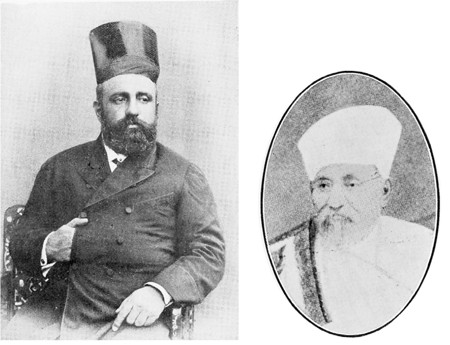
Wadia (left) and Sanjana: dispute over navjotes
The trustees of the Parsi Punchayet took no action on their petition. Some 200 Parsis headed by Naoroji Nusserwanji Wadia and Nanabhoy Dhunjibhoy Banaji collected funds and got their navjotes performed. Before the ceremony Dastur Kekhushroo Jamaspasa took their test, studied their cases carefully and got the navjotes of nine of them performed on June 26, 1882... This created as usual a lot of indignation amongst devout, orthodox Parsis. Dastur Peshotan Sanjana issued a pamphlet to show that the navjotes were not properly performed. It was a quarrel on the rituals to be performed. Jamaspasa issued a rejoinder and stated he had taken all care... beyond a legitimate protest from the orthodox Parsis the matter cooled off as usual. The trustees of the Parsi Punchayet took their stand on the fact that being a religious matter it was for the dasturs to decide and decided in their meeting of July 25, 1882 to inform Sanjana accordingly in reply to his communication. The trustees had before them the custom of admitting such cases followed by their predecessors and obviously the chapter ended there.
Navjote of a Rajput lady
Another incident occurred. A Rajput lady of 58, by the name Cooverbai, presumably married to a Parsi or living with him and having three living children had her navjote performed by a panthaki on March 18, 1904. Public invitations were issued on March 16, 1904 to the effect that the ceremony of a Rajput lady, without disclosing name, would be performed... in the house of Dr Hirjibhoy Jamshedji Appoo at Khetwadi. A representative of the Jam-e-Jamshed met her after the navjote and reported that she looked and talked like a Parsi, only the speech had a Rajput accent. Maybe it was Kathiawadi since she was born and bred in Bhawnagar. She was not keeping good health and as she wanted the disposal of her body as per Zoroastrian rites she had undergone the navjote ceremony.
This was one more straw in the wind and the secretary Dr Jivanji Modi at once circulated the information to the trustees and asked their orders as to how he should act if Cooverbai died and the relatives asked to consign the body to the Towers of Silence. The trustees decided to take a counsel’s opinion. Opinions of barristers Basil Scot and Dinshaw Davar were taken. This was further vetted by senior counsel Inverarity.
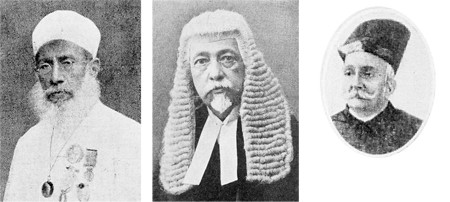
(L to R) Modi, Davar and Petit: legal battle
M/s Ardeshir, Hormusji Dinshaw and Company on behalf of their clients Sir Dinshaw Maneckji Petit, Bt., Sir Jehangir Cowasji Jehangir, Kt., Rustomji Behramji Jijibhoy, Ratanji Jamshedji Tata, Bapooji Sorabji Patel, R. D. Shethna, Dr N. N. Katrak and Ratanji Dadabhoy Tata, by their letter dated May 10, 1905, sent a notice to the trustees asking for inspection of documents relating to the trust deed of 1884 and the counsel’s opinion. There were several charges made in the letter against the trustees. The trustees agreed to inspection but took a strong objection, through their solicitors M/s Craigie, Lynch and Owen, to some of the statements which were "wholly inaccurate, needlessly offensive and calculated to give entirely false impression as to our clients’ position and attitude as trustees and (which) have nothing to do with the avowed objects of your letter.” Voluminous correspondence then ensued between the two parties and the sum and substance of it all was that the predecessor trustees of the trust deed of 1884 had no legal authority to declare the trust, that some of the declarations were contrary to the original documents gifting the property, etc and that "the only materials which were placed before the counsel to whom cases were submitted and whose opinions were afterwards made the foundation for the notification of February 9, 1905 issued by your clients were the declaration of trust made in subsequent trust deeds in which the word ‘Parsi’ appears to have been used. The opinions thus obtained in favor of your clients’ views, whether correct in themselves or not, would altogether lose their weight if the persons for whose benefit the trusts were originally dedicated were wrongly and unauthorisedly described. We need hardly say that very important issues will depend on consideration of this character.”
This was not merely a straw in the wind, it was coming events casting their shadows before. There was a ding-dong correspondence and ultimately it ended in the other party filing a suit, No 689 of 1906, Sir Dinshaw Petit and others v/s Sir Jamsetjee Jejeebhoy and others, now made famous in ordinary parlance as the Parsi Punchayet Case.
In the letter of M/s Ardeshir, Hormusji Dinshaw and Company there is a reference to a notification of February 9, 1905. This was issued by the trustees arising out of counsel’s opinions referred to (earlier). We give the same below:
"We, the undersigned trustees of funds and properties of the Parsi Punchayet, do hereby notify for the information of the public that we are advised by the learned counsel that the funds and religious properties under our charge — such as Towers of Silence, dharamshalas, nasakhanas, fire-temples, etc — are held by us for the benefit of those only, who are Parsis by birth and at the same time Zoroastrians by religion. Such only are entitled to the benefit of these funds and properties. The benefit of the funds and abovesaid properties, in our charge, cannot be given to those who are not Parsi Zoroastrians, as described above.
"If, notwithstanding this notification, those, who are non-Parsi Zoroastrians, will attempt to take benefit of any of the funds in our charge or to enter into any of the religious (charitable) places in our charge or to make any use of them, or if any persons should attempt to bring to the Towers of Silence the remains of any person who was not a Parsi Zoroastrian, such persons and those, who will abet such proceedings, will do so at their own risk.”
The notification was in Gujarati and signed by Sir Jamsetjee Jejeebhov, IV Bart., Hormusji Edalji Albless, Jamsetjee Cursetjee Jamsetjee, Merwanji Muncherji Cama and Bomanji Dinshaw Petit.
As the notification was not clear as to those who were born of Parsi fathers and alien mothers and who were already invested with sudreh and kusti, the trustees got another notification issued over their secretary’s signature that they were also entitled to the benefit of their funds and properties.
The Bansda navjotes
Another bush-fire made its appearance; this time not from a city but from an unknown, unmapped village Bhamti in the erstwhile Bansda state, Gujarat. This controversy as long as it lasted, electrified the whole community and surcharged it with currents that forbode evil. It was the navjote of some 77 Parsis between the ages of seven and 60 alleged to have been born of Parsi fathers and alien mothers and supposed to be within the Davar judgment definition. Those who took a leading part in arranging these navjotes were the late Burjorji F. Bharucha and Dastur Framroze Bode. The Parsi Kom and Jarthoshti Dharma Rakshak Saunstha’s honorary secretary K. J. Dubash sent, over a period of time, forms signed by some 20,000 Parsis (men, women and children too as alleged) requesting the trustees to call an Anjuman meeting to protest against such navjotes, which could harm the fabric of the Parsi communal ‘oneness.’
The trustees were, as though, between two stools. If they called a meeting as demanded they might be hurting the rights of some legitimate cases falling under Davar’s judgment; if they did not, they would be party to an act which the majority did not subscribe to.
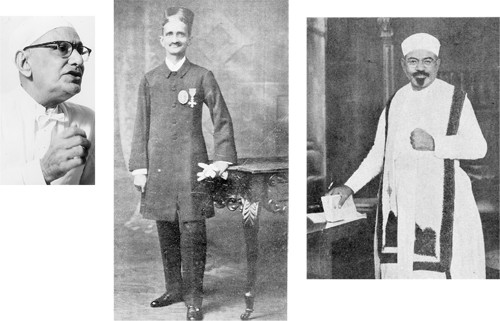
(L to R) Bode, Billimoria and Kutar: failed rapprochement
In order, therefore, to get at the validity of the new navjotes to fall within the limits prescribed by Davar’s definition the trustees asked the parties concerned to send genealogies of the navjotees. In the meantime some 30 associations and anjumans sent their protest too against the navjotes to the trustees. And some anjumans, mostly nearby, moved the Maharaja of the Bansda state also. The trustees moved very cautiously in the matter and even went to the length of taking opinion of two well-known counsels Sir Nusserwanji Engineer and Coltman. Dubash and his friends kept on urging the trustees to call the Anjuman meeting. Discussions between them and the trustees at board meetings and through correspondence on the one hand and between the trustees and Bharucha and Bode on the other continued, until one of the navjotees filed a suit in the High Court against the trustees of a Bombay agiary to enforce his right to enter the premises for the purpose of making use of the same as an agiary and for the purpose of saying his prayers and worshipping thereat. With this the matter became sub judice and the question of the Anjuman meeting went into hibernation.
On August 2, 1942 athornans of all ‘panths’ of Bombay followed their kith of Udvada and Navsari to condemn the navjotes.
At one stage Sir Hormuzdiar Dastur (a retired chief presidency magistrate) in his letter dated November 6, 1942 informed the trustees that "no good purpose will be served by discussing the genealogical trees and other facts referred to in your letter, unless the trustees of the Punchayet are prepared to abide by the proof of the said pedigrees.” And he wanted assurance to that effect. In their reply the trustees informed Dastur, among other things, that, "It is the duty of the trustees to investigate all the necessary facts and form their own judgment, and it would be a breach of their duty to promise any party beforehand that they would accept the truth of the facts as stated by that party alone.” Finally Dastur... agreed with this view.
The question after having gone into hibernation died out, although the gentleman who had filed a suit in the High Court had withdrawn it for the reasons best known to him. But the dying embers kept emanating smoke from time to time, until the Mumbai Vartaman, now defunct, undertook to bring the two sides together and failed. The president of the Parsi Punchayet Sir Shapoorji Billimoria then tried and succeeded in putting cold water on the embers. He brought together the two principal parties Bode and Dastur Kekhushroo Kutar together to agree to the case law as at present prevalent (i.e. Davar’s judgment), and to admit that it is harmful to admit into the fold persons born out of wedlock with alien women.
But this good attempt at rapprochement also failed in the end. There were white-turbaned gentry who were against any kind of children, whether born in or out of wedlock with non-Parsi females. They agitated and wanted to hold meetings condemning even the case law. It seems Sir Homi Mody brought the two dasturs together to get over this and Kutar agreed, but later, due to pressure or otherwise from the athornans, turned round and asked Bode to drop reference to the Davar judgment part but the latter did not agree. Kutar ultimately withdrew his signature.
Directions to the priests
Three years later, in 1949, 14 dasturs (some of them head priests of agiaries), under the wise leadership of Sir Rustom Masani, signed a covenant giving directions to the priests in particular and to the public in general about certain questions, viz, navjote of non-Parsis, jashan ceremony in the presence of non-Parsis, aliens’ presence in an atash kadeh, aalaat for liturgical ceremonies, ceremonies of the dead, and miscellaneous questions. In the last category a sound suggestion was given to establish a standing advisory committee of dasturs, scholars and experienced ‘yozdathregars’ but nothing appears to have been done.
Refusing re-entry
Can a Parsi converted into Christianity re-embrace Zoroastrianism? The question ruffled the tiny community of Colombo, Ceylon (now Sri Lanka) in 1933. A Parsi gentleman belonging to a well-known family had been baptised. B. R. Rustomjee of R. Rustomjee and Company (981 Grandpass Road, Colombo, Ceylon) wrote in his letter dated November 19, 1934 as follows:
"A regrettable incident took place here about one year ago, viz, a Parsi Zoroastrian gentleman of a well-known family was converted into Christianity and as the Parsi Zoroastrians of Ceylon have no fixed constitution and rules and regulations to protect their religious properties and burial ground, they assembled yesterday to pass certain specific resolutions relating to the Parsi converts and their re-entry into Zoroastrian faith. We passed the following resolution yesterday:
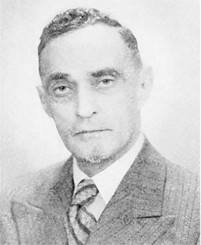
Masani: signed a covenant
–"‘That any Parsi Zoroastrian who shall become a convert to any other faith or religion who has renounced the Zoroastrian faith directly or indirectly shall not be permitted by the Zoroastrian community or members thereof to participate (along with the other members of the Anjuman) in any Zoroastrian religious ceremonies or in any Zoroastrian gatherings of a religious and/or ceremonial nature such as for example jashans, navjotes, marriages, funerals or on any after-death ceremonies or in any navar, maratab or other ceremonies. And such convert attending any navjote or marriage ceremonies or attending the funeral of any Parsi Zoroastrian or attending any other religious or ceremonial gathering or function as aforesaid to which non-Zoroastrians are customarily admitted shall be required by the Zoroastrian community or any member thereof to take his or her place among non-Zoroastrians and to take only such part as is customarily permitted to non-Zoroastrians.
–"‘That such a convert shall not be given or allowed admittance to and he or she is forbidden entry (and if he or she seeks or endeavors to obtain entry into he or she shall be prevented by any member of the Zoroastrian faith from gaining admission or entry) into any Zoroastrian fire-temple, atash behram, agiary, atash kadeh, dakhma or sagdi or any other place or places of religious resort or connected with or used for any Zoroastrian religious uses or purposes whether any religious or other ceremonies are in progress at the time of such intended entry.
–"‘That such a convert shall be and is hereby debarred from having or receiving any benefit from any charities, funds, associations or other benefactions whatsoever founded or established or maintained or administered (in Ceylon) by or for the benefit of Parsi Zoroastrians and that any benefit which he or she may have been receiving up to the time of such conversion shall immediately cease upon his or her conversion.
–"‘That no religious ceremonies whatsoever shall be performed whether during the life-time or upon or after his or her death, or upon any other occasion whatsoever or for any other purpose whatsoever, and whether at the request of any such convert or of any other person whomsoever.
–"‘That no such convert or any parent, relatives or guardian of such convert shall be entitled upon such convert dying (after he or she shall have become so converted and shall not have re-entered the Zoroastrian faith as hereinafter provided) to have his or her body laid to rest exposed or buried in Ceylon in any dakhma, Tower of Silence or burial ground place set apart for Zoroastrians.’
"This is the main resolution of the Anjuman passed yesterday. But we had the following resolution on the agenda on which there was a severe opposition and some points and discussion was deferred, as the meeting asked to get definite information from the Bombay Parsi Punchayet as to whether such resolution has been passed by the Bombay Parsee Zoroastrian Anjuman or any other Anjumans of India. The resolution is as follows:
"‘That any such convert shall be permitted to re-enter the Zoroastrian fold within one year from the date of such conversion provided such convert shall publicly and sincerely in open meeting of the Zoroastrian Anjuman of Ceylon repent of the breach of his or her adherence to the Zoroastrian faith and upon his being reinvested with the sudreh and kusti, by proper initiation if necessary according to Zoroastrian religious or customary uses, and on his or her undertaking to put on and keep on the sudreh and kusti during the rest of his or her lifetime and on his or her promising never to commit the sacrilege of renouncing the Zoroastrian faith and upon his or her undergoing the bareshnum ceremony for nine nights. That any convert who refuses or neglects or fails to comply with any of the terms laid down... shall be permanently debarred from the Zoroastrian fold, as provided above, and shall during his or her lifetime be treated by the Zo-roastrian Anjuman or members thereof as a convert from Zoroastrianism.’
"In writing this lengthy letter and giving you the resolutions passed and are to be passed, I am in need of following information and hope you will give me in details the information asked for, as I must be prepared before the adjourned meeting is called again to discuss:
–"Whether the Bombay Anjuman has passed any resolution relating to the re-entry of converts into Zoroastrian fold and if so in what form? If in negative, whether any Parsi converts have been taken again into the Zoroastrian fold.
–"Does Zoroastrianism refuse to allow any Parsi convert to become a Zoroastrian again? If in negative, what are the essential and necessary ceremonies to be performed when you take back a convert into Zoroastrianism?
–"If the bareshnum ceremony is not possible in a foreign country, what is the other alternative ceremony? (We have no agiary but only one mobed to perform the necessary ceremonies.)
"For your information I may say that the local Parsi community is in favor of taking back the converts into the Zoroastrian fold. But the time limit, which is prescribed... is not wanted and on this chief point, further discussion was deferred till we hear from Bombay. I think the trustees of our Anjuman will write to you about this. But I want this information as I am leading the opposition party who are in favor of dropping the time period, viz, a convert can come back whenever he or she likes.”
The above resolution of the Anjuman insofar as it prescribed the disabilities even overstepped the bounds the trustees of the early 19th century in Bombay had presented for certain defaults. But that perhaps speaks of the fears of a danger to a small community living in a small island. The Ceylon Anjuman also made almost similar queries. Rustomjee was given the following reply and a copy was sent to the Anjuman:
"Re: Readmission into the Zoroastrian faith of Parsi converts to other religions.
"I placed your letter of November 19, 1934 in the above matter before my trustees and have been asked to reply as follows:
"My trustees will try to reply to your queries so far as they can, but as the matter involves questions of religion and law on which they do not claim to be experts, they will not undertake the responsibility of any action you may take.
"As respects your first question there have been instances in Bombay of the readmission into the Zoroastrian faith of Parsis who had become converts to other religions. There appears to be no resolution of the Anjuman of Bombay or of the board of trustees on this subject. The only exception appears to be the resolution passed at Anjuman meetings in 1919 and 1933 against the readmission into the Parsi community of females who have married juddins, but whether that resolution will be enforceable in a court of law is a matter of doubt.
"As respects your second query so far as the trustees know there is nothing in the Zoroastrian religion forbidding the readmission of a Parsi convert. As to the nature of the ceremonies the trustees can give no definite opinion; it is a matter for theologians and lawyers to decide. But attention may be called to the fact that in the well-known Parsi Punchayet Case (No. 689 of 1906) Justice Davar held that for the admission of a pure juddin the nine nights’ bareshnum was necessary whereas Justice Beaman was of the opinion that it was advisable to dispense with such a ceremony especially in the case of a respectable educated female of the present day. Of course the question of the readmission of a Parsi convert is different, but, prima facie, the ceremony can hardly be stricter than that for a pure juddin. It is quite possible that if such a convert be readmitted by a mobed after the performance of the usual navjote ceremony only a court of law may hold such admission valid.
"As, to the imposition of a time-limit, apart from the fact that a court of law could hold such a condition invalid, the trustees are of opinion that it is contrary to the spirit of our religion and undesirable for a small community like ours. It would keep out more persons than the fear of it would keep in.
"My trustees are unable to answer your third question except to say that if the nine nights’ bareshnum is really necessary the convert must go to some place where he can undergo it.”
Whether the Ceylon Anjuman did anything further it is not known, nor is it known if any Ceylon Parsi converts came back to Zoroastrianism.
Death ceremonies necessary?
Are customary ceremonies for the dead a necessity? Perhaps no Parsi would raise such a question and yet such a query came from a Parsi firm of solicitors M/s Ardeshir Hormasji Dinshaw and Company, whose name the reader has noted in connection with the Parsi Punchayet Case of 1906. By their letter dated February 22, 1935 they put the following poser:
"We are instructed by some of our Parsi clients to request you to let us know whether there is any rule of the Punchayet that dead bodies are not to be allowed to be placed in the Towers of Silence at Bombay, unless the customary ceremonies have been performed and customary prayers offered for such bodies.”
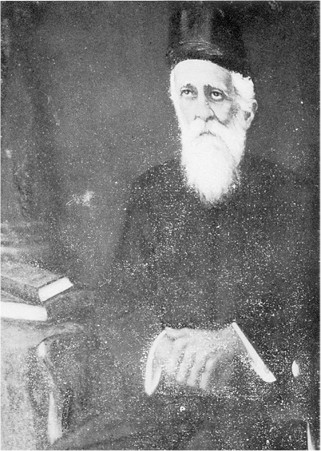
Khareghat: consecrated bodies only to be consigned
The customary ceremonies before disposal of a dead body are sachkar and geh sarna. For the latter ceremony references are found in Pahlavi writings, where there is injunction for reciting the Ahunavaiti Gatha. In the Avesta the words used are Gathao Sravayoit, the effect of which is to drive away drujeh nasus, the obnoxious effects of a deteriorating body. This was the opinion expressed to the secretary, by a great scholar Ervad Bomanji Dhabhar, on the former’s inquiry. The oldest mobed Ervad Rustomji Ranji at Doongerwadi and the oldest nassessalars were consulted and they all said that a body was never consigned to the Tower without the customary ceremonies. M/s Ardeshir Hormasji Dinshaw and Company were informed that there was no precedent of a body being consigned without customary ceremonies and if any one wanted so to be done the trustees would withhold permission, as that would hurt the feelings of a great majority of Parsis. This elicited the following reply from the solicitors by their letter dated March 22, 1935:
"It appears from your letter that the terms of the trusts on which the Towers of Silence are held do not contain any prohibition against the consignment of the remains of a dead Parsi Zoroastrian to the Towers of Silence without the customary ceremonies and prayers but that your trustees would prohibit such consignment on the ground that to permit it could offend the sentiments of a very large majority of the Parsi community. Our clients have, however, been advised that since the terms of the trusts do not contain such prohibition, it is not legally competent to the trustees to make the prohibition on the ground put forward in your letter or any other ground. All Parsi Zoroastrians are beneficiaries of the trusts on which the Towers of Silence are held and an attempt on the part of the trustees to prevent the remains of any dead Parsi Zoroastrian from being placed in the Towers of Silence would be breach of trust on the trustees’ part.
"Our clients are Parsi Zoroastrians and for reasons which it is not necessary to mention for the purposes of the issue under discussion they think the customary ceremonies and prayers superfluous. Your trustees will realize that the question raised is one of considerable practical importance and that to adopt the course which they propose to adopt would mean a denial of our clients’ rights as beneficiaries of the trusts, unless the terms of the trusts justify the proposed course. We are therefore instructed by our clients to request the trustees to reconsider the matter and to let us know whether they adhere to the view expressed in your letter and if so to inform us whether they rely on any particular terms of the trusts as giving them the power of prohibition which they propose to exercise and to give us inspection of the trust deeds or other documents containing such terms. Our clients as beneficiaries are entitled to the information and inspection asked for.
"We should add that our clients have no desire to take legal proceedings and thus raise what is bound to become an unpleasant communal controversy, unless it is absolutely necessary to do so for the protection of their rights, and that if they are satisfied from inspection of the trust deeds or other documents or from any other information which your trustees may give that the trustees have the power of prohibition which they propose to exercise, our clients will drop the matter.
"We wish to make it clear that our clients do not admit that the omission of the customary ceremonies and prayers would offend the sentiments of a majority of the Parsi community as supposed by the trustees but it is not necessary for us to deal with this point further as our clients have been advised that it is immaterial in connection with the question raised by them.”
Muncherji Khareghat felt the Towers had been consecrated before use and properly consecrated bodies after prayers and ceremonies alone could be consigned, otherwise the dakhmas would become desecrated (reeman). He further felt dasturs would have to be consulted.
Sir Phiroze Sethna drew his colleagues’ attention to some persons trying to see if the ceremonies could be curtailed.
The trustees resolved to give inspection as demanded but at the same time firmly informed the solicitors, after Sir Shapoorji Billimoria gave certain information, that the trustees would not allow Parsi Zoroastrian bodies to be consigned to the Towers without customary ceremonies and prayers.
Timings for death ceremonies
By a letter dated May 24, 1859 Cowasji Jehangir suggested that the uthamna kriya (third day afternoon ceremony) should start at 4 p.m. instead of 3 p.m. as those who are working find it difficult to come at the latter hour. If they came at 4 o’clock the ceremony would be over by 5 and they would go home without wasting an hour in between. Although in 1851 the trust deed had been declared and there were five trustees, questions were being brought before the members of the Anjuman, at least those who took active interest. Jehangir’s letter was considered by some eight such members, and they all made different remarks except one who agreed with Jehangir. Ultimately the suggestion was lost.
But at a much later date, to be exact on July 24, 1897 the trustees held a meeting to consider Sir Dinshaw M. Petit I’s suggestions:
–To insert in newspapers a communique stating that the geh sarna would start at 7 in the morning and 3 in the afternoon, Bombay time.
–Those mourners who came before the ceremony should first make sezdo before sitting in the concourse.
–People should enter for sezdo, after ceremony, from the right and come out by the left.
–Those who do not want to go to Doongerwadi should, to do honor to the dead, walk for some time after the bier and then disperse.
These suggestions were published in newspapers and, needless to say, they are being followed even today.
On the occurrence of a death a nassessalar was employed as a crier by the relatives to declare the news of the death, time and place of ceremony, etc...
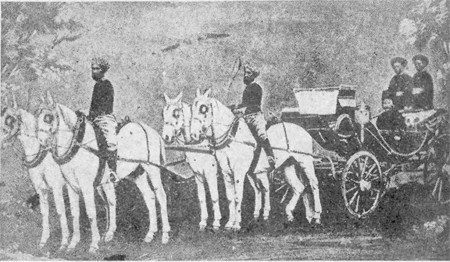
Sir Cowasjee Jehangir in his horse carriage
Photos on pgs 8, 10, 12, 14, 18 and 21 are from Parsi Lustre on Indian Soil
Sir Jivanji Jamshedji Mody, later distinguished secretary of the Parsi Punchayet, writing from Colaba, drew the attention of the trustees in 1878 to this unhealthy practice with its bad influence on the old, infirm and sick. Since it was not a signed letter the trustees took no action but with the passage of time, dispersal of Parsis, and more and more use of newspapers the practice died out.
Similarly the Parsis used to keep benches, etc in the streets for three days and nights for mourners thus disturbing the flow of traffic. In 1883 the police commissioner Sir Frank Souter wrote to the trustees drawing their attention to the inconvenience so caused and the trustees took immediate action and decided to inform the relatives on the occurrence of a death that benches should be removed to the houses nearby after the ceremony and rearranged when another ceremony time came.
As Parsi bodies for post mortem used to be kept in a common room where bodies of all communities were being kept, the trustees got built a special mortuary in the J. J. Hospital premises at a cost of Rs 2,000 in 1890. The tablet bears the following legend:
"This mortuary has been built with the sanction of government at the sole expense of the trustees of the Parsee Punchayet Funds, for the exclusive use of Parsees 1890 A.C.”
Whenever a Parsi intestate died in the Government Hos-pital the Punchayet would take charge of the body for disposal. So did Mahomedans, Christians and Jews, not the Hindus. Thus it was only Hindu bodies that were available for dissection by college students. Certain Hindu associations objected to this and they said they would take charge of Hindu bodies. As that would lead to non-availability of any bodies for dissection, the Government of Bombay brought forward the Bombay Anatomy Bill 1949.
Baptism minutes before death
Edalji Pestonji Hormusji Cama, a cousin of K. R. Cama, was baptised 10 minutes before his death on August 15, 1901 by his eldest son, who had embraced Christianity. Naoroji, brother of the deceased, wanted to take charge of the body for dakhmenashini. The incident created a lot of furore in the community. The police commissioner Kennedy was informed and he referred the parties to magistrate Khan Bahadur Phiroze Hoshang Dastur. The younger son of Edalji gave evidence and said the deceased wanted to embrace Christianity long before his death. The magistrate referred the parties to a padre to find out if the baptism was in order. The archbishop heard them and gave his verdict in favor of the son. The body was buried in the Worli cemetery.
But this raised a 64,000 dollar question. Can a Parsi, who has lived as a Zoroastrian all his life, be converted minutes before his death when he is either in coma or unable to understand the implications, in short when he is not in his complete senses to realize what is being done? The trustees consulted solicitors M/s Craigie, Lynch and Owen and we give below in toto the letter dated September 25, 1901 from the solicitors giving their opinion at length, in reply to the Punchayet letter dated September 3, 1901:
"Shams-ul-Ulma Jivanji Jamshedji Modi, Secretary
Parsee Punchayet
Dear Sir
"We have now fully considered the questions put to us by your letter to us of the 3rd instant, concerning which we had an interview with you, on the same date...
"Your letter then points out, that irrespective of the case of Eduljee Pestonjee Cama, who may or may not, have been a Christian at heart before his illness, there arises a most important question, which is whether a Parsi, who is believed to be a Zoroastrian all his life, who carries on his person the sacred shirt and thread (the symbols of Zoroastrianism) and in whose case there is nothing to show that he was a willing party to a change of faith, loses his right of the Zoroastrian method of disposal of his remains, if during his great (or last) illness and unconsciousness, he is baptised by any person, or made to go through the ceremonies of being turned into a Mahomedan, Jew or Hindu.
"It is desired that we should advise you fully on this point which we now proceed to do.
"We have no hesitation in answering the enquiry, above set forth, in the negative. That is to say, a Parsi believed to be such all his life, and who has always worn the symbols of Zoroastrianism, and in whose case there is nothing to show that he was a willing party to a change of faith, does not lose his right of the Zoroastrian method of disposal of his remains, by reason that during his last illness and unconsciousness, he is baptised by any person, or made to go through the ceremonies of being turned into a Mahomedan, a Jew, a Hindu, or a votary of any other faith.
"It is probably owing to the extreme rarity of an occurrence of the kind, becoming cognizable to any court of law, that we are unable to discover any reported decision of an English or Indian court which touches this subject. But we are clearly of the opinion that legally no man or woman can be made to change his or her faith except with his or her full comprehension and assent.
"And we may add that apart from civil law or the law of the state, we know of no theological tenet to the contrary so far as Christianity, whether Catholic or Protestant, is concerned, with the one exception of infants not arrived at the age of reason, and born of Christian parents.
"It is believed by Catholics, that ministration of the rite or sacrament of baptism to a child immedately after birth, or any time before it comes to the use of reason, will make that child a Christian, and entitle it to entry into the kingdom of heaven, should it die without committing any sin...
"We also think that if Parsi parents (even without any change of faith on their part) were to determine to make a Christian of their infant child, and, were to have such child baptised before it reached the age of reason or assent, by a priest of the Catholic Church, the law would hold such child to be Christian, and to have died a Christian, if its decease took place before it arrived at an assenting age.
(Of course, any child so baptised, might on arriving at the age of reason, repudiate Christianity.)
"But we do not for a moment consider that the law (if occasion arose) would hold a Parsi infant to be a Christian, supposing it were baptised by a stranger, or by stealth, contrary to its parents’ wishes, or without their consent.
"We think that in the instance of the late Cama, the magistrate was quite right in his pronouncement, that ‘if the baptism was a proper Christian baptism, the son of the deceased should be allowed to give him a Christian burial.’
"We also think that when the question whether the baptism was ‘proper’ was referred to the Archbishop of Bombay, His Grace, before pronouncing the baptism to have been proper, satisfied himself that the deceased had an assenting mind, and intended and desired to become a Christian; and further that the deceased being so minded, was ‘in articulo mortis,’ and there being no time to send for a priest, that the son had administered baptism, as permitted by, and in accordance with, the Catholic ritual, and in a manner sufficient to satisfy the same.
"At our interview with you on the 3rd instant, you put to us the case of a Parsi Zoroastrian, who might fall senseless on the road, and expire later without recovering consciousness. You enquired could a chance passer-by or other person, being himself a Roman Catholic Christian, by baptising the unconscious man before he expired, convert him into a Christian? We answer, "certainly not.” Not by any law, human or divine.
"It may be stated generally, in regard to your first enquiry, that the law would not recognize a change of faith in any man, because of any religious ceremonial ministered to him, unless it could be shown that such man was of a free, sound and assenting mind, and intended to change his faith, and did so without any improper coercion.
"We now come to the further enquiry contained in your letter... and our answer to this enquiry will, we hope, further elucidate our answer already given to the first enquiry. Your enquiry is as follows:
"In a case of emergency when the relatives of the deceased suspect that the whole affair is not a bonafide affair, what steps should they take to prevent the disposal of the body in a way other than the Zoroastrian?”
"In the case last put, of a Parsi professing Zoroastrianism falling senseless on the street, and being baptised by a passer-by and then dying, the nearest relatives of the deceased, or in their absence any members of his community, would, in our opinion, have the right to insist upon the body being disposed of according to Zoroastrian ritual.
"If the passerby or any other person sought to interfere, the assistance of the police should be called, and the interferer given into custody, and charged under Section 297 of the Penal Code, with offering indignity to a corpse. It might be necessary to go before the magistrate at once (to his private residence, if necessary) and we think there would under such circumstances as above mentioned be no difficulty in getting the magistrate to make the right order, as to the disposal of the corpse, viz with Zoroastrian rites.
"In any other case where the same suspicions might arise, the same course should be pursued, care being of course always taken to avoid any breach of the peace.
"It should however be borne in mind that in every case where a question might be raised as to the faith in which a man had died, the authorities would naturally look in the first place for information and assurances on the subject, to the widow, or sons, or daughters, or nearest relatives of a deceased (more especially to those who had resided with him) and very strong proof to the contrary, would be required, in order to rebut their statements, regarding the faith to which the deceased belonged, notwithstanding that the rites, whether Mahomedan, Christian, Jew or others, had been ministered to him, at a time when he was ‘in extremis.’
"It need hardly be said, that the attitude of English courts as well as of the law in matters of religion is absolutely impartial, and without any leaning or preference for or towards one creed more than another. The only ground, therefore, upon which a court, or the law, will interfere in matters where religion or faith are concerned, is to see that right be done, and protection afforded to the followers of every creed, in the observance of their particular tenets, and also to mete out punishment to any person who deliberately wounds the feelings or insults the religion of any other person, or commits any trespass in any place of worship, or on any place of sepulchre, or any place set apart for the performance of funeral rites or as a depository for the remains of the dead, or who offers any indignity to any human corpse, or causes disturbance to any person assembled for the performance of funeral ceremonies, or who with intention of wounding the religious feelings of any person, utters any word or makes any sound in the hearing of that person, or makes any gesture or places any object in his sight, or damages any place of worship, or any object held sacred by any class of persons. Perpetrators of any such offences are to be punished with imprisonment, or fine, or with both (Secs 295, 296, 297 and 298 of the Indian Penal Code).
"We think that any person who should make a wrongful representation in regard to the faith of any deceased person, with the object of having his remains disposed of in a manner contrary to his real faith, could be prosecuted, convicted and punished under Chapter XV of the Code.
"Incidental in some respects to the last enquiry which you have put to us, is the question whether there can be any property in a corpse, so as to render any person taking or seizing the same in face of rightful protest, to a place not being a place for disposal of the dead of the deceased’s faith, liable to a charge of theft, and therefore punishable under Chapter XVII Secs 378 to 382 (inclusive) of the Penal Code as well as under Chap XV, as aforesaid.
(Under Chapter XV the longest term of imprisonment provided, is two years, whilst under the theft sections it may extend to seven years.)
"In England it has been held (vide Williams vs Williams, 20 Ch. Div. 659) that there can be no property in a corpse, and that a man cannot by will, dispose of his own body; but that his executors are prima facie entitled to the possession, and are responsible for the disposal of the dead body.
"But it has never been held that the rule of ‘no property in a corpse,’ applies to India...
"We are, dear Sir/Yours faithfully/Craigie Lynch and Owen”
Exhumation
In Meerut a nine-month-old child of one M. P. Cooper of Dadar, Bombay, died of pneumonia in her mother’s lap on April 3, 1934 and a paternal aunt, herself a doctor, took the child to Delhi and after due ceremonies got her buried there in the aramgah on April 4, 1934. The father went to Delhi and wanted the body exhumed and taken to Bombay for dakhmenashini. Ervad Phiroze Masani, a Zoroastrian scholar and solicitor by profession, approached the trustees for permission to allow the child to be brought to Bombay and disposed of at the Towers or the Chotra. He met the trustees but he was informed that as the child was only nine months old and had been buried over 10 days ago, it was not advisable to exhume the body and bring it to Bombay. It was also explained to him that geh sarna had been once performed and as such another geh sarna could not be performed. In view of this the reeman body would have to be put on the Chotra. Masani’s request was declined by the trustees at their meeting of April 10, 1934.
Masani persisted and got the Bombay police commissioner’s permission on the following terms:
–"that the coffin is packed in accordance with instructions of Government order No. S 37 of January 26, 1929,
–that the package on arrival here is taken directly to the Tower of Silence, and
–that the package is not opened till then.”
The above-quoted Government order enjoins the following:
–"A corpse which has not been buried should be enclosed in a shell of zinc or other equally suitable metal with all joints so soldered as to seal them hermetically and prevent the escape of noxious gases or fluids, the shell should be enclosed in a stoutly built teak wood coffin and the coffin should be enclosed in a zinc or tin-lined wooden packing case filled with sawdust and carbolic powder.
–"Where a coffin has been exhumed and proves on examination to be intact, sound and free from offensive odor, it should be enclosed in an hermetically sealed zinc or tin-lined wooden packing case filled with sawdust and carbolic powder.
–"Where a coffin has been exhumed and is not intact, sound and free from odor, its contents should be dealt with in accordance with the above directions for bodies which have not been buried.
–"Forty-eight hours” intimation of the exhumation should be given to the health officer of the town or the district concerned previously.”
The trustees suggested the following conditions informally to Masani:
–The trustees will not be responsible in any way. All government and municipal orders to be followed by Masani.
–The body to be consigned to the chotra.
–The coffin to be opened in the open compound of the Doongerwadi and all implements for the purpose to be provided by Masani.
–If the geh sarna were to be performed, it should be done where the coffin is opened.
–No big gathering to be allowed.
Masani agreed to all the above terms. But the Delhi Anjuman strongly declined to allow exhumation and the matter rested there.
History of chotra
A chotra is not that elaborate. It is just a square enclosure about 15x15 feet with a plinth and a bhandar for bones. It is being used for doubtful cases and for those who have suffered capital punishment. As such it is rarely used. But what is its origin? It is surmised by Dr Modi (Parsi Punchayetni Tavarikh Vol I, p 93) that it is an enclosure built in 1777. At that time there was an epidemic — cholera or plague — and every day some two to four bodies had to be brought to the Doongerwadi. A new dakhma (Anjuman’s) was under construction and as there was not enough room in the existing two dakhmas the members of the Bombay Punchayet wrote to the Navsari Samast Anjuman and asked for their advice if they could build just a wall all round and instead of a regular ‘bhandar’ use only a pit. It was an emergency and time was of the essence. The Navsari Anjuman allowed the request. And so, as Modi says, the chotra came up. He thinks the present chotra is the same structure.
Crematorium
In the early 1920s the Bombay Municipal Corporation was seized of the question of a modern electric crematorium and its active member Jehangir B. Petit was a great exponent. He, along with a cousin of his, mooted a Parsi Cremation Society. From 1916 to 1934 Petit was himself a trustee of the Parsi Punchayet. It was a step unheard of then and the Parsi community was naturally upset as it strongly believed in no other form except dakhmenashini. When the matter was broached before the trustees by an individual and thereafter the editor of the Hind Mitra, the trustees pooh-poohed the idea and took no notice and it all died a natural death.
Mahomedan riots: A sordid tale
Parsis are undoubtedly a law-abiding community of India and they seldom go out of their way to hurt the feelings of members of other religions. But sometimes it so happens that a thought that is furthest from one’s mind is fathered on him to find an excuse for contumely and bloodshed and that is what seems to have happened in 1874, within a year of the end of the criminal case and a year before the civil land suit was disposed of.
Rustomji Hormusji Jalbhoy, a young freelance, with a flare for gorging English literature or other books and disgorging the same in vernacular for the spread of knowledge took into his head to publish in Gujarati a book called (Renowned Prophets). The young man had read authors like Ockley, Washington Irving and Gibbon and thought he was living in as free a society as his English authors did. There was a passage in Irving’s book, which when translated into Gujarati made an unsavory reference to Prophet Mahomed. The book was published some time in the middle of 1873 and the reaction of Mahomedans materialized 10 months later, maybe through some incitement, though that has remained a mystery,
In early February 1874 the air was rife that Mahomedans wanted to create mischief, a riot, or at least disturb the peace. The police commissioner F. H. Souter... was absolutely aware of all this. He had top detectives under him, who were Mahomedans, and one of whom was recently made a Khan Bahadur. On or about February 8-9, 1874, deputy commissioner of police, Edginton, called Jalbhoy to his office and told him in the presence of Souter that a deputation of Mahomedans had told him that "their coreligionists were so excited that they would burn down the homes of the Parsis, would maltreat them and do other injuries to them.” Jalbhoy said it was for sheer diffusion of knowledge that he had written the book and on the request of Edginton in the presence of Souter, Jalbhoy stock-piled his unsold copies with the police. In fact later on knowing the names and addresses of purchasers the police even recalled those books too. A deputation of Mahomedans, which was already waiting in the next room, was informed of what Edginton had done. This should have ended the matter peacefully there and then but that was not to be and rumors persisted that there would be trouble.
And it did happen. Soon after Jumma prayers in the mosque on Friday, February 13, a number of Mahomedans, mostly Siddees and Arabs, came out shouting "Deen, Deen,” went into Abdul Rehman Street, attacked Parsi homes, desecrated the holy fire in Alahi Baugh and started breaking windows and doors, furniture belonging to Parsis living there, looting and burning what came their way. It also happened on February 14 and 15. Parsis suffered considerably. On February 15, there were two funeral processions led by Mahomedans. They started from the Mahomedan locality of Bhendi Bazaar and wended their way via Bhuleshwar through Parsi localities towards Sonapore, their burial ground. One of the Hindu witnesses, the keeper of a temple, stated the Mahomedans were armed with sticks, etc. The Parsis had information that if they did not organize themselves the two atash behrams at Dhobi Talao were not safe and they did do so. Prior to all this the Parsi sethias including the trustees of the Parsi Punchayet had urged government to call military which for reasons best known to them the government had failed to do and depended upon their police force under Souter who perhaps bore a grudge against the Parsis. In fact he once told some Parsis that he would like to see all Parsis killed! Was it then a stratagem? And as sure as six pence the trouble started when the procession neared Sonapore, a predominantly Parsi area. Mahomedans said Parsis threw stones and Parsis said the Mahomedans attacked Parsi homes, broke window panes and did other damage. In the melee that followed one Parsi and four Mahomedans, who were injured, died later, most Parsis then disappeared and the police took a number of Mahomedans into custody for rioting. After this the government of the day saw fit to call up military and the disturbance ended with one solitary instance on February 21.
All this while the trustees of the Parsi Punchayet had along with other sethias tried to set the police and even the governor wise about the motives of the Mahomedans but they were not prepared to listen to good advice. In fact once even the governor, Sir Philip E. Wodehouse, had the audacity to snub Parsis led by Jamsetjee Jejeebhoy and tell them to make their own arrangements for defence. He had made such a statement even in his earlier convocation address. Coming as it did from a ‘Hakem’ and Her Majesty’s ‘Keeper of the Peace,’ it was astounding. He was possibly not guided properly by the police. And Souter should have seen to it. The last straw on the camel’s back came when the government of Bombay reported to the principal secretary of state for India in council, the Marquis of Salisbury, backed by the one-sided police report in which the Parsis were portrayed to be equally blameworthy with the Mahomedans. The trustees and other well-known Parsis then saw fit to send a memorial to the... Marquis on April 13, 1874... The Government of Bombay did try to bolster up but the Marquis saw through all this. The Marquis in his reply to the governor, while condemning the words used by Jalbhoy, clearly took Souter to task saying: "Before that day (February 13), the commissioner of police was informed of the existence of an angry feeling among the Mussulmans, and he tried to calm it by procuring the suppression of the book. In neglecting at the same time to take suitable precautions against disorder, Souter committed an error of judgment. If the feelings of the Mahomedans were not likely to be dangerously excited, there was no need to interfere with the circulation of the book; if they were, that measure would not by itself avail to ensure maintenance of order. Unaccompanied by any preparations for repression, it may have been interpreted as a proof of weakness, and have increased, rather than allayed, the prevailing excitement...”
The memorial to the Marquis was signed by Jamsetjee Jejeebhoy, Ardeshir Hormasji Wadia, Framji Nusserwanji, Byramjee Jejeebhoy, Heerjeebhoy Hormusji Sethna, Dinshaw Manockjee Petit, Cursetjee Furdoonjee, Merwanji Framji Panday, Muncherji Hormusji Cama, Nowrojee Manockjee Wadia, Sorabjee Jamsetjee Jejeebhoy, Dastur Peshutan Behramjee, Jamaspjee Dastoor Minocheherjee and 8,438 other Parsis.
One does not like to wait on this sordid affair for long. Suffice it to say although there have been small skirmishes in 1851, 1895 and again in 1921 (with political overtones) the Parsis have remained completely law-abiding in all respects.
In fine, it may be stated that some 62 Siddees and Mahomedans were tried and sentenced. A few were let off.
Recall of a charity donation
Can executors after having given a certain amount of charity to a trust recall it on account of a legal fault? In 1870 such a question arose. The executors of Dadabhai Manekji Vatcha had given a donation of Rs 11,500 in October 1870, interest to be used as per directions. Vatcha in his will had provided for Rs 33,200 to be given to Punchayet for various purposes, against which the first instalment was sent. Rs 11,500 were credited to the following funds and a proper receipt passed:
Rs 5,000 Avalmanjal Fund, Rs 2,000 Zend Avesta Classes Fund, Rs 1,500 General Charity Fund, Rs 2,000 Andhla-Pangla Fund, Rs 500 Shehenshahi Gahambar Fund.
By their letter dated December 8, 1870 the executors informed the trustees that they were advised by their solicitors... that under Sec 105 of the Indian Succession Act the legacy was void as the will failed to satisfy the provisions of the section and demanded return of Rs 11,500.
The trustees consulted their solicitors and asked them to prepare a case for opinion for a counsel, even a counsel from England. In the meantime, the executors kept reminding the trustees, even threatening legal action. Whether any opinion was finally taken or not is not available from the records but it seems in 1874 the executors gave another Rs 5,100 and in Dadabhoy Maneckji Vatcha Fund No 216 Rs 16,600 stand to its credit. According to the Punchayet Account Book for the years 1951-54 the interest has been credited to no less than 11 different funds.
The section noted above is clear in its design and if the will was not registered within six months or the testator did not live for a year the bequest should have failed, but the executors might have from the residual estate carried out the behest of the deceased. The original bequest was for Rs 33,200. It appears the executors and others who were near relatives and presumably the beneficiaries under the will appear to have given another Rs 32,000 to the Punchayet... Per se, these donations may not have any relation to bequest of Vatcha but the Parsi religious conscience rose to the fore and the general public got the benefit.
Sir Phirozeshah Mehta’s memorable words
"To ask the Parsis to isolate themselves and their interest from those of the other natives of this country is to preach not only equally selfish, but a great deal more shortsighted and unwise. In our case, it would be almost suicidal policy. Its ultimate effect would be only to reduce us to insignificance... Isolated as Parsis, pure and simple, holding ourselves aloof from the other natives of the country, without common interests, common sympathies and common cooperation, we might still remain an interesting community, but of no account whatsoever in the great march of events molding the lofty destinies of this magnificent land.”
◆ ◆ ◆
From the archive