
Health and history
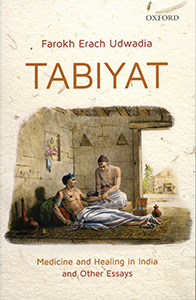
Tabiyat — Medicine and Healing in India and Other Essays by Farokh Erach Udwadia. Published in 2018 by Oxford University Press. 2/11, Ground Floor, Ansari Road, Daryaganj, New Delhi 110002. Pp: xi + 210. Price: Rs 695.
 To review a non-medical book written by a master physician of the old school is not an easy task, particularly when the writer is perhaps the last of the great physicians trained in the mold of the greatest of all medical professionals, the legendary Sir William Osler.
Having read Dr Farokh Udwadia’s (pictured) earlier volume of essays The Forgotten Art of Healing, I thought he had, as the saying goes, shot his bolt. But this second volume Tabiyat — Medicine and Healing in India and Other Essays transcends the previous volume both in the ease and beauty of its language and its content. If he writes another in the same vein, which I hope he does, I doubt if he will be able to better this one. The author, a versatile physician, an uncanny diagnostician, philosopher, musician and a man who pioneered critical care in this country and excelled in its practice is above all a humanist who subscribes to and practices the French-German theologian Albert Schweitzer’s philosophy of "reverence for life." Udwadia has poured his heart out in carefully chosen nine essays which demonstrate his wide interest and learning in unrelated subjects tackled with consummate skill. He has called this book Tabiyat, a word that means health in many Indian languages — health in various forms, physical, mental, emotional. A title both original and eye catching, it excites the interest of the reader.
 In his second essay "The Microbe Hunters," a title borrowed from an old book I read many years ago, he tells the reader in no uncertain terms where lies the cause of suffering. A Hungarian obstetrician, Ignez Philip Semmelweis, proved by clever deduction that it was the doctors who were killing their patients by carrying infection from postmortem rooms to expectant mothers. He was ridiculed, ostracized, and ultimately died abandoned in a mental asylum. He pointed the way to the great microbe hunters like Louis Pasteur, Robert Koch and Joseph Lister who, by their brilliant work, changed the lives of suffering millions. The author shows that these were not ordinary men, they were giants who lacked the sophisticated machinery of modern science but possessed intuitive brilliance, phenomenal powers of observation and indomitable courage. Today millions of us are still alive because of these four men.
The author says that the sword that was put in their hands was the microscope first made by Johannes Faber and Zacharias Janssen of Middleburg in Holland and later improved for practical use by Anton Van Leeuwenhoek, an insignificant draper also born in Holland. The microscope became the magic eye which helped the hunters track down and ultimately slay the enemies of mankind. The author shows in his later chapters that the battle is not over but goes on and will go on, until in his last essay "Death" he philosophises that death is man’s surest hope in life and ultimately beyond the healing hand of medical science.
The third essay is on "Medical Ethics." I presume that Udwadia believes that ethics is a topic badly needed to be discussed, nay thrashed threadbare, in this day and time as he has done under several headings. When sharing his views on "Respect for Human Rights," he has written without pontificating or riding the high moral ground, hitting straight from the shoulder. The profession cannot and should not miss the message conveyed in these few pages. In fact, I laughed when I saw his opening quote for this essay from Hermann Nothnagel, the great physician who described the symptoms of angina (any disease marked by painful attacks of spasmodic choking). The quote is "Only a good man can be a great physician."
The chapter "War and Medicine" tells you how the harbinger of untold suffering and death brings in its wake remarkable progress not only in surgery, but in medicine also. We are told about the great barber surgeon Ambroise Paré and Napoleon’s surgeon Dominique Jean Larry. Napoleon thought no end of him and said, "He is the most virtuous man I have ever known." Plastic surgery and its wonders, pioneered by Sir Harold Gillies and Archibald McIndoe, came into its own in World War II. Penicillin and sulphonamide were first used during this war. The author philosophizes that much good can come from evil.
Though a master exponent of allopathy or now known as biomedicine, the author treats with great respect the ancient systems of ayurveda and the great physician and surgeon of yore Charaka and Sushruta. He speaks of their great achievements, and the limitation of the science as it stands today but hopes that in the future all medicine will merge into one "Universal Medical Code." Perhaps, as he says, a "utopian dream."
The essay on "Florence Nightingale" is perhaps my favorite piece. It romantacizes the life and achievements of a remarkably brave and compassionate woman who fought against disease, squalor and death and defied the chauvinistic opposition of powerful men in the army. She won over them all. However, the author mentions that she was no saint and had her faults, which to my mind, makes her more human and lovable. It is said that she would take a daily night round when all were asleep. Lamp in hand, she would pass by every bed and one of these soldiers wrote, "We lay there by hundreds, but we could kiss her shadow as it fell and lay our heads on the pillow again content." The author has woven in a lovely sentence, almost poetic, when he says. "And then Florence Nightingale walked into history; known as the lady with the lamp… she lit her way into the hearts of the very many she nursed."
The reviewer is more than aware that the seventh essay "Music, the Mind and Medicine" is a topic very dear to the heart of the author but unfortunately, this reviewer, though he does enjoy classical music and is moved by song and certainly by poetry, has no indepth knowledge of music and is therefore, ill equipped to comment on this essay. The reader however, will learn a lot about music as such, and how the human brain processes the appreciation of music and the therapeutic effect of good music on pain, insomnia and the general well-being of a patient. The medic tells us how he has used music on his patients with great benefit to their condition. I was quite intrigued when I read in this essay that "There is, however, no greater or more sublime instrument in the world than the human voice. A sweet, melodious, far-ranging voice is the personification of quintessential beauty in music."
Medicine in the Renaissance era
All civilizations have a beginning and an end. After the fall of Rome came what history calls the "Dark Ages." The dawn of modern civilization came in the 14th century with what history calls the Renaissance. The author talks with great feeling about the Renaissance men like Andreas Vesalius, Paracelsus, Paré and the great Leonardo Da Vinci. When the author talks about Paré, his skill, his humanity, his charity and his modesty he says, "Ah, would to God that more surgeons were cast in his mold!" As a surgeon, it made me smile for I do believe that the dig, if it was meant to be, was well deserved.
The author meaningfully keeps death as the subject of his last essay. If anyone is qualified to talk on death in its various aspects it is this man, for he has seen the dark reaper manifest in various shades, for death can be cruel and can be kind. This chapter contains some lovely quotes. My favorite is the one from Lucan wherein he says, "The Gods conceal the happiness of Death."
He deals with after death experiences and gives it all a logical, scientific explanation which convinces the reader that there is nothing supernatural about it. There is an interesting paragraph on French philosopher Michel Eyquem de Montaigne’s near death experience. He advises, "If you don’t know how to die, don’t worry; Nature will tell you what to do on the spot." The author gives a personal touch to the essay by telling us with great sensitivity and pathos what he himself believes or likes to believe of what comes after death. The reviewer was not surprised that it expresses his own belief.
These essays are to be read in a pensive frame of mind. This is one of those books that I would keep at my bed side for it contains much food for thought. The little volume is beautifully produced by the Oxford University Press and would make an excellent gift for the discerning.
Dr HIRJI S. ADENWALLA
Adenwalla is head of the Department of Plastic Surgery, Burns and the Charles Pinto Centre for Cleft Lip, Palate and Craniofacial Anomalies.