
Seminar
The medium is the message
The importance of going online was the theme of the Empowering Mobeds workshop
A sea of white dotted with a green here or a red there greeted visitors to the airconditioned Mancherji Joshi Memorial Hall of the Dadar Athornan Institute at the Empowering Mobeds (EM) workshop on May 13, 2018. Jointly organized by the Athornan Mandal (AM) and the WZO Trust Funds Mobed Welfare Scheme, Mobeds Moving Online was the theme of the one day seminar. The object was to guide the clergy on the use of media to spread religious knowledge. Around 25 mobeds attended the free workshop along with some spouses and parents.
Core team member of EM and chairman of the WZO Trust Funds, Dinshaw Tamboly briefly welcomed the gathering and wished all mothers present a Happy Mother’s Day. Ervad Kaizad Karkaria of Dadar’s Rustom Framna Agiary invoked divine blessings while Dastur Khurshed Dastoor, high priest of Udvada gave his welcome address. Lamenting that "aapra mobedo baddha ma paachhal rahi gayach (our mobeds are lagging behind in everything),” he said it is high time that the mobeds take advantage of social media to "spread the goodness.” A mobed being freed of his priestly chores by 11 a.m. can use that time more effectively. He cited the example of Florida based Ervad Soli Dastur who used social media to familiarize a behdin paasban in another US state with the afargan, farokshi prayers and other ceremonies. "This is how you can make a difference. You will be pulled down by some people, but don’t be scared. Do what you have to do,” exhorted the high priest.
Core team member of EM and chairman of the WZO Trust Funds, Dinshaw Tamboly briefly welcomed the gathering and wished all mothers present a Happy Mother’s Day. Ervad Kaizad Karkaria of Dadar’s Rustom Framna Agiary invoked divine blessings while Dastur Khurshed Dastoor, high priest of Udvada gave his welcome address. Lamenting that "aapra mobedo baddha ma paachhal rahi gayach (our mobeds are lagging behind in everything),” he said it is high time that the mobeds take advantage of social media to "spread the goodness.” A mobed being freed of his priestly chores by 11 a.m. can use that time more effectively. He cited the example of Florida based Ervad Soli Dastur who used social media to familiarize a behdin paasban in another US state with the afargan, farokshi prayers and other ceremonies. "This is how you can make a difference. You will be pulled down by some people, but don’t be scared. Do what you have to do,” exhorted the high priest.
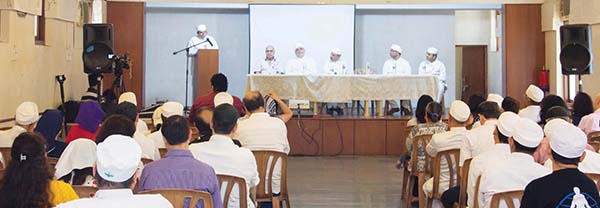
A session in progress
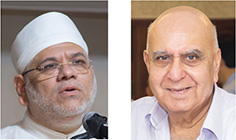
Dastur Khurshed Dastoor (left) and Dinshaw Tamboly
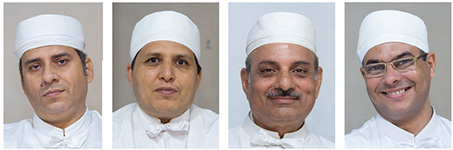
(From l) Ervads Cyrus Darbari, Hormuz Dadachanji, Darayesh Katrak and Kaizad Karkari
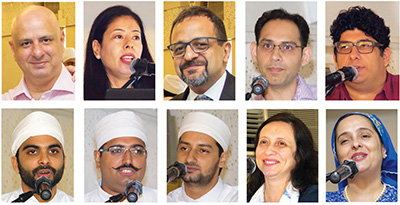
(Clockwise from top left) Berjes Shroff, Shernaaz Engineer, Drs Kersi Chavda and
Ervad Mazda Turel, Rayomand Patell, Pearl Mistry, Binaifer Sahukar,
Ervads Jehan Darbari, Firdaus Pavri and Sheherazad Pavri
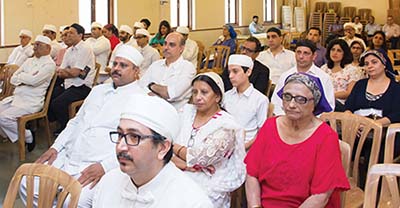
Section of the audience
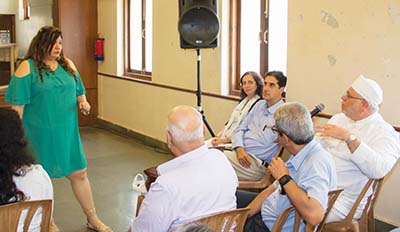
Delphi Wadia conducting the interactive session
Dastoor also welcomed the concept of a behdin boy becoming a navar if he so wished to. "Why not?” he inquired. "If the boy learns all the 72 chapters (Has), why can’t he become a mobed? It is high time we change,” he said.
Secretary of the AM, Ervad Cyrus Darbari advised teenagers and parents to use social media to their advantage. "Social media is good, but sometimes it is misused. Use it cautiously, judiciously. Don’t forward wrong messages. As soon as you press the forward button, you become party to it — means you are encouraging it.”
"Those who do more for the community are closer to Dadar Ahura Mazda,” said Ervad Darayesh Katrak. Speaking on "Bringing more Mazdayasnis into the Fire Temples,” he advised "Parsipanu aapra gher ma laavo (bring Parsipanu into our homes).” Comparing one’s body to a discharged mobile phone, he urged one to "recharge your batteries by going to the agiary.” Credited with starting the first Behram Yazad shrine in Bombay’s Dadysett Atash Behram, Katrak said he got the idea when he visited Tehran in 2015. "Miracles happen to those who believe in them. Never underestimate the power of our prayers. Respect other religions, but follow your own,” he concluded.
Speaking on a "Young Priest’s Perspective on Social Media,” panelist Ervad Hormuz Dadachanji said that "social media is like a double edged sword. It can bring about a sense of togetherness and awareness if used wisely. However if abused the repercussions are great… The best teacher in the world is just a click away. Let us truly capitalize the strength of ‘Digital India’ and build a community that uses technology in spreading the word of God in a peaceful and loving manner,” he urged.
Counsellor Pearl Mistry made a short presentation on Jiyo Parsi (JP). Two earlier programs on enriching mobeds’ lives were conducted under the JP banner (see "Mentoring Mobeds,” Parsiana, June 7, 2017 and "Mobeds as mediators,” Parsiana, December 7, 2017).
The second session was moderated by core team member and mainstay of the EM program counselor Binaifer Sahukar. The ‘experts’ on this panel used Power Point (PP) presentations to put their message across. Jam-e-Jamshed editor Shernaaz Engineer talked about "Using Parsi publications to your advantage.” "Yes, social media has its benefits, but print is a very powerful medium too,” she stressed. "Jé article chhapainé aavé paper ma (the article that is printed in a paper), has a different feeling, a different value…”
"Imparting knowledge is a very important part of priesthood and what better way than writing about the religion. The written word carries considerable weight. Despite social media, the (printed) word is significant,” she noted. Engineer urged the "spiritual shepherds” to write articles that inspire. "We are living in times where religion does not play an important part in people’s lives. But the minute the chips are down, when some musibat (difficulty) or takleef (hardship) comes, what do you do? You turn to a higher power… So articles that inspire faith in the religion must be written consistently,” she summed up.
"No, I’m not on social media,” announced Ervad (Dr) Mazda Turel. He was introduced as a person who "when he is not making us laugh with his column in the Jamé, works as a neurosurgeon at Wockhardt Hospital.” He was quick to add, "I am one of those Parsi priests (he is also an ervad) who uses Jamé to their advantage.
There is a whole science of how humor affects the brain, said the doctor whose topic was "Neurochemical Brain Changes Through Humor.” "There is an eternal conflict between the brain and the heart. It’s (brain) an amazing organ. It works 365 days of the year, 24 hours a day until you fall in love,” he jested. Use humor as a coping medium, he advised. "I see people die regularly, that doesn’t mean I am a bad doctor. It means that the situations we are faced with are different and challenging. We (doctors) may not be able to increase the length of survival, but with humor we may be able to improve the quality of life.” Stressing that laughter is the best medicine, he ended by saying, "when you are able to find humor in a difficult situation, you will end up winning.”
"Effect of words, spoken/digital on emotions” was Dr Kersi Chavda’s topic of discussion. Psychiatrist and consultant at the Sir H. N. Reliance Foundation Hospital and Research Centre and the P. D. Hinduja Hospital and Medical Research Centre, Chavda mentioned that "words are not just strings of alphabets sewn together with ink. Words are cues, are triggers. Words when used correctly can transform an ‘Eh whatever’ into a ‘Wow! That’s it!’ … We know that social media can get people to take action, can arouse people in many ways — good or bad — can evoke curiosity or empathy. So be aware of how you respond to words that you hear or read. Be aware of how you use those words with others...It is amazing that we can control both our own emotions, as well as that of others by the words that we use — both digital and spoken.”
Berjes Shroff, founder and chief executive officer of Infosec, an information and cyber security training company spoke impromptu on "Cyber Safety and Etiquette.” He mentioned the various perils of cyber space. "Do not use fake email IDs. It can be traced back to you. Anything you write in an email can be used against you in the court of law. Don’t believe all that you see on social media.” Sharing his own experiences, he summed up, "Don’t write anything while you are angry or upset. It can come back to bite you very badly. One can even make enemies out of one’s best friends.”
Advertising professional Rayomand Patell, while displaying photos of Iran in his PP presentation, noted, "The priest was the spiritual anchor of the community. We worked together, played together and most importantly prayed together. Just as our ancestors set out across the waters, today the time has come for us to set out on another journey. A journey not through the oceans, not through the lands, not through outer space, but cyber space.” Calling out to the mobeds to be community leaders who can reach out, guide and shape the community, he requested them to use social media "simply, safely and securely.”
After a hearty lunch by Jimmy Gadiwalla, the last session had three young mobeds sharing their insights. The session moderator was EM volunteer Ervad Khushroo Makihatana. Ervad Sheherazad Pavri narrated his experience of attending the recently concluded World Zoroastrian Youth Leaders Forum (WZYLF) in the UK (see "Bonding at WZYLF,” Parsiana, May 21, 2018). He showed the audience a brief slide show.
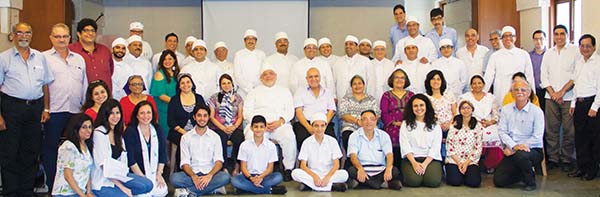
Participants and organizers of the workshop
A lover of cars, movies, music, food and travel Ervad Firdaus Pavri, panthaky of the Godavara Agiary in Fort spoke on "Digitization — The Way Forward to Promote Zoroastrianism.” The tech savvy ervad said, "we have come a long way from using messenger pigeons and postal telegraphs to smartphones, text messages and emails. Embrace the latest gadgetry with open palms and open minds, because one who doesn’t change, becomes extinct like a dinosaur.”
The youngster confessed that it was "none other than digitalization that allowed me the freedom to pursue my interests and passions along with doing mobedi.” He soon realized that "it’s our beautiful profession of priesthood that in spite of it being a full-time job, still gives us the free time to pursue our hobbies and passions.” Firdaus concluded his speech by quoting noted Hollywood icon Sylvester Stallone’s phrase from the film Rocky IV: "If I can change, you can change. And if you can change, everybody can change!”
Citing his personal experience with social media Ervad Jehan Darbari of Rustom Framna Agiary confessed that it was never his goal to become a full time priest. Now he is very happy to be part of this "noble profession.” He used social media to spread the good news of all his achievements and received positive feedback. "That is the outreach of social media to get your message across to the community. Actively participate in the new digital revolution and use it for the betterment of yourself and the community,” he advised.
"Bèsi, bèsi né thaki gayach né (You all are tired sitting, right)? So I’m going to wake you up, shake you up and move you’ll around,” promised Delphi Wadia, global head — learning and development at United Phosphorus Limited. Conducting an interactive session with the participants, Wadia spoke about the pros and cons of using social media and gave useful insights in enhancing social etiquette. In order to be a good speaker she mentioned certain dos and don’ts in terms of body language: No crossing of hands across one’s chest, no hands in one’s pockets, no leaning on chairs or other furniture. Be audible, be presentable, have good speech content and most of all maintain eye contact. "Have a ‘lighthouse effect,’ i.e. look at the entire crowd, not at a single individual. Look them in the eye, not above their heads, not below their necks,” she advised.
In his summation of the day, Tamboly thanked his EM team and was happy to witness the enthusiasm of the panelists and audience. Acknowledging that "our young, dashing and dynamic mobeds have reignited pride in that calling,” he hoped that they will "pursue mobedi with greater passion.”
A participation certificate was given to all those present. A week later, a letter of thanks from Dastoor and Tamboly was emailed to all those registered for the workshop.
◆ ◆ ◆
From the archive