
Power to Perveen
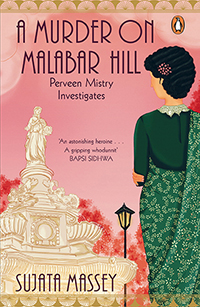
A Murder on Malabar Hill. Perveen Mistry Investigates by Sujata Massey. Published in 2018 by Penguin Random House India Private Limited, 7th floor, Infinity Tower C, DLF Cyber City, Gurgaon 122002. Pp: 426. Price: Rs 399.
 In A Murder on Malabar Hill, Sujata Massey’s (pictured) protagonist, Perveen Mistry, is an Oxford educated solicitor working in her father’s law firm. This is rare, as the novel is set in 1921 when the legal arena was a totally male dominated profession. In her acknowledgements, Massey mentions she was inspired by two outstanding Parsi women. The first, Cornelia Sorabjee, the first woman graduate of Bombay University, proceeded to Oxford to become the first woman to sit for the British law exam in 1892. She returned to India to fight several cases especially for the purdahnashin (those living in seclusion) women. The second, Mithan Tata Lam, who also read law at Oxford and who was the first woman to be admitted to the Bombay Bar in 1923.
The novel moves between 1916 when Perveen is a student and 1921 when she is back from Oxford and working with her father. As a student at the Government Law School in Bombay she is the only girl studying law. Just as Sorabjee faced many insults from Indian male students: they played practical jokes on her and shut the classroom doors on her face, telling her in no uncertain terms that her place was at home (the British students were kinder), Perveen suffers from a similar fate. At the height of her frustration with the course, the students and her professors, she meets Cyrus Sodawalla, a young man from Calcutta who has come to Bombay in search of a bride, falls madly in love with him and after a quick meeting of their parents, decides to get married.
 In 1921, while she is in the process of helping her father with the execution of the will of a Omar Farid, a wealthy mill owner, who has left behind three widows living in strict seclusion, she notices certain discrepancies which arouse her suspicions. Apparently, the widows seem to be at the mercy of an unscrupulous Mr Mukri, who has submitted documents to show that they want to give up their entire mahr (dowry) and donate it to the family’s wakf (inalienable charitable endowment). Perveen decides to investigate the case as she is particularly interested in knowing if the Muslim women were aware of their rights. The fact that she is a woman makes her ideal to question the widows who would have no direct contact with men and the outside world.
As the story evolves, we see Perveen grow from an immature and lovesick girl into a woman who takes charge not only of her own life but also of that of the women and the other inmates of the house. Her marriage to Cyrus is a disaster. Within months she returns to her parents’ house. He not only physically abuses her but also gifts her with a venereal disease. She then goes to Oxford where she acquires her degree and returns with confidence and a determination to succeed in the legal world.
The novel also contains a great deal of legal information which is very carefully integrated into the fabric of the novel. Whether it is Muslim or Parsi law, Massey seldom seems to indulge in her knowledge of legal expertise at the expense of the plot. The practice of segregating Parsi women during menstruation and confining them to a small room with an iron bed is not used just for the purpose of describing an archaic and outdated custom. This event plays a very important part in the unraveling of the plot. Often, the little bits of law introduced by her are very interesting as well. Not many persons would know that as per the Parsi Marriage and Divorce Act of 1865, a Parsi woman could only divorce her husband on grounds of adultery, if the sexual intercourse had taken place with "a married lady, not a prostitute.”
It is strange that Massey has titled her novel A Murder on Malabar Hill. Yes, there is a murder, and the murder as well as the unravelling thereof occupies one half of the novel. The situation is fraught with danger and it is evident that Perveen’s own life is in danger. Yet she does not flinch from her role as a lawyer and even goes beyond the bounds of duty to become a detective and solves the case. However, to read the novel as a mere crime story would not do justice to the intricate time frame and the careful research which has been done as a background to the novel.
If, on the one hand, it is a ‘mystery story’ with the resolution of a crime, Massey balances this by giving equal importance to Perveen’s personal life in 1916 and the trials and tribulations she faces as a student as well as a married girl. The author presents the problem of being a female student in a male classroom, the problem of being accepted as a female lawyer in a man’s world and the problems faced by women in seclusion. There are certainly well-developed male characters like Perveen’s father, but it is the women who dominate the book and finally learn to assert themselves. Perveen moves from a young girl who is unable to withstand the teasing of her classmates and the unpleasant and unjust professors to a solicitor who holds her own against the British officers and the whole male dominated society of durwans and policemen. One sees a similar acquisition of power in two of the widows who agree to sell the property and live normal lives forsaking the seclusion they earlier practiced. They take charge of their own lives, acquire property, make arrangements for their daughters and one of them even decides to marry a second time.
In fact, the final scene is not the discovery of the murderer. The novel ends with a scene in a restaurant where Perveen and her friend, Alice, manage to obtain alcoholic drinks which are not permitted to women unaccompanied by men. They raise their glasses "to the power of women” and that is, to my mind, the central theme of the novel which Massey skillfully uses to bind the private lives of Perveen and the widows with the unravelling of the murders which take place.