
Books
Maneuvering Matheran
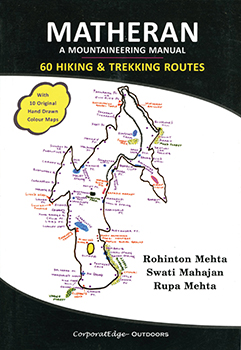
Matheran: A Mountaineering Manual, 60 Hiking &Trekking Routes by Rohinton Mehta, Swati Mahajan and Rupa Mehta. Published in 2017 by CorporatEdge – Outdoors, 779, Nirvan, 602, 6th Floor, Parsi Colony, Dadar (E), Bombay 400014; email: corporatedge@gmail.com; website: http://site.google.com/site/corporatedge33/ Pp: xvi + 232. Price: Rs 230.
"We hope this Manual can spark the spirit of adventure in the youth,” write the authors, all adventure seekers who are convinced, "Hiking is both intoxicating and addictive… Trekking is a great leveler… It pits you against yourself… Mountaineering teaches you humility and patience and brings the best and worst out of you. Trekking hones your judgment and makes you decisive. Good judgment comes from experience and experience comes from bad judgment!”
Looking through the three-page glossary at the start of Matheran: A Mountaineering Manual, 60 Hiking & Trekking Routes, a reader may wonder why the authors needed to include easily understood terms like hill and mountain, river and stream but the authors obviously want to ensure that their Manual is well understood even by those who can’t differentiate a hike from a trek. A hike is usually a short, one day or overnight trip into the outdoors or mountains while a trek is a longer (usually more than two days) sojourn.
Looking through the three-page glossary at the start of Matheran: A Mountaineering Manual, 60 Hiking & Trekking Routes, a reader may wonder why the authors needed to include easily understood terms like hill and mountain, river and stream but the authors obviously want to ensure that their Manual is well understood even by those who can’t differentiate a hike from a trek. A hike is usually a short, one day or overnight trip into the outdoors or mountains while a trek is a longer (usually more than two days) sojourn.
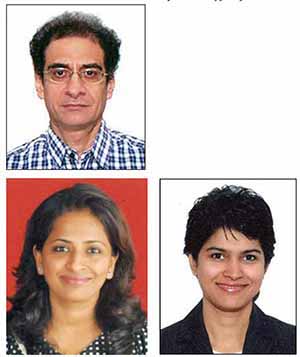
Clockwise from top: Dr Rohinton Mehta, Rupa Mehta and Swati Mahajan
One-fourth of the 232-page book carries general information on Matheran which is the smallest hill station in India, admeasuring 7.35 sq km at a height of 2,625 ft, and the only one in Asia that does not permit motorized vehicles. It is considered a unique mountain with routes going up from every village surrounding its base and from every neighboring mountain. The rest of the pages are devoted to the five dozen ascents and descents. "The most fascinating aspect of hiking in Matheran is the flexibility that it gives a hiker in terms of time, energy, technical ability and/or endurance. It is possible to climb from one route and descend from the other” or in reverse gear, climb down first and then up, a rarity in mountaineering. Considered a hikers’ paradise, although there are only five to six routes known to most hikers, "we have undertaken to showcase various permutations and combinations of about 60 routes… Each and every route delineated in the Manual has been personally climbed by at least one of the authors themselves or their close mountaineering club associates…”
All the three authors have trekked extensively. Dr Rohinton Mehta, doctor of philosophy, criminologist, professor, lawyer, martial artist, athlete who has won international medals including the World Masters Games gold in Sydney in 2009 in the 400 m hurdles, is very familiar with the 200 mountains in the Sahyadris, the Indian and Nepalese Himalayas, terrains in the USA and New Zealand.
 Swati Mahajan is a national level Masters track and field athlete who has trekked in the Nepalese Himalayas and being considered a specialist in the central Matheran range, has climbed the Sahyadris with members of her mountaineering club who fondly address her as the "little mountain goat.”
Rohinton’s wife Rupa who is involved in diverse sports including karate, athletics, trekking and cycling has won medals in Masters athletics and other events. She is a senior corporate trainer and director of CorporatEdge, this book being published by CoporatEdge - Outdoors. She has done various hiking routes in the central Matheran range and is a specialist is cartography and route mapping using satellite imagery. She has also authored a book on credit card frauds.
The methodology adopted by the authors is to give sufficient information on each of the routes in terms of the terrain, difficulty levels — both technical (graded from T1 which anyone can do, to T5 that requires specialized equipment and training) and endurance (E1, very easy that only requires some willpower and a spirit of adventure, to E5 that is very tough demanding huge energy and aerobic reserves with mental tenacity), approach routes, and time required. The scenic views and religious shrines along the way, availability of food and water, the pitfalls and dangers, are all delineated to give a comprehensive picture. The most difficult trek in the manual is "The 4 Day 7 Mountains Killer Trek” which has been described by the authors as "all four days are virtual killers but days one and four are suicidal!”
The authors’ caution should be heeded by novices: "As a general thumb rule, in mountaineering you require more technical ability to come down any mountain…and more endurance climbing up (though calves and knees will pain much more going downhill!)... Most mountaineering accidents happen on descents rather than on ascents. So please be careful whilst selecting the routes to come down, given the route’s terrain and the weather conditions.”
The last chapter in the book is "Maps.” Had it been carried prior to the one on trekking routes, it would have enabled readers to better understand the rationale of the hand drawn routes meticulously delineated on the maps.
In Marathi, Mathe ran means forest on the head, an apt description of the mountain that earned this name because of the dense foliage on its peak. Nearly 50 varieties of trees, fruits and herbs found in the region have been listed in this Manual with their local and botanical names. The committed mountaineers say they "swear by the Leave No Trace ethos which is leave nothing but footprints; take nothing but photos; kill nothing but time; keep nothing but memories!”
The chapter on flora and fauna informs us that there are 28 varieties of animals found in the region. Horses though, numbering around 350-400, find a mention in the preceding chapter giving details on modes of transport. Bird watchers can delight in sighting 75 species. With 52 varieties of insects and annelids, not counting the 20 types of butterflies, 14 different reptiles and amphibians, and 22 kinds of non-venomous, semi-venomous and venomous snakes, the region appears to be a favored natural habitat of many creatures.
Even those not interested in hiking or trekking would enjoy the chapter on "Matheran vital statistics and synoptical information” which mentions that before the hill station was officially discovered by the then collector of Thana Hugh Poyntz Malet in 1850 it was only used as a grazing ground. Shivaji apparently had once considered building a fort here but abandoned the idea on realizing there were too many approach routes.
As compared to the permanent resident population of 7,000, during the weekends of April and May, tourists number around 13,000. Among the 17 "famous persons of Matheran,” listed here are six Parsis including Nowroji (Naval) Lord who established the iconic Lord’s Central Hotel and his son Jimmy, also known as Jimmy Baba. The other four are ladies: Zenobia Lord, who after the demise of husband Jimmy has been running Lords (along with her son Shiavax) and is dedicated to keeping Matheran pristine and environment friendly; Piloo Richardson, a municipal councilor and a diehard member of the Matheran Bachao Samiti; social worker Mehraan Mehta who led the Tata Convalescent Home for 40 years; and firebrand Bapsy Sabavala known to have worked relentlessly for Matheran.
The 38 lookout points and lakes, table land, caves and water tanks in Matheran can be enjoyed on foot, horseback or by hand-pulled rickshaws. Most of the points bear a British name or connection although Parsis will be happy to see Rustomjee Point and Chenoy Point featuring here. As narrated in the history of some of the points, there is "Our Point” near Malet Spring which Parsis renamed "Avvar (evil) Point because one Parsi is known to have committed suicide by jumping from there.”
Among the Parsi founded institutions in Matheran, the Byramjee Jeejibhoy Hospital built in 1902 by Rustomjee Jeejibhoy, continues to offer medical facilities to the hill station and the surrounding villages. Unfortunately, the "Parsi Dharamshala at Aman Lodge is completely dilapidated and encroached upon,” and the "Sir Ratan Tata Convalescent Home on Shivaji Road is now defunct,” state the authors. There are two other properties with Parsi connections: Sohrabji L. Panday Playground near Girivihar Hotel; and the Parsi cemetery. Both these are recommended for sprinters seeking practice space in Matheran, with an assurance that there are no ghosts at the cemetery!
As the legendary mountaineer Harish Kapadia writes in the foreword to this book, "Along with Gujaratis, the Parsis were the earliest visitors to this hill station. They built several bungalows and famous hotels which are still central to the ethos of this hill station.”
In the acknowledgements, the authors mention that they were able to keep the price of this publication down to Rs 230 thanks to ITC Limited helping with free supply of superior quality paper and Union Press offering typesetting and printing at discounted rates. They took nearly four years to complete the book as not only did they need to network with other senior mountaineers and mountaineering clubs but also with the local villagers and guides residing in the base villages. A detailed bibliography and references as also an extensive index are indicators that the authors were determined to produce a meticulous Manual.
Enhancing the appeal of Matheran is a quotation related to travel and adventure carried at the bottom of every page, and route separators using small icons like images of horses, monkeys, scorpions, trekking paraphernalia… Proofing and editing lapses could be overlooked by those on the path of discovery, for as a quote by Lee Hiller states in the book, "I am never lost in the mountains; it is where I found myself.”
PARINAZ M. GANDHI
◆ ◆ ◆
From the archive