
Backroom boss
There was pindrop silence in the boisterous City Hall, as the returning officer entered, with the result of the vote count for the mayoral election. The ruling party, entrenched for decades, was confident that the minority opposition party would not vote for an independent Parsi candidate. The returning officer cleared his throat, looked apologetically at the ruling benches, and announced that the Parsi had indeed won, by just four votes. The tall, pleasant looking new mayor graciously acknowledged the greetings. The defeated candidate walked out in a huff and loudly said, "Did not expect a Bawaji to buy votes!" The mayor gave him a broad grin too.
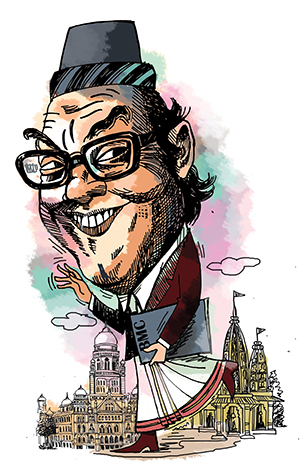
Illustration by Farzana Cooper
Vocal, articulate and able to communicate well, he had built a modest practice as a rent control lawyer. However, politics was his passion. He instinctively knew how to cajole, manipulate, dodge, please, threaten and prevaricate. In the mold of a political boss operating from smoke-filled backrooms in Chicago of the 1930s, he expected loyalty at all costs. Dissenting views had no place at his table. The outwardly pleasant smile could instantly turn into an ugly scowl.
He loved elections. Whether it was the municipal corporation or his community’s august charity trust, barring the election mentioned above, he never lost one. If the arithmetic of electoral politics dictated that he must forge an alliance with someone he despised, he would do so, with consummate ease. If winning required him to espouse orthodox views, he donned the pheto and dugli, and walloped the liberals. In private, he would call the orthodox lunatics.
He entered Parsi politics in an era when the aristocracy was losing its grip over the august charity. His native cunning ensured that his co-trustees always toed his line. If someone upstaged him at a World Zoroastrian Congress, he dramatically withdrew his organization from the FPZAI (Federation of the Parsi Zoroastrian Anjumans of India) overnight. He could spell politics and pragmatism backwards; but he floundered when it came to principles.
A minority South India based community was an important part of his municipal constituency. He spared no effort to woo them. Somewhere in this game, he developed a genuine affection for this sect. Within the close confines of a temple, he enjoyed dancing half-clad and playing a vajintra (an ancient musical instrument). It is unknown whether he had secretly shed his bachelorhood. Tongues wagged about his being extremely fond of a little orphan boy, for whom he wa a father figure. Those days, in the absence of television or social media, and a pliant Parsi Press, he successfully managed to hoodwink the community into believing that he was a staunch orthodox who abjured extra religious worship.
He had a theatrical sense of timing. Although he knew little about the religion, while inaugurating a new operation theater in a Parsi hospital, he recited stanzas from the Hormuzd Yasht and proceeded to translate them, by explaining that cure by surgery was mentioned in our Avestan prayers. The misty eyed crowd would applaud his scholarship.
Not all were impressed though. A well-known solicitor, tough as nails, saw through his charade and publicly criticized him. They traded insults in the then eveninger, The Evening News, by calling each other names like ‘Tamarind Lane Solicitor,’ and ‘Medows Street Advocate’ (lanes in the Fort area of Bombay, known for housing sharp and litigious lawyers). His ally in the charity trust was a spinster doctor having barmy views on religion. He was truly revulsed by her but compelled to tolerate, due to her legendary ability those days to win community elections. His other ally was a pompous old retired municipal engineer, also his neighbor, who detested the slightest criticism of the charity trust. Tongues began to wag overtime about this pair. The pomposity’s brother-in-law, an amateur playwright, wrote and staged a comedy play on Parsi New Year called Houdas Chowdas (loosely translated, the corrupt), to the former’s great discomfiture. Our pal though was unfluttered.
After his election as mayor, the unkind alleged that the Parsi charity had financed his dramatic victory. One section of the Parsi Press then began a vitriolic campaign which pulled no punches. Questionable allotments of community homes were exposed. The mayor’s efforts to silence the editor failed. He simply could not fathom as to how his own people, whom he had bestowed favors upon, were turning hostile. Hitherto indifferent and unconcerned, a ‘very-thin-cucumber-sandwich-eating’ elite, started a ginger group for electoral reform. The masses lapped it up. Suddenly, the spotlight was on him.
He unleashed his oft used weapon. Brand the gingerers as religious reformists. He garnered orthodox support and was confident that his friend, the loony doctor, would deliver once again. He tried to manipulate voters’ lists. In the past, bogus voting was rampant. Tehmulji voted 21 times and Eruchshaw 38 times. Duplicate voter certificates were easy to manufacture. There was no indelible ink. He tried to create diversion through court process. Who knew better than him as to how the complex electoral system could be doctored. Unfortunately for him, some nasty street fighters suddenly backed the polite ginger group. If he was the Establishment, they were the Mafia. The spinster doctor’s mild muscle power [some old fashioned haandagiri (coarseness)] melted before the onslaught of the Real Thing. He tried in vain to stall the declaration of results.
Every candidate backed by the ginger group was elected, barring one homeopathic doctor from his side. Overnight, he retired from Parsi politics, municipal politics and public life. Bitter and frustrated, in his final hours, he lamented as to how the stellar virtue of loyalty had been forgotten. How all the money he had spent on lavish dinner parties at the Ripon Club (those days, it was quite upmarket) serving fish fillets with tartar sauce, had gone waste. He simply could not fathom this new world which talked of principles. The only ones he knew, were those in his old Parsi school. Such fine gentlemen they were.
As a consolation prize, they named a road after him, which was not too far away from both Tamarind Lane and Medows Street.
Berjis M. Desai is a lawyer in private practice and a part-time writer. He considers himself an unsuccessful community activist.