
Music
Ariana’s arias
An Iranian Zoroastrian’s first concert tour of India pays homage to her father and her cultural roots
"The Gathas are very modern and reflect what I feel as a woman in a European country. Part poem, part prayer and part philosophy, the hymns of Prophet Zarathushtra are relevant even today although they date back thousands of years,” says Ariana Vafadari, the French-Iranian mezzo soprano, creator and star of the concert titled "Gathas: Songs My Father Taught Me.”
Vafadari and her ensemble — Leila Soldevila (double bass), Haroun Teboul (oud, ney and tanbur) and Tarit Pal (percussion) — recently completed their first concert tour of India. They performed at the World Sacred Spirit Festival in Jodhpur, followed by recitals in Bombay, Bangalore and Poona, the latter event sponsored by the Institut Français India, the Alliance Française Poona, Bonjour India and the Poona Music Society.
The backstory of "Gathas: Songs My Father Taught Me,” Vafadari’s musical homage to her father and to her Zoroastrian roots, has all the elements needed to inspire heartfelt music, namely, a combination of tragedy, passion and talent. The songs performed by the group at the recitals in India are from a 2016 album dedicated to her late father, Dr Kasra Vafadari, an Iranian Zoroastrian academician, who lived in Iran for several years with his French wife Laurence Delasalle and their two daughters, Afsaneh and Ariana. He then moved to France, where he was murdered in 2005. In a tribute to Kasra, Aban Rustomji of Houston writes: "He was deeply concerned about the Zoroastrian youth in Iran. As a contemporary western civilization professor as well as an ancient Persian history specialist, he focused on cultural activities and was concerned about the lack of opportunities for the young Zarathushtis in Iran. Following the cultural revolution that closed the Iranian universities, he was left with no job, and had no choice but to leave Iran with his wife and two daughters for Paris.” Internet sources strongly hint at the likelihood of Kasra’s pro-Zoroastrian activism being the cause of his murder, terming the assassination "a cruel and senseless act aimed to silence a patriot (see "The price of commitment,” In Memoriam, Parsiana, August 21, 2005).”
Vafadari and her ensemble — Leila Soldevila (double bass), Haroun Teboul (oud, ney and tanbur) and Tarit Pal (percussion) — recently completed their first concert tour of India. They performed at the World Sacred Spirit Festival in Jodhpur, followed by recitals in Bombay, Bangalore and Poona, the latter event sponsored by the Institut Français India, the Alliance Française Poona, Bonjour India and the Poona Music Society.
The backstory of "Gathas: Songs My Father Taught Me,” Vafadari’s musical homage to her father and to her Zoroastrian roots, has all the elements needed to inspire heartfelt music, namely, a combination of tragedy, passion and talent. The songs performed by the group at the recitals in India are from a 2016 album dedicated to her late father, Dr Kasra Vafadari, an Iranian Zoroastrian academician, who lived in Iran for several years with his French wife Laurence Delasalle and their two daughters, Afsaneh and Ariana. He then moved to France, where he was murdered in 2005. In a tribute to Kasra, Aban Rustomji of Houston writes: "He was deeply concerned about the Zoroastrian youth in Iran. As a contemporary western civilization professor as well as an ancient Persian history specialist, he focused on cultural activities and was concerned about the lack of opportunities for the young Zarathushtis in Iran. Following the cultural revolution that closed the Iranian universities, he was left with no job, and had no choice but to leave Iran with his wife and two daughters for Paris.” Internet sources strongly hint at the likelihood of Kasra’s pro-Zoroastrian activism being the cause of his murder, terming the assassination "a cruel and senseless act aimed to silence a patriot (see "The price of commitment,” In Memoriam, Parsiana, August 21, 2005).”
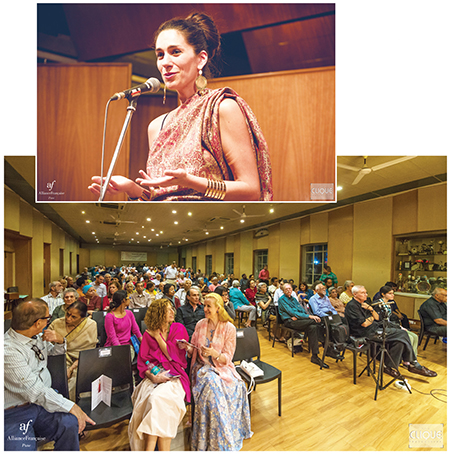
Top: Songstress Ariana Vafadari; above: audience at the concert in Poona Photos: The Clique Photography
Against this backdrop of personal tragedy and loss, Ariana’s compositions take on a more poignant dimension. She was five years old when the family relocated to France, but remembers going to Iran "on holidays” and thus keeping in touch with her Iranian Zoroastrian roots. Ariana finds the ancient Avestan hymns not only inspiring, but also surprisingly modern, "expressing the life, doubts and choices of a man.” As a student, Ariana initially displayed a more scientific bent, graduating as a civil engineer and wanting "to become a mathematician.” But once she "discovered” singing, there was no turning back.
Studying at the Academy of Music in Paris and the Hanns Eisler Academy of Music in Berlin, Ariana soon made a name for herself as a remarkably versatile mezzo soprano whose range covers opera, Western classical music, jazz as well as traditional Iranian, Moroccan and Ottoman music. "Gathas: Songs My Father Taught Me” is an enchanting amalgam of these diverse musical genres, with each song composed according to radifs or oriental scales. "I like to sing stories about strong emotions. I feel I am telling my own story here,” she admits.
"Oriental music comes from the inside,” Ariana explains. "Sometimes during a performance I can feel my heart beating a different way. It makes me feel good; it makes the audience feel good.” Her accompanists pick up on her mood, and play along and improvise accordingly. The recital’s opening number, Ahang Zayesh, was about beginnings and birth, and the words of the Ashem Vohu prayer were instantly recognizable in Ariana’s goosebump-inducing rendition. There were also songs about innocence, about finding love and about the choices one faces in life — especially the challenge of living up to the credo of good thoughts, good words and good deeds. The compositions and musical arrangements were haunting and catchy, with Teboul and Pal introducing Middle Eastern and Indian flourishes.
A few purists in the Parsi community were disappointed that the Poona recital did not feature the "actual hymns and words of the Gathas.” Although Ariana’s focus is less on the prayers and more on the music, she deserves full credit for creating awareness of the Gathas in international circles through her music and her melodious voice. Her father would be very proud of her.
◆ ◆ ◆
From the archive