
ART
Presiding over puppeteers
President of UNion Internationale de la MArionnette, Dadi Pudumjee promotes the interests of global puppeteers
"Life within flesh I have encaged, but now these bodies shall have souls within…They will perceive…have the power to think and the strength to act…” declared the Supreme Being in "Ma’arfet — The Awakening,” a visual performance specially conceived for The Everlasting Flame Programme in Delhi. These words may well have been addressed by "Ma’arfet” director-designer Dadi Pudumjee to describe his specially crafted puppets, some a foot high and other giant figures almost 14 feet tall, to complement the actors and dancers who brought to life the story of creation according to Zoroastrian mythology.
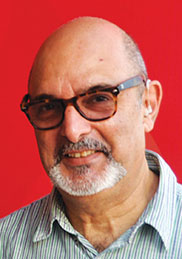
Dadi Pudumjee
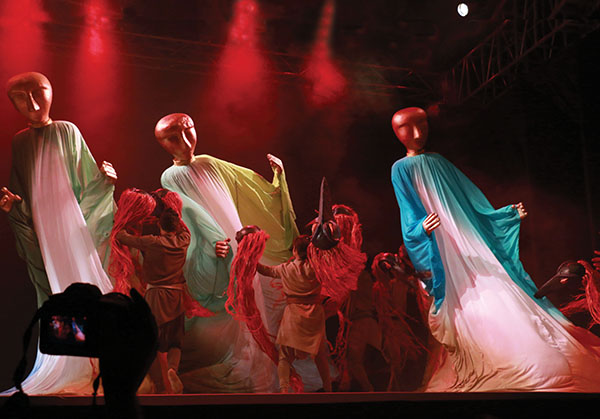
A scene from "Ma’arfet — The Awakening;"
The audiences who came backstage to congratulate the performers were "swept away by the sheer spectacle and power of the imagery,” reveals Pudumjee who was particularly humbled when Mobed Mehraban Firouzgary of Iran, whose recitation of prayers was included in the production, commented he had never seen anything like this. "I have always wanted to do a production in my style with puppets, masks, objects and music, actors and dancers on a Zoroastrian theme,” says Pudumjee, founder of the 30-year-old Ishara Puppet Theatre and the first non-European president of the world puppetry body, UNion Internationale de la MArionnette (UNIMA), a nongovernmental organization affiliated to the United Nations Educational, Scientific and Cultural Organisation (UNESCO).
For those who missed out on the "Ma’arfet” experience (see "Stoking the Flame,” pg 70), Pudumjee conveys that the larger than life puppets represented the amesha spentas (archangels). The two main actors — good and evil — try to destroy the creations of each other but it is the good that lives on. Abstract images with sound and music (narrative by Inder Misra of Delhi and music by Amit Bhavsar of Bombay) relate the story of creation and eventually glimpsed were the first man and woman, beautifully lit by Hidayat Sami of Bombay.
Drawing his inspiration from many sources, be it a poem or a performance or an art piece, for "Ma’arfet,” a word in Persian/Farsi, Urdu meaning awakening/awareness, Pudumjee acknowledges drawing on Gool Savaksha’s "The Splendoured One,” a theatrical rendition on the life of Zarathushtra, directed by Roshan Kalapesi. Over four decades ago he had assisted the legendary sculptor Piloo Pochkhanawala in designing sets and creating puppets for that production. "Whilst the ideation and design for ‘Ma’arfet’ started long in advance…we worked on it hands on for over a month,” Pudumjee responds to Parsiana’s queries en route to Ajmer, in preparation for a production his Ishara Puppet Theatre will be staging at Mayo College in January 2017.
"Treading on religious themes could be sensitive at times,” realizes 65-year-old Pudumjee who preferred to play it safe by issuing a disclaimer: "While artistic license has been taken, we believe that this performance is true to the essence, values and integrity of Zoroastrianism… This is an imaginative interpretation and not a literal one. This performance is not meant to hurt any religious sentiments or be biased in favor of or against any particular person, society, gender, creed, nation or religion.”
While the "message was universal and not restricted only to Parsis and Zoroastrians,” what made this production special to the performers and puppeteers was their experience of Zoroastrian culture, food, ideology. "We are all prepared to work further on this production provided we have sponsors and platforms,” says Pudumjee, grateful that Dr Cyrus Poonawalla’s philanthropy had made "Ma’arfet” possible.
"Using puppets is not an end in itself but a means to tell a story combined with other theatrical forms like actors, dancers, sound, movement, objects, etc,” states Pudumjee who in June 2016 was elected to his third four-year-term as president of UNIMA which, according to its website is the oldest international theater organization in the world. UNIMA is present in more than 90 countries, offering an exchange platform between people who practise puppetry (amateur or professional), work on this art (as researcher, historian, etc) or any who are passionate about this art. Since 2016, Pudumjee additionally serves as the president of UNIMA International’s Social Justice Commission.
It was during Pudumjee’s first term as president that UNIMA, with the partnership of UNESCO, published the World Encyclopaedia of Puppetry Art in French in 2009, and then translated it into English and Spanish. It was 80 years prior that UNIMA had been mooted by French author and journalist Paul Jeanne in Czechoslovakia at the Fifth Convention of Czech Puppeteers, an event to which guests had been invited from Bulgaria, France, Yugoslavia, Germany, Austria, Romania and the Soviet Union, states the UNIMA website. Its first head office was in Prague before it was shifted to Poland and later, France. During World War II the members were not able to maintain the frequency of their meetings. However, the ties forged among the puppeteers was so strong that they continued to keep in touch even if their meetings had to be arranged in secret, sometimes via the most daring routes.
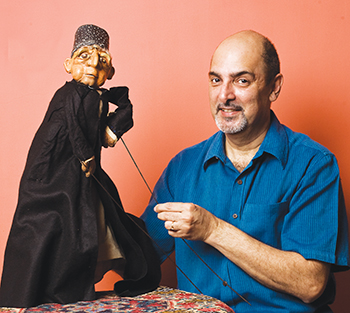
Pudumjee with his puppet that originally served as the
Readers’ Forum logo for Parsiana Photo: Anay Mann
Whilst steering the international body, Pudumjee has also been strengthening The Ishara Puppet Theatre as its director, designer and puppeteer, collaborating with puppeteers, actors and dancers, both traditional and modern. Excited that they will be performing at the Tehran Mobarak Puppet Festival from August 21 to 27, 2016, Pudumjee mentions that Ishara will be staging "Satya Ke Pratirup” on the ideology of Mahatma Gandhi, set to world music. At the closing ceremony a special felicitation has been planned for Pudumjee whose work spans multiple cultural traditions — from India and beyond, especially countries of the East.
Ishara has trained and continues to train and offer workshops in puppet theater to youth and adults with an equal focus on social causes like HIV/AIDS awareness and substance abuse, and entertainment (see "Puppeteer Pudumjee’s path,” Parsiana, March 21, 2008). The Ishara Puppet Theatre Trust (IPTT) that he formed in 2001 organizes its annual international festival in Delhi and as part of their 30th anniversary, he hopes "we will celebrate our annual Ishara festival in February 2017 with a new performance. But till then we create productions, workshops for students, teachers and underprivileged children,” working with the Samarpan Trust in Delhi. As long as Ishara is able "to work as a great team and bring a smile to all who see our shows,” Pudumjee feels they would have accomplished their mission of bringing "happiness to others.”
IPTT’s objective of strengthening the art of puppetry in India has been met by collaborating with craft and folklore centers, artistes, actors and dancers, explains Pudumjee. He particularly appreciates "our trustees Sunil Dogra and Sanjoy Roy, and Teamwork Arts who have always supported our activities.”
Pudumjee’s formal journey in puppetry commenced after his graduation from Poona’s Nowrosjee Wadia College, attending a course in visual communication at the National Institute of Design, Ahmedabad (NID). His intensive training in puppet theater was under Meher Contractor at the Darpana Academy of Performing Arts, Ahmedabad and Michael Meschke of the Marionette Theatre Institute in Stockholm, Sweden. He is particularly grateful to his parents, "the late Dorab and Jeroo Pudumjee who after my NID studies in Ahmedabad let me make my hobby into a profession, and my teachers along the way.” A pedagog in creative drama and puppetry he has created puppets for national bodies like SITE Satellite TV Experiment and Indian Space Applications Organization. Among the many institutions with which he has been affiliated is the Shri Ram Center for Art and Culture in Delhi where he served as artistic director and founder of Sutradhar Puppet Theatre, as notes an introduction to the popular puppeteer.
Settled for the last 35 years in the capital, his work in puppetry has won him accolades from the Sangeet Natak Akademi, Sanskriti Pratisthan, Delhi Natya Sangh with the Padma Shri conferred on him five years ago. Content with the encomiums, Pudumjee says, "It is now time to introspect and train more puppeteers and give them what I have got from my elders and mentors as a contemporary puppeteer from India.”
◆ ◆ ◆
From the archive