
Cover Story
Puppeteer Pudumjee’s path
Making his mark in the art of puppetry was a challenging but rewarding journey
A huge hand appears from behind a backlit, white-sheeted prop. The painted thermocole forelimb hovers dramatically and then disappears from the stage. Silhouettes of human figures dance behind the screens.
"Simple dreams” a visual poem on nature and life was noted puppeteer Dadi D. Pudumjee’s most recent production with a performance at the prestigious National Centre for the Performing Arts (NCPA) Experimental Theatre on December 12, 2007.
"With ‘Simple dreams’ Ishara (Puppet Theatre Trust) returns to the essence of puppetry and imagination,” notes the literature distributed at the Bombay performance "where the puppeteer creates celebratory images with simple objects and movement.”
We are "getting back to something very minimal,” explained Pudumjee, one of the country’s leading puppeteers. The performers worked with sticks and umbrellas on a bare stage for most of the performance. The sticks are placed on the floor and then lifted in the air to recreate the same design they formed on the ground. The idea was from a Japanese choreographer and Pudumjee thought it worth a "try.”
Writing in The Times of India (December 12, 2007) about the show, correspondent Mukta Rajadyaksha, noted, "Their performance is something to look forward to. It will be an interplay of animation of objects and dance, creating vivid images of birds, fish, animals, human beings and the cycle of life.”
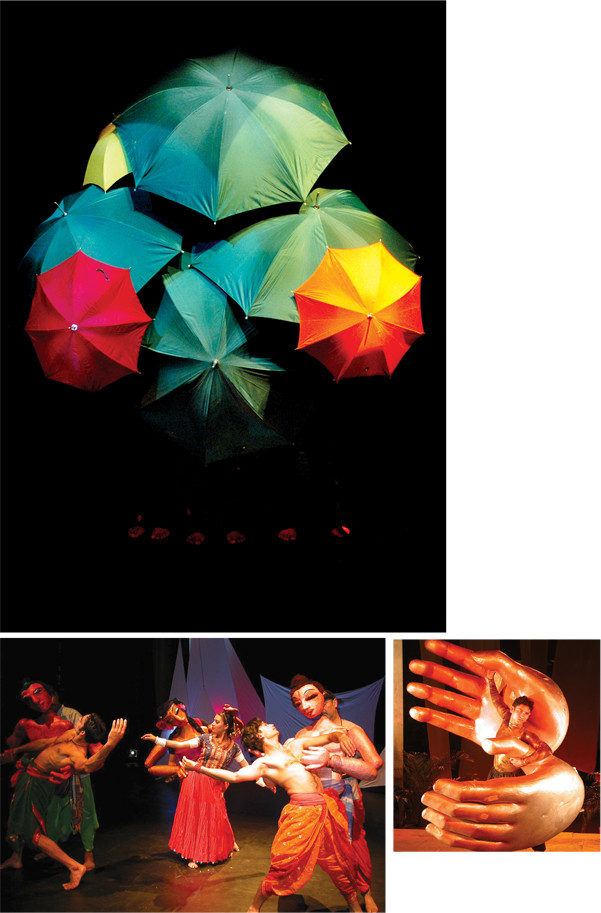
Top: Umbrellas used as props in"Simple Dreams” Left: Masks and dancers in "Transposition” Above: Scene from "Decote”
"For two months the guys prepared for the show,” said Pudumjee. "Astad Deboo helped us with the choreography of one of the dance sequences with the umbrellas.” The performers were "all street kids… Some of them don’t even know where their parents are… They have gone through things they will never talk about,” says Pudumjee. As they gained skills their livelihoods improved. "One boy came to a workshop in 1986. He went on to London… they are no longer streets kids. They roam around with tip-top mobiles” now, better than even the one Pudumjee carries, he observes. He recruited youngsters for the show from the Salaam Baalak Trust founded by film maker Mira Nair and others to assist street children.
Part of a United Nations Educational, Scientific and Cultural Organization (UNESCO) project for educating people on the Human Immunodeficiency Virus (HIV) and substance abuse, Ishara receives funds from the international body to help create awareness. "There are 17 to 18 such UNESCO projects in the world. We are one of them,” says Pudumjee, "My job is to make the medium and the message meet.”
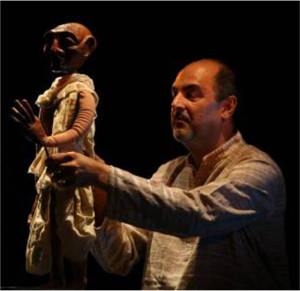
Dadi Pudumjee with Gandhi puppet;
When dealing with sensitive issues, "such as how does one get AIDS… gender issues… people accept” the medium "because puppets put (ideas) objectively… through puppetry you can get away with things.” Puppets are also utilized to depict political satire. NDTV features puppets of national politicians and other celebrities. "They are doing a good job though at times it’s monotonous,” says Pudumjee.
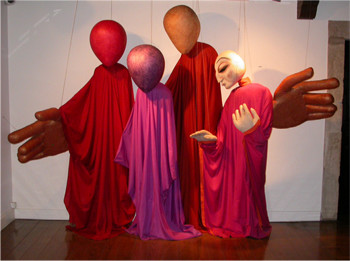
Puppet display from "Journey’s”;
For him, the hands, eyes, face are the most expressive aspects of puppets. Especially "large hands.” The puppets are made from thermocole and then laminated with paper and cloth. "They last 10 to 15 years,” he notes. He has even made puppets for a movie, namely Prakash Rao’s A bellyful of dreams which won the best film award at the National Film Festival in 2007.
A student at the prestigious National Institute of Design (NID) in Ahmedabad, from 1971-1976 Pudumjee left in his final year to take up a one-year assignment with The Indian Space Research Organisation (ISRO) to make puppets for their shows. Meher Contractor of the Darpana Academy of Performing Arts in Ahmedabad was one of Pudumjee’s mentors.
He then received a scholarship to study puppetry at the prestigious Marionette Theatre Institute in Stockholm, Sweden. By 1976 he was into puppetry full time. Being single, "I could make a living more or less (but) without support from my family and parents it would not have been possible.” In 1981 he shifted to Delhi and worked with the Shree Ram Center for Art and Culture till 1986 and thereafter stayed on in the capital city. He formed the Ishara Puppet Theatre group around that time and later made it a trust with assistance from the Ford Foundation.
Pudumjee was vice president of the puppeteers world body UNIMA (Union International de la Marionette) for 12 years before stepping down from the post four years ago. He may however be reelected at the meet in Perth, Australia this March. The international puppet body meets once every four years. Eighty-two countries are members of this oldest world puppetry body founded in 1920. Pudumjee also served on the general council of the prestigious Sangeet Natak Akademi and was awarded the body’s award in 1992. He was a guest director at the Puppet Theatre in Berlin, according to "Wikipedia,” the on-line free encyclopedia.
His former professor in Sweden Michael Meschke noted in an interview with the IGNCA (Indira Gandhi National Center for the Arts) Newsletter that Pudumjee was "inspired by the Rajasthan tradition where he mixes big puppets with small puppets creating a fusion of traditional elements and using them in a contemporary way.”
At a function in Johannesburg, South Africa on October 2, 2007 Pudumjee gave a puppet performance on the occasion of a launch of a book on Mahatma Gandhi by the Indian ambassador.
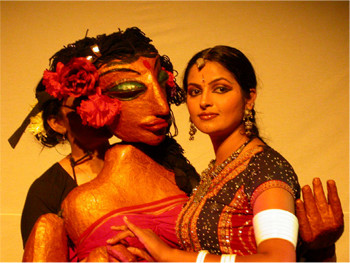
Scene from "Transposition”
His dance and puppet show titled Transposition won awards for music, choreography and set design at the Mahindra National Theater awards this year.
A committee member of the Delhi based UNESCO PARZOR project, Pudumjee gives the Delhi Parsi Anjuman (DPA) "moral support” when required. The DPA is "very kind” and provides space in their hall for conducting rehearsals, he notes.
From paper to puppets
A student of Bishop’s School and of the Wadia College in Poona, Pudumjee studied political science, history and economics. His spare time was spent at his family’s Pudumjee Paper Mills. His great-grandfather started the Mundhwa Paper Mills 100 years ago. The machinery arrived on elephants, says Dadi. The Pudumjee Mills at Chinchwad were subsequently sold to the Jatias who were shareholders.
Dadi was interested in puppetry from childhood. A relative, Aimee Adenwalla-Wadia, encouraged his creative activities causing his mother to complain "you’re spoiling him.” When Pudumjee wanted to attend NID he found "no one knew about the institute.” His parents, Dorab and Jeroo, consulted Nelie and Homi Sethna. Nelie was a reputed textile designer and Homi, a documentary filmmaker. "They said it’s okay. My parents trusted them. When I look back today I think about (my parents). They didn’t stop me. Hats off to them… Other people were more worried.”
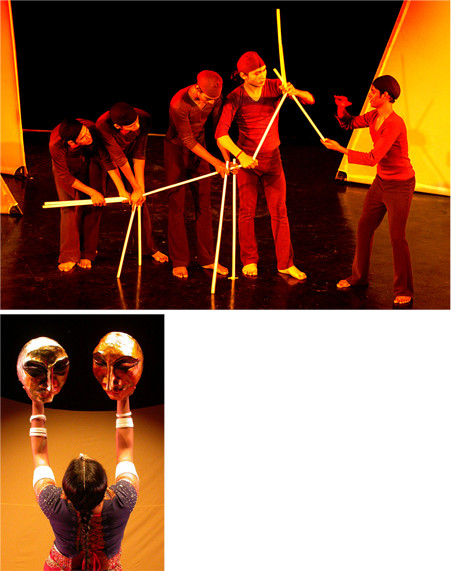
Scenes from "Simple Dreams”(top) and "Transposition” (above)
Pudumjee worked on Gool Savaksha’s production of The splendored one, a theatrical rendition of the life of Zoroaster, assisting noted sculptor Piloo Pochkhanawalla with the sets. "It was great fun working with her,” says Pudumjee. He speaks fondly of those days recalling unconventional socialite Bapsy Sabavala who as part of the performance represented wealth, and held Dr Pesi Warden (Parsiana’s founder) representing the oppressed, by the reins. Warden moaned that Sabavala actually kept whipping him instead of pretending to do so! The show was directed by Roshan Kalapesi.
Pudumjee also made Parsi puppets for an Adi Marzban entertainment review. A photo of one of his puppets donned the masthead of Parsiana’s Readers’ Forum column for several years till readers complained that it projected an erroneous image of the letter writers.
Dadi’s niece Perin Coyaji (née Pudumjee) specializes in pictorial calligraphy and was awarded a scholarship to study in Japan. "I tell her to develop” her talents, he says.
As for his views on the community Pudumjee observes he has been away from the mainstream for long. But he terms himself "a liberal, not an orthodox.” His mother Jeroo was more traditional while "the Pudumjee” side of the family are not so conservative, he observes.
Pointing out that there are no other "Parsis in puppetry,” Pudumjee notes careers in "art, theater and music are more accepted.” Traditionally puppetry was the preserve of families that made a living from the art.
What advice would he give to an aspiring puppeteer? Noting that while there are more avenues for puppeteers today he adds, "It’s (still) as tough or as easy as any other art form. You have to make your path.”
◆ ◆ ◆
From the archive