
History
The ashes and the altars
Fires were meant to provide heat and light, rather than religious symbolism
There were several fire cults in the pre-Zoroastrian period. For religious ceremonies after daylight hours, a fire was essential for fulfilling their requirements and, additionally, providing light and heat. The fire was lit within a specially cleared area and devotees gathered around to worship and attend the priests’ sermons. These early rites and rituals anciently preceded the formal evolution of our fire temples.
This is evident in India from the very early open fire temples at Kalibangan (c 2000 BCE), located on the southern bank of the Ghaggar river in the Hanumangarh district of Rajasthan. The fire altar was a simple shallow pit dug out from the ground with a low protective upstand.
These are a few later examples of the hole-in-the-ground fires, without actual altars, at Kalibangan, Taxila, and sites such as Surakhani near Baku, Azerbaijan. The first fire altars that we know of have a considerable ancestry. Fire altars have been excavated at the Harappan site of Kalibangan in northern India. The fire cult is also claimed to have been concurrent at Lothal on the west coast of India.
There seems to be no ground-placed fire altars in the open during the Achemenid period; they appear to have gradually developed in the Sassanian period.
The word ‘altar’ implies a raised table or platform where sacrifices are made to a god. In Christianity, it is the table at the front of the church that was consecrated for use during communion. It is an Anglo-Saxon word from the Latin ‘altaria,’ meaning ‘high place.’ It is not a Persian word.
This is evident in India from the very early open fire temples at Kalibangan (c 2000 BCE), located on the southern bank of the Ghaggar river in the Hanumangarh district of Rajasthan. The fire altar was a simple shallow pit dug out from the ground with a low protective upstand.
These are a few later examples of the hole-in-the-ground fires, without actual altars, at Kalibangan, Taxila, and sites such as Surakhani near Baku, Azerbaijan. The first fire altars that we know of have a considerable ancestry. Fire altars have been excavated at the Harappan site of Kalibangan in northern India. The fire cult is also claimed to have been concurrent at Lothal on the west coast of India.
There seems to be no ground-placed fire altars in the open during the Achemenid period; they appear to have gradually developed in the Sassanian period.
The word ‘altar’ implies a raised table or platform where sacrifices are made to a god. In Christianity, it is the table at the front of the church that was consecrated for use during communion. It is an Anglo-Saxon word from the Latin ‘altaria,’ meaning ‘high place.’ It is not a Persian word.
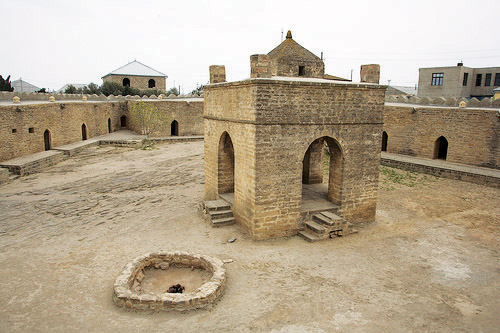
Atash-gah in Surakhani, Baku, Azerbaijan
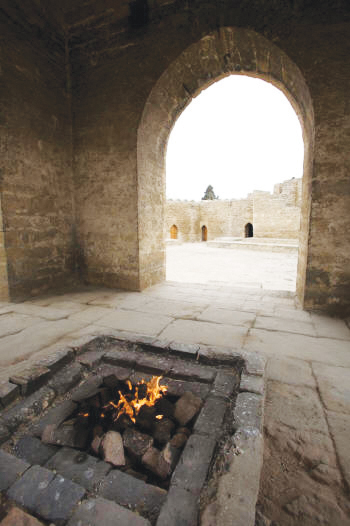
Fire temple with fire in the ground, Baku
The stepped pedestal altar was quite suitable for placing a fire urn on it, thus, the name ‘fire altar’ came into use. In some respects, its basic form recalls a similarity to the Olympic Torch.
Some of the old Achemenid kings, after winning a war, used to erect a fire altar as a victory monument in which an attended fire burned continuously, by day and night. Fire was probably placed in the altars to conspicuously act as street lighting. Stepped altars are often discovered in Central Asia.
The early Persians could not have possibly gathered around the altars for religious purposes. There is scarce evidence of people assembling around the altar for prayers: there are no terraces visible for people to gather and pray at most of the altars.
The high pillar on the Persepolis terrace, and the two similar columns at the excavated city of Bishapur, are most probably victory monuments. There is no place for holding a fire in them, nor would it have been practical to attend to the fire at such a height. These pillars are like Nelson’s Column in Trafalgar Square, London, Ashoka’s Pillar, Delhi, Cleopatra’s Needle, Egypt, etc. The terraces seem to be used for big official ceremonies.
In the sacred precinct of Pasargade, there are two massive stone stepped plinths, presumably used for public worship in the open, the then normal tradition of Iran. Fragments of three large holders (not altars) were found, with the flat surface indicating use for sacrificial offerings but not for holding fires. Throughout Zoroastrian history, personal and family prayers have been offered in the presence of a hearth fire; but in the sixth century BCE, to denote the imperial splendor of the kings, the fires were placed on an elevated platform before which the royals prayed. There is no mention of any ritual of worship in the Gathas where fire is treated entirely in the abstract.
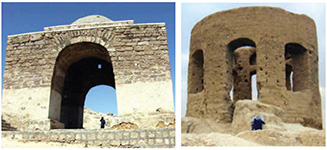
Sassanian Chahr-Taqi, Niasar, Kashan, Isfahan (l) and Sassanian fire temple, Isfahan
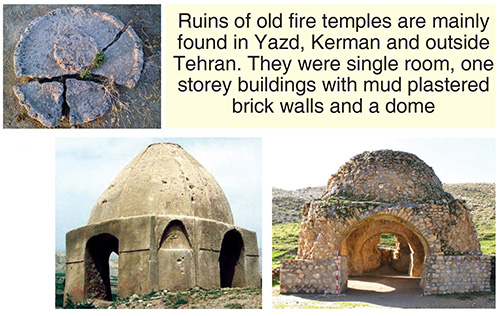
Top: center of fire temple, Taxila; above: Sassanian fire temple, Arrshshahr, Ilam (l)
and ruin of Chahar-Taqi temple, Ilam, Siah-Kal, Zarneh
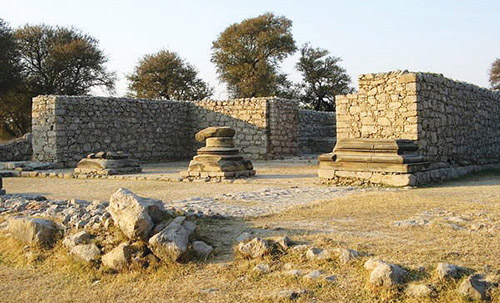
Jandial temple, Taxila
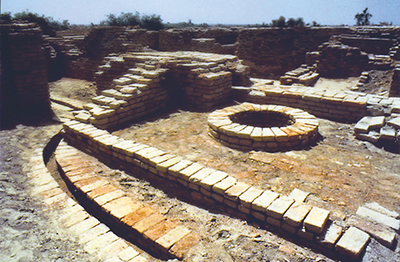
Fire temple with no altar, Kalibangan
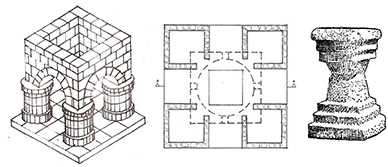
From left: Fire house in Ani (Turkish Armenia); plan of Chahar Taq; Parthian stone stepped fire altar, Kuh-e-Asa
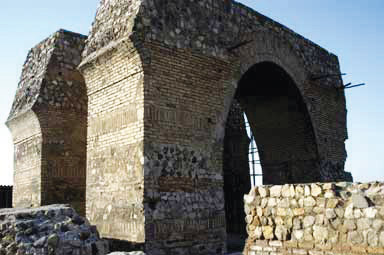
Fire altar Ragha near Tehran
The object on which the kingly fire was placed in a type of modified fire altar, was found in the excavation at the Median site of Tepe Nush-i-Jan near Ecbatana (Hamadan). Usually, a fire altar top had a shallow depression to hold the fire. The altars with flat tops were basically stepped pedestals to support the fire urns, or used for sacrifices.
The earlier altar houses were known as Chahar Taq, "four arches,” comprising a small square room, with walls with arches on all or some sides, with or without a dome, in which a fire was placed on a stepped platform. In later examples, some more rooms were added to the sanctorum. People usually prayed in the privacy of their houses. The nobility and monarchs had a special room in their houses and palaces for prayers and had devotional fires placed within urns.
In the early period the fire was not necessarily seen as a point of worship, but for light, heat and domestic purposes. The old type of altar was being placed in rooms, and finally into fire temples for collective worship.
Based on the account of the Greek historian Herodotus (c 430 BCE), and also on the earliest archeological sites discovered up to the fifth century BCE, the Persians had no temples or altars, and their use was strictly avoided. The early Zoroastrian scriptures make no reference to worshiping in temples or other places of worship.
At the end of the Achemenian period, the fire temples were like image sanctuaries, a status of Zoroastrian worship. Some 500 years after Herodotus’ Histories, Greek historian Strabo, in the first century CE, reported that there were fire houses in Cappadocia (now Turkey), consisting of a central altar with large quantities of ashes from continuously burning fires. The altars that Strabo refers to are fire holders.
In the Parthian era the Zoroastrians developed fire houses for community use, where an ever-burning fire was maintained by priests; thus, the priestly profession was born. The Chahar Taq design continued in the Sassanian period up to 650 CE.
During the Sassanian period, fire temples had fires which were placed upon elevated altar type stands; these were eventually changed to large metal fire urns/vases. Nowadays the fires are kept in large German silver or stainless steel vases of different styles and shapes, housed in the sanctum.
The kings of old, to show their power and wealth, used to build fire temples. The earliest fire sanctuary is near Persepolis at Naqsh-e-Rustam. Here, the ruins of a number of Achemenid altars (atesh gahs) survived. A fire in an urn, raised on a three stepped pillar altar was found from the Achemenian period. A bas relief of Darius III was found above his rock-cut tomb at Naqsh-e-Rustam, depicting the King worshipping before a fire urn.
In the Sassanian period, more rooms were gradually added around the altar. This is the beginning of the temples with ever blazing fires. Ardashir I (224-241 CE), founder of the Sassanid dynasty, built a fire temple at Firouzabad.
Fire altars persisted for centuries, and were even found on the reverse of coins of Shapur I and other kings, mainly from the later Sassanian period.
Ruins of old fire temples are mainly found in Yazd, Kerman and outside Tehran. They were single room, one storey buildings with mud plastered brick walls surmounted by a dome. A few fire temples have rooms added. In Yazd, there are dedicated sites of six well known pirs, probably constructed after the Islamic conquest.
Hindus also used to revere fire (agni); they even had similar fire temples. There is a classic example at Baku. It is a pentagonal complex, surrounded by cells for the monks, with a terra pillar in the middle. Built in the 17th and 18thcenturies, it was abandoned in 1883, when the surrounding oil and gas plants were established. It was declared a World Heritage site in 2007, and has been a museum since 1975. Even now scholars are not certain whether it is a Zoroastrian or Hindu fire temple. There was a constantly burning natural gas fire which was extinguished in 1969; but, for tourists, it is now lit from the main gas line of Baku city.
It was not only Hindus who worshipped at fire altars, but also the Jews whose fire urns were similar to those of the Zoroastrians.
Ardashir I built a circular tower about 100 feet high, with a circular staircase around it. This tower, now in ruins, was later known as Gur, and claimed by some historians to have been built to commemorate Ardashir’s victory over the Parthians and to display his growing power and wealth. There was a fire altar on the top.
Architecturally, the earliest surviving fire temple is the Ayadana at Susa, which is attributed to Artaxerxes II (424-358 BCE). It had a wooden columned porch at the front, two stepped altars, and a terrace for the worshippers. Fire temples continued to be built in the Parthian period, according to Strabo in the first century BCE (Geography XV, 3, 15). He noted that the priests (mobeds), who wore high turbans of felt and masks covering their lips, kept the fire ever burning; the ash was piled high in the fire temples.
Ardashir built a fire temple in the Chahar Taq form. Not only did it have a high tower on which the fire burned, but also living quarters for the priests together with store houses and a pool fed by a four to five mile aqueduct. In fact, 40 fire sanctuaries have survived in Iran. They are usually in the form of a domed hall, surrounded by barrel-vaulted corridors.
When Ardashir ecaped from Ardavan, the last Parthian Emperor, he established the city of Bukht-Ardashir and ordered a fire varhran to be included. Again, for his victorious battle with Karm, he ordered another atash varhran to be built. When Ardashir saw his son Shapur for the first time, he ordered yet another atash varhran be built. This proves that atash varhrans were installed to mark special events, victories in war, etc. There are many more examples of atash varhrans, built by various kings throughout Iran. Most of them are in ruins, and regretfully they are not being reconstructed, or even restored.
The Arabic writer, Al-Khwarizmi (10th century), has recorded that there were so many fire temples built that a Zoroastrian secretary of state was appointed to look after and maintain the fire temples, and that a proper register had to be kept which was regularly audited by Arab officials.
According to science, fire does pollute the atmosphere and is not at all environmentally friendly. Every kitchen in the villages that used wood as fuel was always covered with layers of soot, especially the ceiling. The same is the case with the sanctum sanctorum where the fire is kept in the fire temples. A number of our priests suffer from asthma and breathing problems due to the smoke. Even the fire in the Zoroastrian houses has now gradually been substituted by a diva (oil lamp), mainly because of it being a fire hazard, soot collection, pollution, higher insurance, etc.
In most European countries, even chimney-stacks are not permitted, e.g. in Scandinavia, one has to pay a special high tax to obtain a permit to use a log fire hearth and must have special triple filters, etc.
In the fire temple at Sacramento USA, inaugurated on March 26, 2017, they have used an adjustable electric lamp fire in a grand metal vase, instead of wood. There is no command in the Zoroastrian ideology specifying that only sandalwood or any specific wood must be used in fire temples. As a matter of fact, there was no sandalwood available in the older Persian period; and has not even been heard of. Every time sandalwood is burnt, not only is good money going up in smoke but also pollution of the environment is caused, aside from being a fire hazard.
Instead of wasting good money on burning precious, costly wood during maachis, hamkaras, etc, especially in Udvada and the other big atash behrams, the same money ought to be set aside into a trust for retired priests and needy Zoroastrians.
About 20 years ago, while touring Yazd with my family, the taxi driver, who happened to be a Zoroastrian, kindly took us to see an ancient fire temple. It was in the midst of a few houses. The priest, a woman farmer, arrived from the field, washed her hands, and instructed us to do our kusti.
Then she unlocked a door leading into an underground cave-type hall. We had to bend down to go in, and it was very dark. When the lady priest lit the fire, it was an unforgettable, marvellous scene. There was no vase/urn; the fire was the top of a heap of ashes on the ground.
Whether the fire temples are of genuine Zoroastrian origin or not, there is no objection in continuing this glorified grand custom. It is nice to see an open fire, but fire is always considered a danger throughout the world. It may be worthwhile to use artificial electric fire and by doing so, the stigma to Zoroastrians being fire worshippers would automatically vanish.
Reviewed and revised by the late Farrokh Vajifdar and edited by Parsiana.
◆ ◆ ◆
From the archive