
Life-Style
Sentimental journey
In the past the preparations for travel and the journey itself were an integral part of the holiday experience
We were packed and ready to load the car to leave for the airport to catch a flight to Sri Lanka. As I looked at the two, smart grey coordinated suitcases and the overnight tote, all with sensible wheels and business-like extendable grips to help pull them along, I was overcome by crushing nostalgia.
Nostalgia for when travel was not one-phone-call-to-your-travel-agent away and when luggage did not look like regimented soldiers but came in a variety of shapes and colors. Black, mean tin trunks, lined up alongside khaki green, roly-poly beddings looking like ample proportioned army Majors with tightly pulled belts and buckles around their bellies; the romantic cane tiffin basket, divided into trays and compartments to comfortably hold your tiffin and the graceful surai, an earthenware water urn standing in its special wooden rack to withstand the lurching of the train. One or two kandias (rough cane baskets) carrying oranges to Bombay and tarvana kéra (a variety of plantains) on the return journey to Nagpur were also to be counted in.
When I was a child, an annual summer holiday to escape from the grim heat of Nagpur in May, was about the extent of traveling we did. But the anticipation and preparation for it lasted a quarter of a year. And talking about it could easily fill the other three quarters!
A week before departure the most hotly debated topic at home would be, what to take for bhatiu, the travel repast. Papéta ma marghi or vindaloo? Patties or cutlets? Bread or parathas to go with it? For nibbling between meals should it be sandwiches or bhakras? Such agonizing decisions to be made! Of course a packet or two of the Jubilee Bakery jam-tarts, ginger biscuits or macroons that we took for the family in Bombay, could always be opened if we fell short of anything in the train, or if there were interesting traveling companions with whom we might want to share.
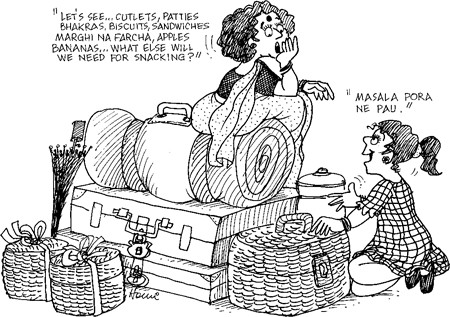
Menu set, the tin trunks, tiffin basket and bedding-rolls were taken out of the storeroom, cleaned and sunned. Travel clothes were likewise brought out and inspected. Under grandma’s diktat, all the young girl cousins wore similar, brown, checked frocks. Brown was melkhau (didn’t show dirt) and we could be easily identified in a crowd. The frock had two deep pockets into which were dropped a few annas, a handkerchief, a packet of SenSen and a yo-yo or crayons to keep us amused.
Young people today carry a veritable backpack of gizmos to keep them entertained and are yet bored before their flight is over!
The commute from home to station on the day of departure, was an event by itself, involving heavy logistics. Three hours before the scheduled departure of the train, Yakub, our trusted Man Friday would bicycle to the railway station to bargain for and bring home a tonga (horse carriage) or two, depending on the amount of luggage and number of travelers. Amid the din from multiple instructions "Péti neeché, kandia upar, pani no kujo pag aagal (trunk down, baskets up, water jug near the feet),” Yakub and Ismail, the bearded tongawalla would load the rickety tonga. Through sheer fright and overburden, the horse would pee in a big puddle and plop cakes of dung. If a youngster exclaimed, "Oh, shit!” an optimistic aunt was bound to say, "Ai tau sagan kéhvai (this is auspicious.)” For us children, the plum of excitement on the adventure of clip-clopping to the station would be the chance to sit next to the tongawalla, on a narrow wooden plank in front, with the horse’s tail swishing under our nose!
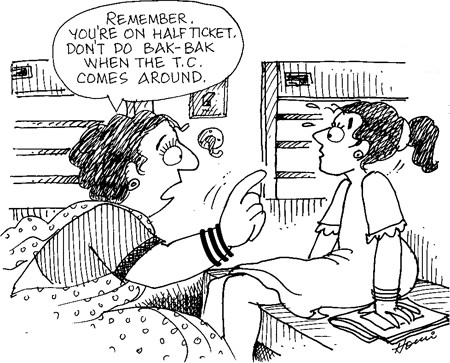
When the train arrived on the platform, temperatures and tempers rose to a crescendo, as shove turned to push and everyone outside tried to get in, even while those inside wanted out! This was the least enjoyable and actually frightening part of travel for me. Fortunately it was intense but short-lived. Once the guard waved his green flag and the train chugged slowly out of the platform, the older folk settled into their seats, with pillows behind osteoporophic backs. We fought to claim the window seats and with faces pressed to the bars, watched brown farmers on their parched brown fields and waved to villagers at railway crossings. Those who had just crossed the age of 12 but were still trying to be passed off on a half ticket were told to sit tight and do no bak-bak (prattle) when the ticket collector came around. About every two hours and in between games of Buzz and Muggains the tiffin basket would be opened for a round of refreshments.
After dinner it would be lights out with a stern admonishment of no further talking or giggling because we’d be left behind in the train if we did not get up bright and early. To this day I love the lurch and rhythm of the train, as it speeds through the night, repeating exciting phrases in my ear! Even as I fell asleep my mind would be flying flights of fancy to all the exciting things we would do in Bombay — tramcar rides from Dadar TT to the Victoria Gardens zoo; red double-decker buses taking us to Colaba Causeway to visit vaguely remembered relatives in Cusrow Baug; an evening at Hanging Gardens, as wondrous to my mind as the Hanging Gardens of Babylon! The ultimate Bombay experience, a visit to the beach at Chowpatty or Juhu and the sight of endless blue sea and golden sand!
We would wake up early in the morning to know we were nearing Bombay by the inlets of sea, the energy and purpose with which people on the roads moved and most of all by the peculiar smell of stagnant water and rotten eggs. Years later I was told it was the smell of chemicals and gases from the industrial areas in the suburbs. We would help tie the bedding rolls, by pressing on them with one foot and pulling on the strap with all our might. We ran a comb through our hair, pressed down the pleats of our brown, checked frocks and were ready for the thrills and spills of the big city! As the train slowed down at Victoria Terminus we spotted our aunt and cousins. We had arrived!
BHAKRAS
Wheat flour (1 cup)
Refined flour (½ cup)
Semolina (½ cup)
Sugar (1 cup)
Eggs (2)
Curd (2 tbsp)
Ghee (2 tbsp)
Vanilla essence (¼ tsp)
Cardamom and nutmeg (¼ tsp — powdered)
Salt (a pinch)
Soda-bi-carbonate (a pinch)
Oil (for frying)
Ghee (for frying)
In a large thali, mix together the sugar, eggs, ghee, vanilla essence, cardamom and nutmeg and salt, till the sugar dissolves. Add the wheat flour, refined flour, semolina and soda-bi-carbonate with enough curd to knead to a stiff dough. Cover and keep for three hours.
Roll out quarter inch thick large rounds. Cut rounds of desired size with a small steel glass. Deep fry in half oil, half ghee till golden brown. Drain on paper. Store in an airtight box.
BREADED BREAST CUTLETS
Lamb (1 kg — breast piece)
Ginger-garlic paste (1 tsp)
Salt (to taste)
Pepper (to taste)
Chilli powder (to taste)
Eggs (3)
Bread crumbs (for coating cutlets)
Oil (for frying)
Thick chutney (made by grinding together a bunch of coriander, a bunch of mint, four green chillies, a tsp of cumin seeds and a pod of garlic.
Marinate the meat with ginger-garlic paste, salt, pepper and chilli powder and pressure cook till tender. Drain and preserve stock. While still warm, remove all bones and cut the meat into large squares 3”x 3”. Apply chutney on both sides, coat with bread crumbs, dip in well beaten eggs and fry as you would cutlets.
For traveling, take the cutlets dry. If using at home or for a party, reduce the stock in which meat was cooked. Before serving, put the breast cutlets into the stock in a frying pan and simmer for a few minutes. Remove cutlets onto a serving platter and pour the stock over them. It makes them moist and succulent.
Bon appétit!
◆ ◆ ◆
From the archive