
Making place for the young
The panel discussions organized by the World Zarathushti Chamber of Commerce sought to connect two generations
While some youth in the community have become complacent, with talk of entitlement, there are others doing well in multiple businesses, observed Dastur. "In other communities, it is okay to start and fail. We are too frightened to fail,” Dastur advised the parents whilst reminding them that dropouts too can be "successful people, net worth wise… It is better to let them make mistakes when they are under your roof.” According to him, the youngsters today "are focused. They know what they are doing. They are not interested in seminars or talks but want action. Create an environment where you are available to answer their questions. In Bombay we have become too cosmopolitan for our own good.”
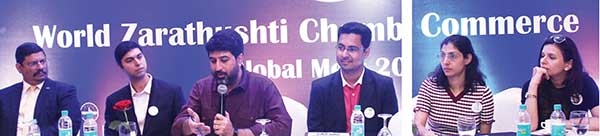
Kaizad Hansotia of Baroda who has initiated a platform, GetNatty, for upcoming fashion designers recalled the time when he was scouting online and got to read about WZCC. He decided to send off an email to WZCC, and "the first person to respond was Edul Sir (WZCC global president Edul Daver). How much those words of encouragement meant to me.” His outfit was then only six months old with two people working on the team. "We need to create a supportive eco system. Not be afraid to make business mistakes,” he declared.
Financial advisor Delna Sethna of Bombay believed that WZCC is there "to help you and hand hold you.” Anahita Jassawala, head of project management office and organizational development at Pink Lemonade Private Limited in Bangalore, a design and communications firm, reiterated that "everyone has soft skills that can be transferable to different fields. With the right touch you can move forward.”
"What is the value WZCC brings to a member?” nudged Dastur. "Connection,” responded Kotwal, clarifying, "Everyone on the WhatsApp group is an admin who can add any friend or relative” to expand the network. In the diaspora, where the nearest Zoroastrian may be residing two hours away from you, "social media really helps,” stated Arzan Wadia, vice president of the Federation of Zoroastrian Associations of North America who runs the portal Parsi Khabar. He related the instance of a query being raised on the social youth group regarding availability of large quantity of sea salt that was successfully resolved with the right guidance. Social media can create "synergies with other organizations,” Wadia was convinced. "If you are not finding success stories, you are looking at the wrong places,” he said. In a business environment, a shared religion serves as a link, helps to break barriers, he noted.
When inputs were sought from seniors, Pheroze Kharas, international director on the WZCC board said, "You will never be educated unless ‘you learn to learn.’” Viraf Deboo, former chair of the Poona chapter and director of Albaj Group of Companies felt that "as a chamber of commerce, our networking is less than it should be.” Rusi Gandhi, owner of Rusi Gandhi Realty in New York referred to his migration to the US in the 1970s and his ability to earn more through his part-time job in real estate than through his regular job as a financial controller.
When the audience was asked if they would serve as mentors, around 10 hands went up. The pairing of mentors and mentees is an important role of WZCC. Dastur though advocated, "Whilst the human touch and involvement makes a huge difference, you can’t have open ended mentoring (that continues indefinitely).”
Work values
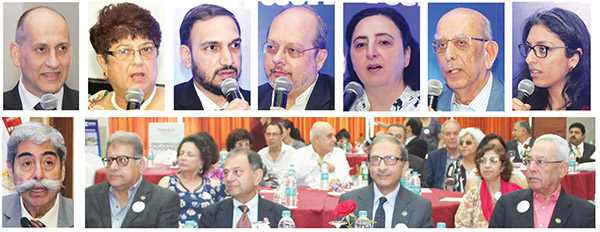
"Will there be another (Jamsetji) Tata in the making?” asked Cyrus Dhabhar, director international business, at Volvo India Private Limited when moderating the discussion on "The Relevance of Zoroastrian Values and Work Ethos in Today’s Complex Entrepreneurial and Start-up Environment.” He had directed his query to two of the younger members on his six-member panel on the morning of December 16, 2017, the day following the WZCC AGM.
"The beginning of any success is the ability to dream,” stated corporate lawyer Zerick Dastur, proprietor of Zerick Dastur, Advocates and Solicitors. "I hope to build that empire,” responded Rokhsar Vakharia who has done her doctorate in sociology and is currently assisting her husband Tarun Sardesai build up his golf academy.
"What do we mean by Zoroastrian values?” asked Dhabhar. "Business today being very different with the change in technology, is there place for values today and going forward?... In performance appraisals, how should we rate individuals whose performance may be good but not matched by values?”
Pilloo Aga, director of Gold Seal-Saargummi India Private Limited, considered Zoroastrian values as a "unique set, the foremost of which is integrity, that comes from good thoughts, words and deeds. We have honesty in our dealings with all stakeholders. In earlier days, the cashier in a bank was usually a Parsi. Every community respects our values, ethos and ethics… In Bombay, everyone knows a Parsi” and even unknown shopkeepers are willing to extend credit just as policemen are willing to condone minor traffic violations. Refusing to compromise on their standards even though Gold Seal may lose some business she declared, "We may not be the top company but we are among the top three” in the field of automobile component manufacturers.
Deboo felt that "honesty is a little different in the community. At the time of demonetization, how many Parsis sweated as versus non-Parsis? We have a reputation of keeping our dealings clean and uncomplicated.” Rather than indulge in unethical operations Parsis are "very clear about the line that cannot be crossed.” The personalized business of yore was built on trust, where outstanding payments could be adjusted against future bills, something that is "impossible to replicate today.” While some employees have been with Albaj for over 30 years, other young engineers have left for a monthly emolument that is higher by only Rs 600. Working in the same place for more than five years is considered passé by many of today’s youth.
Zaver Divecha, proprietor of Gallianoz chocolates, was convinced, "We do have inherent traits passed on from generation to generation. Parents have to inculcate these values in the next generation knowing the political and economic climate in which we live. As a very small, dwindling community, our uniqueness — love for good food, making fun of ourselves — should stand out.” The premium that a Parsi businessman/woman places on quality may not permit growth especially when competitors are willing to bargain and give substandard goods at a lower price.
Adi Siganporia, global secretary of WZCC with 50 years of association with Tatas including as chief ethics counselor, believed, "Something on our faces indicates we are slightly different… Even though youngsters may not agree because they want to use logic, I think some divine force is behind us to indicate we are Parsis.” He remembered J. R. D. Tata’s advice that if we want to hold our heads high, time tested values have to be preserved. Being in close contact with Naval Tata, he knew the credibility and respect the Tata Sons director commanded in the banking sector.
Zerick Dastur considered Zoroastrian values as "a legacy, an advantage you inherit; and since we represent a value system it requires living up to others’ expectations.” Alluding to his trip to Iran and seeing the secret passages and burning fires convinced him that "historically as a religion, we are survivors. We represent perseverance, acceptance and tolerance” as exhibited by Cyrus’ charter of human rights. "We are generous and indulge in charity.” Instant results must never be sought at the cost of compromising on integrity. Successful people are susceptible to arrogance whilst those who give respect will get respect.
Vakharia observed, "A lot of people practice integrity. I don’t know if it is unique to our community. I don’t think we are honestly that different. I think what will hold us good is a certain amount of discipline.” In the business context, one’s religion or community "doesn’t matter to a person sitting across,” she stated whilst unable to suppress her delight when people informed of her ethnic background in social circles considered her "exotic.”
When the discussion was thrown open to the audience, the day’s master of ceremonies for the two-day event Shereyar Vakil commented that whilst he took pride in mentioning that he had worked with GE for 54 years, his son-in-law Dhabhar feels restless after four years of service in one organization. People of Vakil’s generation believe "a rolling stone gathers no moss;” whilst Dhabhar’s contemporaries believe a rolling stone "collects a hell of a lot of shine!”
Shernaz Siganporia of Bangalore who tries to raise employability of college students through "responsibility, ownership and accountability which gets translated into humata, hukhta, huvrashta (good thoughts, words and deeds)” viewed the constant movement of the youth as arising from the feeling, "If I don’t move, I am lost.”
When Zarine Kharas, partner of the restaurant Red Fork Deli and prime organizer of the WZCC meet in Bangalore, asked Dastur how he would resolve the conflict of Zoroastrian values versus loyalty to clients, he answered that there are certain fundamental principles or core from which he would not derogate and would prefer to heed the inner voice.
Rustom Engineer, regional WZCC director from US, referred to the Parsi businessman in Seychelles who made his wealth from the license granted by the British governor who permitted him to sell commodities during World War II. From his bountiful earnings he gave a cheque to the British governor that reflected his honesty.
The recurring plaint that the youth are not working hard enough and there are no Parsis left in the Central Bank is due to "the obvious reason that no one is trying to become a Central Bank no Parsi,” observed Wadia. "No one wants to be a director of Tatas. They want to be the next Tata.”
All WZCC members should be issued a certificate to signify his/her membership on the world body and the Zoroastrian values they are expected to display in the conduct of their business or profession, suggested Farrokh Rustomji, chief executive officer of the R. D. Sethna Scholarship Fund.
President of the Bangalore chapter and former Air Chief Marshal Fali Major asked the panel how they would grade their employees on integrity/honesty during a performance appraisal. He then revealed, "My way of scoring is different. On a scale of zero to nine, you either get zero or nine. There is nothing in between. When a person has to be rated on intelligence, energy, integrity, if they don’t have the last, I don’t bother about the first two… It is naïve to assume that every Zoroastrian has integrity. People with integrity belong to every community.”
"For international corporate governance you cannot say ‘I am a Zoroastrian.’” Compliance with the bank and government regulations is necessary, pointed out Neville Shroff, managing director of Shroff and Company in Hong Kong, before enquiring, "Has anyone spoken of integrity to the Bombay Parsi Punchayet?”