
Enable and encourage
At the 11th World Zoroastrian Congress successful entrepreneurs reflected on their early struggles before they emerged as leaders
Joining him on the panel were WZCC global president Edul Daver, founder of ACuPowder International, 11WZC chair Firoz Pestonji, managing director of Aussie Perth Tours, holistic health practitioner and founder of Subtle Energies, Farida Irani, president of the Dabestani Group, Alayar Dabestani, and faculty member of the Sharif University of Technology in Tehran, Dr Mehran Sepehri.
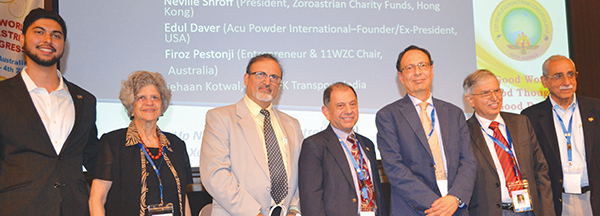
From l : Jehaan Kotwal, Roshan Rivetna, Firoz Pestonji, Edul Daver, Neville Shroff, Sam Balsara, Rohinton Rivetna

.JPG)
Participants at the youth power networking Photos: 11wzcperth.com.au
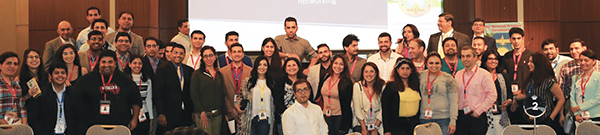
Participants at the youth power networking Photos: 11wzcperth.com.au
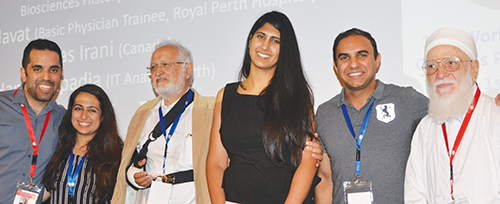
Kayras Irani, Zenia Sunavala, Prof Farrokh Mistree, Dr Delara Javat, Hanoz Kapadia, Ervad Asphandiar Dadachanji
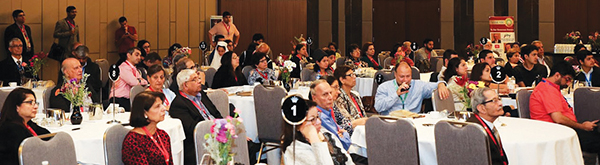
A section of the audience Photo: 11wzcperth.com.au
"In Iran, big organizations are losing money. They are not hiring so the only way out is entrepreneurship,” remarked Sepehri, adding that "entrepreneurs are not born but can be trained. Start-ups need innovation. Once you see an idea is workable, with focus, passion and a lot of hard work you can make it grow. For every successful business, there are 100 not successful. Lessons should be learnt and transferred on how to raise finances and manage resources.” Consultants too have a role to play.
With his grandfather’s brother Sir Sorabji Pochkhanawala being the founder of the Central Bank of India and hearing the family constantly talk about him, Daver presumes the seeds of entrepreneurship must have been sown in him since a young age. Even though he graduated from the Indian Institute of Technology, Bombay, Daver confessed that he always got into arguments with his fellow students and professors on the unsuitability of economic models being promoted in India. With the first available opportunity he left India for the US and after completing his masters in business administration (MBA) and working for five years he decided to start his own manufacturing business. Whilst education in one’s area of expertise is helpful, greater education correlates with lower risk taking, he stated. "Persistence leads to success and confidence.” Knowing the perils related to big loans, including putting the family at risk, he advised, "if the wife is not supportive, don’t listen to anyone else… When things go wrong, the lows are lower, and when things go right, the highs are higher.”
"As you make it, as you make it, it gets made,” Irani shared her experience of launching her business when the prevalent attitude was "chaaalti roji né laat nahi maarvani (you must not spurn an on-going steady income).” Opting to pursue her intuition, she remembered the words of her father, "No man is unsuccessful, till he has given up trying.”
"When an opportunity comes, grab it,” advised Dabestani whose initial foray was in an investment company before he worked on 40 different real estate and film distribution projects in Vancouver and Washington. Instead of depending on only one venture, there should be alternative plans A/B/C in place, he recommended.
"I devoured knowledge. With my interest in reading and history, I read biographies. From the great lives I observed their trends…boldness,” said Pestonji. "Whether you are qualified, or street smart and foolhardy, one must be willing to take the challenge… with blind faith in God… Even if I fail, I can at least say I tried.” When he chose to graduate in engineering, the elders in the family advised him to do finance and join a bank. He ultimately joined the refrigeration plant at Godrej and Boyce before he launched his own businesses.
Some of the same panelists were on another group discussion the following day on "Zoroastrian Businesses and Encouraging Entrepreneurs,” moderated by Sam Balsara, chairman of Madison World. Joining him on the panel were Neville Shroff, chairman and chief executive officer of Shroff and Company Limited, a manufacturing and trading firm in Hong Kong, Daver, Pestonji and young Jehaan Kotwal, chief executive officer of JFK Transport in Poona who sought to explore "why are Zoroastrian entrepreneurs on the decline? What can we do to encourage young Zoroastrians to take up entrepreneurship rather than jobs?”
"Cut off financial assistance to kids after they have crossed 21 years of age,” asserted Kotwal, citing his own example, when during his college days he went from door-to-door selling Domino’s coupons, later started a cafeteria on the college campus, and then turned around his father’s business seeking to convert it into a mega platform from 100 to 1,000 trucks.
"Don’t depend on anyone,” Pestonji advised. Having left his home in Jhansi at age 19, he recounted his initial foray in selling the famous Jhansi bor (small plums) when staying at the M. N. Sett Hostel at Fort. Preferring to distribute one consignment for free during one year rather than yield to the distributor who refused to negotiate, he sustained a temporary loss but enjoyed an upper hand with the same distributor the following year. "We should be flexible and see what is working and what is not,” he stated. Before taking a calculated risk, do a due-diligence study, he recommended. "Read, read, read, read, read… Learn from the mistakes of others. I too have made colossal blunders,” admitted Pestonji, critical of community members "who have become ungrateful, take money and don’t repay, or are content with job security.”
"It’s not easy being an entrepreneur. There is high risk, no guarantee that what works today will work five or 10 years down the road. You need to be futuristic, critical thinkers, analyze and adapt to change. Entrepreneurs need to be creative. See how you can add value to products and services. Nine out of 10 start-ups fall into difficulties. Losing is part of the learning curve,” commented Shroff. To follow a project and make it succeed involves considerable investment of time and requires the support of one’s partner/parents/family.
To ensure that "a business model is sustainable, 80% depends on the mindset and 20% on the mechanism to make it work,” Shroff noted. As compared to his grandfather who came to Hong Kong 150 years ago in a sailing ship, Shroff referred to "the opportunities today that were not available (then). There is a lot of capital to access today… Your first qualification does not have to be your last degree.” A trained scientist, he admitted that joining his father’s trading business was 100 times easier than being a scientist.
"Looking and crossing the road is risky; closing one’s eyes and crossing the road is a gamble,” reminded Daver, who admitted he suffered from "an entrepreneurial itch” and chose to buy over the loss making Alcan Metal Powders division of Alcan Corp for $ 12 million. Despite knowing it was "a major risk with a high debt load, with environmental problems and a confrontational union,” he took over the business and launched ACuPowder International. "Risk is not a dirty word,” he sought to impress on the parents in the audience. Offering 20% feedback profits to all his employees proved a miracle incentive to his colleagues. A professor came and taught every employee, including the janitor, how to read the profit and loss statement.
At another session "WZCC: Youth Power Networking,” the youngsters were given an opportunity to expand their professional and business horizons. As reported by Kotwal, the youth director on the WZCC board, they sat together in a group with members expressing what they are looking for and others opining on what can be done to add value to the individual’s service or product. A similar networking exercise in Bombay had resulted in business worth $ 50,000 being generated in one-and-a-half hours. "We look at social media to get in touch faster, for quicker returns,” he added. "Subconsciously we trust each other.”
Fast paced world
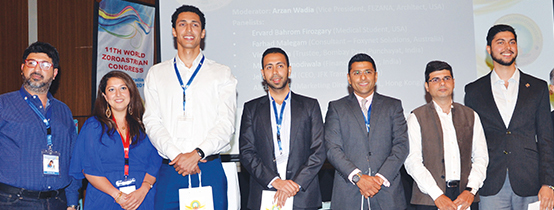
Two other panel discussions at the 11WZC involved the youth. Five youthful panelists under moderator Arzan Wadia, vice president of the Federation of Zoroastrian Associations of North America (FEZANA), expressed their views on "Challenges and issues for youth in a global diaspora, our fast paced world with high expectations, connectivity and networking.” In the glorious days of yore, "individuals gave back to the community. We have lost that touch,” commented Wadia. Engaging with him on the panel were Mobed Bahrom Firozgary, a medical student in the USA; Farhad Malegam, consultant, Foynet Solutions, from Sydney; Alisha Shroff, Fossil marketing director, Asia-Pacific, from Hong Kong; Viraf Mehta, trustee of the Bombay Parsi Punchayet (BPP); Maher Dhamodiwala, certified financial planner, from Bombay; and Kotwal.
To Malegam who believes in the "universality of faith… Mazda is universal. Mazda is love… Change awakens from slumber… Change cannot be made. Change must be allowed to happen… From a universal law of oneness we adopted the law of superiority. Is this our greatness?... We have people claiming to be saviors, choosing for us how to dispose the dead or choosing our life partner… We fell because our leaders were blinded by their ego, power, pride and position… Choice is a lock and the power to choose is the key that helps one to progress from perception, to purpose, to the path…Stop treating religion as dogma. Look at religion as a way of life. Neither should priests nor should leaders be paid.”
Known for his height of 6’9”, Firozgary stated how he is forced to be unique, an amalgam of Iran and India with his grandfather being the respected Mobed Mehraban Firouzgary of Iran, and his mother’s side owning the well-known Kayani bakery in Poona. Regardless of one’s beliefs on subjects like conversion and interfaith marriages, as a young priest he was more keen to "add meaning to what you pray by offering translations of jashans, etc. It is from the homes that kids know about religion. It is a blessing to have stability... Risk does not equate with loss,” he commented. "The second generation is 50% less religious and more career oriented. Religion should be less demanding and more flexible and dynamic.”
"How do we encourage the youth to be interactive? How are we communicating across the globe?” enquired Alisha Shroff who viewed Hong Kong as "rich in assets but poor in legacy.” The youngsters in Hong Kong try to meet up for social activities to stay connected. Citing the success stories of Airbnb (an American company which operates an online marketplace and hospitality service) and Uber (San Francisco based peer-to-peer ridesharing, taxi cab, food delivery and transportation network company), she advocated, "We need to take the best from the past.” Buddy schemes and mentoring schemes are as important as attending conferences "to open oneself to think differently, to think outside the box... Coming to Congresses we do learn a lot. It helps us feel connected to our faith and our parents’ values.”
As the youngest BPP trustee Mehta commented on how India’s flag is just one of the many on the dais, representing the delegates from 14 nations who attended the 11WZC. With as many Parsis outside India as within, he hoped the youth would facilitate a smooth progress. A proactive and an inclusive approach by the seniors would keep the next generation within the fold, he felt. Regretting the "headwinds I had to fight to become a trustee,” he commented on how the once dynamic Zoroastrian Youth for the Next Generation was able to register 4,500-5,000 youngsters in the 18 to 40 age group and involve them in social programs. With 55% of the Parsis in Bombay living outside baugs and having limited platforms to intermingle, finding a Parsi partner is almost impossible. "Complacency in the youth is a double-edged sword… Some have come to regard charity as ‘my birthright’. What is the incentive for youngsters to take risks? Everyone talks of ‘should’/ ‘could’/ ‘would’ but no one ‘is’ doing it.” Seeing not more than 40 youth at the Congress he enquired, "Where is the community going in the next five or 10 years?”
The plethora of Parsi trusts has led to "the emergence of takers rather than givers” in the community, commented Dhamodiwala. Although he would like to employ Parsis in his investment business handled "by a four-man army,” he finds non-Parsis willing to work "at half the rate with double the productivity.” He wanted to create "an eco system of gratitude and paying back.”
The youth wing of the WZCC started a year ago stands on the five pillars of networking, mentoring, industry experience, knowledge sharing and incubation, reminded Kotwal. "Entrepreneurship can solve problems. It essentially creates value,” he noted, convinced that entrepreneurship is "giving an individual a chance to make mistakes… believing in that individual… Without failure there is no success.” Although a trained priest, he chose not to pursue it as a profession because there was no respect and income. Yet during muktads when there is a dearth of priests, "I take it as a primary duty.”
"Two Models, Two Paths, One Community,” was the second workshop where the youth participated. Having explored the topic with moderator Farrokh Mistree, professor of mechanical engineering at the University of Oklahoma in USA, the panelists read out the salient features of each model with the accompanying pros and cons, ramifications and consequences from the PowerPoint presentation on their laptops. "Good and bad are not defined in the religion… It requires each individual to listen and reflect on the dilemmas inherent in one’s understanding and practice of the faith,” stated Mistree. For those who give importance to the Gathas, the inference is mind matters more; for those who veer towards rituals, feelings count more, he observed. As recommended in Yasna 30.2, he advocated the audience to "discover an understanding of Zoroastrianism, and based on this understanding ensure the survival of our faith whilst promoting harmony in our community.”
"Without practicing rituals, how do you apply the principles of the faith?” asked Zenia Sunavala who is a student assistant at Texas A&M University – Veterinary Integrative Biosciences Histology Lab in the USA. If the navjote ritual is of no consequence, who will be deemed to be a Zoroastrian? Ultimately an over emphasis on the Gathas whilst underplaying rituals may "allow you to be closer to Zoroastrianism but may take you out of the community,” she noted.
For those who would like the future of the religion to be based on the Gathas alongside some select later texts and practice of a few rituals, Dr Delara Javat, basic physician trainee at the Royal Perth Hospital inquired: Which rituals or parts of rituals would be retained? How would a consensus be obtained from the wider community?
For those who choose to validate the Gathic principles through mid-Persian texts, Kayras Irani of Canada wondered whether validity would be consistent and whether issues like ‘who is a Zoroastrian?’ could cause a further divide in the community. New institutions should represent already standing pillars with modern adaptations. Since older sources have more valuable information, they should be studied thoroughly.
Hanoz Kapadia, an information technology analyst in Perth, referred to those who choose to follow the fundamentalist path based on faith in one’s heart, but dismiss logic, research and science as noise. The consequences of such an unquestioning approach are notions of superiority of one’s own religion and unfair judgment of others, inability to adapt to modern challenges and difficulty to pass down beliefs to the youth.
According to Mistree, parting of the ways doctrinally will bring about two very important developments: differences in the practice of Zoroastrianism and reduction of bitterness and confusion if each path is pursued independently without trespassing on the other. "Look within yourself. You have a right to figure out what is right about the religion; then communicate with others to bring about harmony.” He further urged the audience to "believe… but not be indifferent.”
The talks by the main speakers will be covered in forthcoming issues of Parsiana.