
Business
WZCC wends its way
With the opening of a new chapter in Bangalore, the World Zarathushti Chamber of Commerce is expanding its reach in India
The working of the India Region of the World Zarathushti Chamber of Commerce (WZCCI) has been strengthened with the addition of the Bangalore chapter during the year 2016. The initiative of restaurateur Zarine Kharas helped the Bangalore chapter commence its activities under the stewardship of Dr Zarir Sholapurwala, announced Capt Percy Master, president of WZCCI in his welcome address at the 13th annual general meeting (AGM) at Yiamas, in Bombay on September 24, 2016. The enrolment of 58 new members during the year saw the strength of the Region that includes active chapters in Mumbai, Pune and now Bangalore rise to 325.
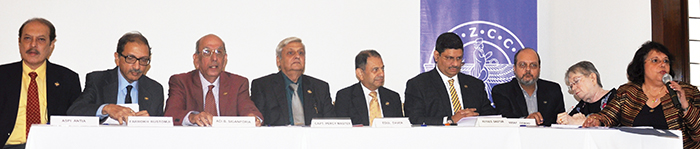
From left: Aspi Antia, Farrokh Rustomji, Adi Siganporia, Capt Percy Master, Edul Daver,
Xerxes Dastur, Viraf Deboo, Zarine Khan, Behroze Daruwala
To promote interaction via multimedia, a WhatsApp group has been formed to facilitate fellowship among the WZCC members in India and internationally and to give an update on WZCC events. Inducing members to pay up their dues and attend events, Master stressed, "Without financial support we cannot achieve professionalism and encourage entrepreneurship.” He was keen to "restore past glory” in the community in India and urged the leaders to "put their egos in their pockets… not be dogmatic in ideas… continue with integrity… be bold to take important and critical decisions.” He concluded in the words of the late economist A. D. Shroff, "Free enterprise was born with man and shall survive as long as man survives.”
WZCC is planning a venture capital fund of two-three crore rupees for entrepreneurs, announced global president Edul Daver who emphasized that despite "the hard work required, this has to get done. Without it we will remain a paper tiger.” The GDP (gross domestic product) is growing in India and is the second highest in the world. "There are 48 million small businesses in India. In this growing entrepreneurial culture, young Zarathushtis must make a start,” advised Daver, a successful entrepreneur in New York whose venture ACu Powder International brought him returns enough to convince him that success is possible with "hard work, brains, leadership and luck… The quickest path to become a chief executive officer is a winding road.”
Daver was also happy to report that since he had taken on the mantle last December, the participation of international directors at their quarterly video conference calls is almost 100% enabling the board to "take the best from each of us to make the best for each of us.” He referred to the WZCC publication Synergy which is in need of advertisements and their e-newsletter which carries member stories, live and relevant updates. "To increase traffic to the global website which is being improved, they have planned a jobs portal as also a separate chapter page for each WZCC group.” To those asking "What is the benefit of WZCC membership?” Daver responded, "It is a two-way street. To give and to receive… The power of networking cannot be underemphasized (especially for small companies)… A business person must keep his hook angling for you never know when a fish may swim by.” He invited members to attend the global AGM in Hong Kong on December 17, 2016 and the forthcoming Iran Trade Mission in 2017 that will be finalized by the end of the year.
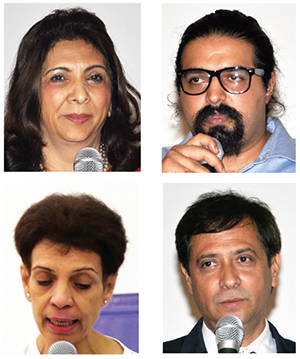
Clockwise from top left: Dr Indu Shahani, Darius Bharucha,
Hoshang Jalejar and Villie Daruvala
Benefits of bonding
The corpus of WZCCI stands at Rs 44 lakhs. The deficit for the year 2015-16 was Rs 8.14 lakh due to the events organized and the investment made on the website, revealed treasurer Xerxes Dastur.
Describing the Mumbai chapter as "extremely active,” its chairman Adi Siganporia gave an overview of the events held during the year to cover subjects like leadership, finance, management, marketing, health. "What is important is not how many events are held but what benefits members derive,” he stated, keen to see youngsters grow and prosper. Their activities held in coordination with the Holiday Programme for Youth and Zoroastrian Youth for the Next Generation saw good attendance of nearly a hundred, he reported.
The Pune chapter has 50 active members, reported immediate past president Viraf Deboo. The team organizes a members’ night every quarter when they invite speakers on different subjects. To focus on women empowerment, they had a session titled "The Professional Edge” where 15 ladies were mentored on eight consecutive weekends. In February they staged a skit, "How Stella saved the farm” that enabled members to empathize with similar problems they face in their business. They have been "very successful” when collaborating with the Poona Parsee Panchayat and the Poona Parsi Dramateurs. According to Deboo, "We are not doing enough networking. Only then will we retain members… There should be a separate youth wing or one committee member in charge” of youth matters.
"I wish I was addressing more youth,” said Darius Bharucha, treasurer of the Bangalore chapter that has 40 members, most of whom are confectioners with some others who are chartered accountants, venture and financial analysts, and builders. "Started two months ago we have collected Rs 1,60,000. We don’t mind few members so long as they are active,” he added. When he had enquired what benefits he would derive from joining WZCC, he remembered his father Cyrus advising him to share with the others the kind of mistakes he had made so that others could benefit. Describing himself as a pioneer skate boarder, he related the different ways he had tried to raise funds over the years — from selling fish tanks when he was 15 to starting a rehearsal studio and ultimately launching a skate park.
The corpus of WZCCI stands at Rs 44 lakhs. The deficit for the year 2015-16 was Rs 8.14 lakh due to the events organized and the investment made on the website, revealed treasurer Xerxes Dastur.
Describing the Mumbai chapter as "extremely active,” its chairman Adi Siganporia gave an overview of the events held during the year to cover subjects like leadership, finance, management, marketing, health. "What is important is not how many events are held but what benefits members derive,” he stated, keen to see youngsters grow and prosper. Their activities held in coordination with the Holiday Programme for Youth and Zoroastrian Youth for the Next Generation saw good attendance of nearly a hundred, he reported.
The Pune chapter has 50 active members, reported immediate past president Viraf Deboo. The team organizes a members’ night every quarter when they invite speakers on different subjects. To focus on women empowerment, they had a session titled "The Professional Edge” where 15 ladies were mentored on eight consecutive weekends. In February they staged a skit, "How Stella saved the farm” that enabled members to empathize with similar problems they face in their business. They have been "very successful” when collaborating with the Poona Parsee Panchayat and the Poona Parsi Dramateurs. According to Deboo, "We are not doing enough networking. Only then will we retain members… There should be a separate youth wing or one committee member in charge” of youth matters.
"I wish I was addressing more youth,” said Darius Bharucha, treasurer of the Bangalore chapter that has 40 members, most of whom are confectioners with some others who are chartered accountants, venture and financial analysts, and builders. "Started two months ago we have collected Rs 1,60,000. We don’t mind few members so long as they are active,” he added. When he had enquired what benefits he would derive from joining WZCC, he remembered his father Cyrus advising him to share with the others the kind of mistakes he had made so that others could benefit. Describing himself as a pioneer skate boarder, he related the different ways he had tried to raise funds over the years — from selling fish tanks when he was 15 to starting a rehearsal studio and ultimately launching a skate park.
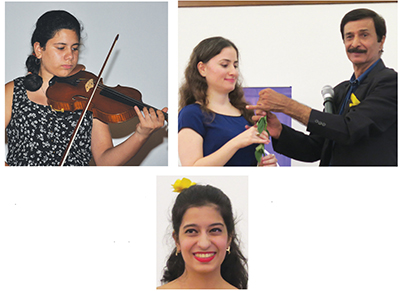
Above (from left): Leah Divecha, Nainaz Shroff, Mhelly Bhumgara; Zenia Bhumgara
.jpg)
A section of the audience at Yiamas Photo: Arish Patel
"We are trying to change the way the world perceives women’s strength,” commented Behroze Daruwala, global chair of WE, the Women Entrepreneurs wing of WZCC. "We would like WE to stand for Women Empowerment,” stated Engineer who was also serving as the evening’s master of ceremonies. "It requires strength, courage, education, fire in the belly of a woman to make an impact on the family, community, society and nation,” declared Daruwala on behalf of the body with 50 members that seeks to promote professional networking, enterprise and grooming. In the absence of WE-India president Homai Mehta who was abroad, vice president Villie Daruvala outlined their activities during the year that included yoga, workshops on finance and investment, environment, and joys of conducting one’s own business.
The term of five WZCCI committee members has been extended by another year: Siganporia, Dastur, Adil Dadachanji, Maher Dhamodiwala and Murrad Currawalla.
Hoshang Jalejar of Spenta Tours informed the members of the packages they were offering to induce attendance at the global meet in Hong Kong in December. Subsequent to the talk by chief guest Dr Indu Shahani, the members could unwind with the magic show by Mhelly and Zenia Bhumgara and violin recital by Leah Divecha.
Education: an elixir
"Students today know which search engines to use. As educators we have to see that they are moving in the right direction. Real life education must become a hands-on experience,” impressed Dr Indu Shahani, former principal and dean of the H. R. College of Commerce and Economics, and president and chairperson of the Indian School of Management and Entrepreneurship when speaking on the topic, "Education: Elixir of Life.”
The optimistic educator was sanguine that the global shortfall of human resources by 2020 could be filled by India where the average age of a citizen is 29 years with 65% of the population being aged under 35 years. "Are we ready? Are our students ready for a globally competitive (market)?...
"In India the entrepreneurial DNA is very strong. It is a country with the largest number of family businesses but the children don’t want to continue with the family business… Instead of laboratories we need incubators,” she stressed. As she further related, "There are 23 million babies born every year in India but only two million jobs created. Why are we not teaching entrepreneurship?... Are we only looking for job seekers?... We are not able to do dynamic things in education. There is need for a new curriculum…innovative assessment… Autonomy is the way ahead” for higher education in India.
When students come to her seeking enrolment, she no longer asks what their career goals are but enquires: "What is the problem to which you will seek a solution?” Knowing that 50% of India is underprivileged she feels that during their three years of undergraduate studies, University students should complete at least one NGO (nongovernmental organization) project and only on earning a certificate from the NGO should they be entitled to a University degree. She cited the instance of her student Dhruv Lakra, who was brought from strife torn Jammu and Kashmir by his mother for higher education under Shahani at H. R. College. Unfulfilled with his job as an investment banker he chose to found Mirakle Couriers that employs nearly 70 hearing impaired individuals.
With information and knowledge readily available on the Internet, the role of an educator in today’s world is "to bring up young responsible citizens,” believes Shahani, emphasizing the importance of "design thinking or thinking differently… to find a solution to different problems.” Being instrumental in founding the Indian School of Design and Innovation with the collaboration of Parsons in Bombay, she related her conversations with Sir Martin Sorrell, founder of WPP (reportedly the world’s largest communications services group) that has bought over 63 advertising agencies in India, employing 48,000 personnel and facing a challenge of recruiting 15,000 fresh, qualified talent each year.
According to her "the gap between academia and corporates” is due to the curriculum in Indian colleges that is confined to text books. When she recommended the setting up of a school of communication, Sorrell assured her support, not financially but the expertise and experience of his 63 companies that has resulted in 100 students each year receiving practical exposure in communication. The next step was to start a school of management on five floors offered to her at One Indiabulls Centre where "the curriculum is created by the students, the pedagogy is determined by them, and assessment is project based.”
She further referred to her experience that morning of conducting a class on marketing strategies at the Worli branch of Starbucks where she was impressed that students came on time to ensure they found a seat and had even studied the menu in advance because they were assured a cup of coffee. When she asked them to list the top three companies known for their values and not value, at the pinnacle of the list was Tatas, she informed the Parsi audience. The fact that Tatas have a joint association with Starbucks has further enhanced their reputation since they have shown their allegiance to the fair trade practices cooperative where no child labor is employed.
Shahani who has been familiar with the Parsi community since her childhood, having studied at the J. B. Petit High School and being a close friend of Yasmin Shroff (now Banatwalla) at whose home she learnt to express her emotions with a "kissi and koti (kiss and hug) and enjoy chutney-eeda na pattice,” said she is always happy to avail of "any opportunity to be with Parsis.” In her engaging style the raconteur mentioned that as the fifth child there was no pressure on her to pursue a predetermined calling. Just when she was about to take up the job of a management trainee with Hindustan Lever after she had completed her MCom, her mother whispered, "The returns you get from the smiles of students will be far greater than selling shampoo, soaps and detergents.” When she was keen to accept a modeling assignment for Khatau saris, once again her mother’s wisdom prevailed when she pointed out "If you join the teaching profession, you can walk the ramp all your life.”
And thus it was that Shahani was to become principal in the same college where her father Prof H. C. Malkani too had served as principal, being a popular professor of economics, as recounted Siganporia, when introducing Shahani. Quoting poet T. S. Eliot, Siganporia wondered aloud, "Where is the life we have lost in living? Where is the wisdom we have lost in knowledge? Where is the knowledge we have lost in information?”
On behalf of WZCC, Pheroze Kharas, director on the international board, thanked Shahani for offering insights into the "elixir of life… when generally bawas are used to a scotch-whisky elixir at that hour of the evening!”
◆ ◆ ◆
From the archive