
Global guardians - II
Besides religious issues, the Global Working Group discussed cultural, economic and educational proposals
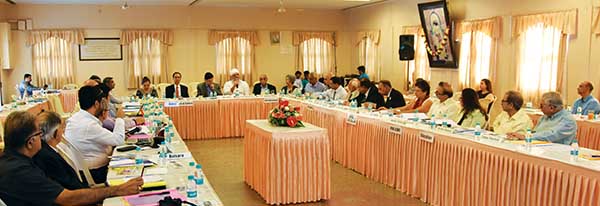
Global Working Group meets to discuss world-wide community issues

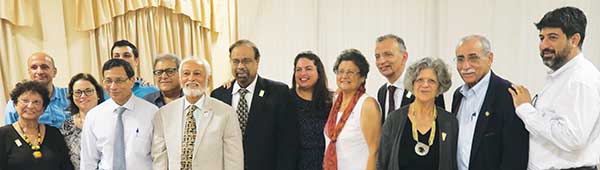
FEZANA delegation at the Global Working Group meeting
Of the 30 to 35 mobeds eligible to serve the Iranshah, only 10 or 15 do so, the rest being employed in Bombay, said Dastoor. The Anjuman gives Rs 9,000 to each of the current and retired boiwalas and those performing prayers like farokshi and baj earn Rs 6,000. The kitchen staff earns Rs 20,000 and the chasniwala is paid Rs 10,000 per month.
When he was asked why the priests are paid less than the kitchen staff and helpers, he mentioned that the priests earn additional income from the prayers and rituals they perform for individual worshippers. Further, the Atash Behram’s funds are inadequate to pay more, he said, pointing to the Bombay Parsi Punchayet (BPP) trustees. The Udvada Anjuman has to pay BPP seven percent as service charges for the Udvada funds managed by the BPP. (In bygone days when the BPP was at its zenith, the trustees of smaller anjumans/institutions would vest their funds with the BPP that would invest the monies and pay them the accrued interest whilst levying an administrative fee.) When the trustees agreed to bring down the charge to three percent or even zero, Dastoor responded, "It is best you give me back my money.” Dinshaw Tamboly, chairman of the World Zoroastrian Organisation Trust (WZOT) wondered why this favor should only be granted to Udvada and not Navsari, making BPP trustee Kersi Randeria comment tongue-in-cheek, "For Navsari we will charge nine percent since you are there.”
Currently there is only one program in operation for the uplift of young mobeds. Under the auspices of the Athornan Mandal, 67 young mobeds are given a monthly stipend ranging between Rs 1,000 to 3,000, depending on their need, grade and performance of ceremonies, reported Dastoor. This program being supported by WZOT that receives funds from the Zoroastrian Charity Funds of Hongkong, Canton and Macao, Tamboly felt the amount should be raised to Rs 25,000 to keep the youngsters interested in mobedi. Additionally 45 elderly mobeds who used to be paid Rs 3,000 per month will now be given Rs 4,000.
The BPP scheme introduced in 2011 and assisting 200 full-time mobeds with Rs 10,000 each month has been discontinued since July 2016 due to "cash constraints,” mentioned BPP chairman Yazdi Desai, inviting overseas Zoroastrians to donate: "We have FCRA [Foreign Contributions (Regulation) Act]” registration.
The Athornan Mandal that has a FCRA registration permits overseas donors to remit money. They get donations from the Federation of Zoroastrian Associations of North America (FEZANA), and Minoo and Mehru Patel who are willing to support higher Avesta and Gatha studies for mobeds who are interested but "there are no takers. At the end of the day the matter is finance…Unfortunately there is no scope in mobedi,” reiterated Dastoor. Each year two or three students from the Dadar Athornan Institute become navar/maratabs but after passing their 10th or 12th grade exams they would rather take up a white-collar job as "there is no stable income in mobedi.” He was particularly concerned that in mofussil areas, after over two decades of service, a priest earns Rs 20,000 as income and his leave is sanctioned subject to his finding a substitute. Sometimes he is asked to pay the substitute’s salary. Tamboly knew of a young priest in Bombay who each night performs the Ushahin gah boi in five agiaries to earn money.
FEZANA president Homi Gandhi offered to circulate an appeal among FEZANA members to support priests in India. Farrokh Rustomji, honorary secretary of The Federation of the Parsi Zoroastrian Anjumans of India (FPZAI), recommended that agiaries be merged to reduce the cost and burden on priests. Dastoor mentioned that he had given a proposal to the BPP to shift the Godavara Agiary fire to Godrej Baug and after selling the property, create a corpus for the uplift of priests.
Roshan Rivetna of Chicago was keen to resurrect the idea of each overseas association adopting an agiary like a "sister” institution. But Dastoor was worried that the funds may be directed to affix "marble and granite on the walls” rather than the upkeep of mobeds.
With many other delegates contributing to this discussion, Meher Bhesania of Dubai commented, "This random talk is not going to help. The Group has come after spending a lot of money. Please do not waste time. We have just one day.” A three-member committee with Dastoor, Tamboly and Sam Balsara, chairman of Madison World, has been tasked with preparing a white paper on the issues facing agiaries and mobeds.
Rustom Engineer of Houston mentioned that the list of service charges introduced by the North American Mobeds Coucil (NAMC) has "encouraged mobeds and shows the community is willing to pay.” "For 50 years we (priests) volunteered our services,” said Ervad Kobad Zarolia, erstwhile NAMC president, who felt the priests should progress from "performing mobeds to teaching mobeds.” While the newly ordained navars are invariably felicitated by their respective associations, "when they go to college we lose them,” pointed out NAMC president Ervad (Dr) Arda-E-Viraf Minocherhomjee. Dastoor referred to the young Ervad Yazad Bhadha from Bombay who was sent to serve the community in London. Zoroastrian Trust Funds of Europe (ZTFE) encouraged him to complete his masters from the School of Oriental and African Studies. "We see it as serious investment,” stated ZTFE president Malcolm Deboo. The priest was induced to attend another program on pastoral care and shadows Deboo and ZTFE trustee Rusi Dalal at interfaith events.
Tamboly informed the gathering that the roof of the Dadysett Agiary in Bombay needs to be repaired at a cost of Rs 15 lakhs and funds are also needed for the 150-year-old Saronda agiary. The Rustom Framna Agiary where he is trustee sends kathi to 15 fire temples in the mofussil areas on the understanding that the agiary should not sell the kathi to visiting devotees.
The Zoroastrian Shop in Chicago where the community in North America from can order online religious items like sudreh-kusti, Avesta books, sandalwood is in good demand, said Rivetna. Four years ago, the Batliwalla Agiary gave four afargans of different sizes which were distributed in North America. Engineer mentioned that since Quetta is left with only five or six Parsis, they were willing to send their big afargan to Houston "if we provide them a small afargan.” "I can give a small afargan from the Rustom Framna Agiary,” said Tamboly. While old afargans are available for donation, Tamboly mentioned some agiaries expect a donation from the association seeking the German silver vessel. He pointed out that a new afargan can be ordered as per specifications at affordable rates, having recently paid Rs 2,30,000 for a four-foot afargan on behalf of an overseas association.
Committee concerns
A coffee table book carrying information on the religion and the community that could serve as a guide to teachers will be launched at the 11th World Zoroastrian Congress (WZC), stated Bhesania who is co-chair of the GWG Arts and Culture Committee. With contributions from 15 renowned scholars, the book explores the historical, cultural, social and economic legacy of the community. Also in the pipeline is a new documentary of five to seven minutes presenting facts concerning Zarathushtra and the spread of the religion. Since children like to see films, they expect the film to gain popularity once it is uploaded on the web.
A feasibility study is being planned regarding setting up of a museum. Whilst land worth four crores has been given for the development of the museum, it was reported that art curator Pheroza Godrej who is masterminding the renovation of the Framji Dadabhoy Alpaiwalla Museum at Khareghat Colony was questioning the necessity for a second museum. "It is a huge project. The state of the art museum will require funds from the community and the Government of India. Let’s see how it takes off,” said Dastoor.
Since FEZANA has a representation on the United Nations, "we were offered space in the front lobby to put up a permanent exhibit,” revealed Dr Behram Pastakia of Washington. Since they did not have an exhibit, he recommended that as part of the museum planning they could consider a traveling exhibit. "There are exhibits from The Everlasting Flame exhibition,” first organized in London in 2013, that could possibly be recycled, suggested Javid Canteenwala of London.
On behalf of the Infrastructure Committee Rohinton Rivetna of Chicago declared that the diaspora needs help and funds to build infrastructure, both physical and organizational, like senior citizens homes, facilities for resident priests, higher learning and promoting scholars; community centers, regional headquarters. "We are incapable of generating funds for infrastructure needs. Although we have billionaire entrepreneurs in our community, unfortunately we are not able to bring them on board and make them aware of the urgency of our needs. Philanthropy (to support such projects) is not to be confused with charity (to assist the underprivileged),” he added. Dadrawala regretted that there are "people who want to give and people who obstruct,” citing the "classic example in Bombay” of The B. D. Petit Parsee General Hospital. [Hong Kong based Pervin and Jal Shroff’s magnanimous offer of USD 22.5 million to stem the colossal losses of the Hospital by setting up a cosmopolitan institution on the premises, the profits for which could support the floundering Hospital, is being obstructed by a traditional section of the community. A joint statement issued by the BPP chairman and the president of the Hospital Homa Petit in early January 2018 expressing "unequivocally, firmly and wholeheartedly support (for) the new secular hospital project,” it is hoped, will pave the way for Medicity of Medanta Group to operate the new state of the art hospital facility.] Co-chair of the Infrastructure Committee, Engineer "hoped the next generation will have the infrastructure to practice their version of the religion.”
Reporting on the Entrepreneurship Committee, Yazdi Tantra as vice president of the World Zarathushti Chamber of Commerce (WZCC) gave an overview of their developments and the launch of their Finance Initiative (see "Widening the worlds,” Parsiana, January 7, 2018). Financial incentives to upcoming entrepreneurs should be in the form of venture capital suggested Minocherhomjee whilst Randeria pointed out that they can tie up with banks through collateral funding where property is accepted as security. When Desai referred to BPP’s venture capital fund which "is not publicized,” Randeria asserted "it is defunct.”
Chair of the Education Committee, Rustomji mentioned that he had exchanged letters with the Ministry of Minority Affairs regarding reserving seats in professional, technical and medical colleges run by the central government and hoped that Dastoor as the Zoroastrian representative on the Minorities Commission would be able to push things forward. Dastoor was wary, though, of pursuing the idea knowing the parental attitude in the community of mollycoddling children instead of encouraging them to venture out.
As chief executive officer of the R. D. Sethna Scholarship Fund (RDSSF) that gives loans for overseas studies, Rustomji had been in touch with Dr Indu Shahani — president and chair of leading institutes like The Indian School of Design and Innovation in Bombay which has a tie-up with the Parsons school in New York, ISDI/WPP School of Communication, and Indian School of Management and Entrepreneurship — who assured him that students recommended by him would be granted scholarships at these three institutes. Further the Sciences Po University in France and RDSSF are exploring possible collaboration opportunities for Indian students. Even the New York University introduced its polygraduate program to the Sethna Trust to encourage Indian students to enroll there. Pastakia reported that Prof (Dr) Farrokh Mistree of the University of Oklahoma has offered to mentor Zoroastrian youth who want to apply for University positions by guiding them on crucial processes like how to write a Letter of Intent, how to conduct themselves at an interview…
In charge of youth affairs at the GWG is Arzan Wadia, vice president of FEZANA, who takes a keen interest in the Return to Roots program that organizes a trip to India to familiarize youngsters in the diaspora with their parents’ roots in the subcontinent. Twenty-five youngsters from six countries participated in the fourth avatar of the Roots program that commenced on December 22, 2017. He referred to Zerbanoo Gifford and Sanaya Master’s efforts to bring promising youth on a common platform at the World Zoroastrian Young Leaders Forum at the Asha Centre in UK in March 2018. He further referred to activities of XYZ (Xtremely Young Zoroastrians), run by Hoshaang Gotla, that grew out of ZYNG (Zoroastrian Youth for the Next Generation, the moribund youth wing of the BPP). Referring to social media as a great tool he alluded to the group "Parsis exchange recipes” which has 8,000 members willing to cook, and share photos and recipes of their culinary creations. Voicing the thoughts of the youth, Wadia said, "The world is changing. If we are not cognizant, we are going to lose out on a lot of people… We have to stop solving yesterday’s problems.” Pastakia referred to the activities of Zoroastrian Youth Without Borders that is willing to render service in areas that are not affluent.
The demographics of the community are "shifting constantly,” observed Rohinton Rivetna who claimed that less than 50% of the global Zoroastrian population of 110,000 now remains in India. "With people moving back and forth, we don’t know who lives where,” he said, recommending the formation of an Organization for the Resettlement of Zarathushtis (ORZ). He wanted each region to appoint a coordinator who could function as a single point of contact for immigrants and emigrants. Besides maintaining a demographic count, a coordinator would be expected to guide and assist new immigrants to the region. Dalal described ZTFE as "an established group with headquarters” and felt more than naming an individual for the task, it is the institution that is important. Gandhi though felt that when moving from one country to another, it helps if you know an individual whom you can approach.
Rohinton Rivetna also expressed the need to set up an International House in Bombay offering affordable, decent living quarters for community members visiting the city. He was keen that some unused property be made available to the diaspora. With hotels becoming prohibitively expensive he feared the diaspora may "otherwise lose contact” and be demotivated to visit India.
"Jam-e-Jamshed to serve as the voice of the global Zoroastrian community” — an item scheduled on the agenda on the recommendation of Rohinton Rivetna — was deliberated for a while until it was agreed that information dissemination should not be controlled but democratic. Tantra mentioned that the online Parsi Directory lists 82,000 people or nearly 70% of the global population with another 800 Parsi institutions. Data can be searched by name, city or profession. Wondering whether the information is regularly updated, Firoz Pestonji, chair of the 11 WZC, enquired, "How do you ascertain that the data is accurate?” Tantra responded, "I would say 90% must be accurate. If you come across erroneous data, please bring it to our notice.” The latest addition on the online portal is "Parsi match” for those interested in matrimony.
Since the item on the agenda of creating posts for GWG officials appeared to divide the assembly, other related subjects of "operating agreement with a commitment to work together, administration and GWG funding plan” were not even broached.
At the Parliament of the World’s Religions in Toronto from November 1 to 8, 2018, FEZANA will be sending 25 participants as speakers, priests, panelists. They invited delegations from other regions to participate and sponsor programs.
Pastakia was keen to promote a worldwide community without borders and suggested that a day be determined around Navroz time (between March 21 and April 22) when individuals can contribute with their head, hands and heart. They would be required to prepare a dish and share sweetness or shirini with people in their neighborhood or do something for Planet Earth by cleaning rivers or planting trees. Success stories should be shared, he recommended. He reminded the gathering of the maxim adopted by Rohinton Rivetna, "If it is to be, it is up to me.”
Those present were Firoz and Mahrukh Pestonji from Australia; Yazdi Desai, Armaity Tirandaz, Noshir Dadrawala, Kersi Randeria, Zarir Bhathena, Viraf Mehta, Cawas Panthaki and Anahita Desai from the BPP; Kersy and Meher Bhesania from Dubai; Homi Gandhi, Arzan Wadia, Roshan and Rohinton Rivetna, Katayun Kapadia, Bomi Patel, Dolly Dastoor, Rustom Engineer, Behram Pastakia and Freyaz Shroff from FEZANA; Farrokh Rustomji from FPZAI; Neville, Farida and Natasha Shroff from Hong Kong; Sam Balsara from India; Arda-E-Viraf Minocherhomjee and Kobad Zarolia from NAMC; Dastur Khurshed Dastoor from Udvada; Yazdi Tantra and Khodayar Attaie from WZCC; Dinshaw Tamboly from WZOT; Adil Minocherhomjee from World Zoroastrian Youth Congress; Astad and Behroze Clubwala from Zoroastrian Association of Greater New York; Malcolm Deboo, Rusi Dalal and Javid Canteenwala from ZTFE. The Press was represented by Parsiana.